Thursday, March 31, 2022
Carrer de les Egipcíaques
El Raval
Barcelona, March 2017
“On Egipcíaques Street, there was established, in 1670, a convent for women of ‘bad reputation’ which, having had a libertine life, hoped to distance themselves from vice and live out a life of exemplary conduct, as did Saint Mary Egipcíaca from whom the convent got its name. In 1679, the Casa de les Egipcíaques (House of the Egipcíaques) was also referred to as the ‘monastery of damsels’ or ‘room of damsels’ and used as a women's prison. Today, the building in Egipcíaques street dates from 1952 and 1954 and it is the headquarters of the Spanish Scientific Reasearch Council in Catalonia.” (Convent de les Egipcíaques, Route You)
Wednesday, March 30, 2022
Santa Maria dell'Umiltà
Via dell'Umiltà
Rome, September 2019
“This is a small church, on a simple rectangular plan with a little square apse and four side niches functioning as chapels, two on each side. The exterior is inserted into one wing of the convent, and so is invisible from the street. There is a campanile, erected in 1655 over the right hand side wall. It is in the form of two little triumphal arches, one on top of the other; the lower has two archways, and the upper just one. Over the upper arch is a little triangular pediment. The three bells fit into the arches.” (Santa Maria dell'Umiltà, Churches of Rome Wiki)
Tuesday, March 29, 2022
Monday, March 28, 2022
Catrin Glyndŵr
Memorial to Catrin Glyndŵr by Richard Renshaw, 2001
St Swithin's Church Garden
Salters Hall Court, City of London
London, September 2014
“Catrin ferch Owain Glyndŵr (died 1413) was one of the daughters (probably the eldest) of Margaret Hanmer and Owain Glyndŵr, and her marriage to a claimant on the English throne was used by her father to gain support. Catrin is one of the children of Owain Glyndŵr about whom most is known. In November 1402, she married Edmund Mortimer, an unransomed hostage who entered into an alliance with her father. Edmund Mortimer died during the siege of Harlech Castle in 1409, of unknown causes. Catrin was subsequently captured alongside her three daughters. They, as well as her mother and one of her sisters, were taken to the Tower of London. The deaths of Catrin and her daughters are recorded, and their burial at St Swithin's Church in London, but the cause of their deaths is not known. A memorial to Catrin stands in St Swithin's Church Garden, where the church formerly stood; the statue was designed by Nic Stradlyn-John and sculpted by Richard Renshaw, and was unveiled in 2001 by Siân Phillips. Her mother's fate is not known; it is known only that Margaret Hanmer outlived Catrin. In 2003 an exhibition was held at the National Library of Wales to celebrate Catrin's legacy, and a short poem was composed in her memory by Menna Elfyn. A play, Catrin Glyndwr by Heledd Bianchi, was premièred in 2004.” (Catrin ferch Owain Glyndŵr, Wikipedia)
Sunday, March 27, 2022
Palazzo Reale
Palazzo Reale (Royal Palace) by Bernardo Buontalenti, 1583
Lungarno Pacinotti
Pisa, September 2020
“Built between 1583 and 1587 by will of the Grand Duke Francis I de’ Medici, to a plan by the Florentine architect Bernardo Buontalenti, the palace is situated in a prestigious area of Pisa, where the residence of the Marquis of Tuscia stood in the 10th century. Several already existing buildings were incorporated into the new one, among which were the tower known as "della Vergadoro" (Golden Rod) that belonged to the important Gaetani family, some towers (case torri) belonging to the Dodi e dei Gusmari coteries, and the "del Cantone" tower, most of the structure of which is still visible between via S. Nicola and via S. Maria. Several buildings, workshops and even a church were demolished to make way for the new palace and the adjacent piazza Carrara. In the18th and 19th centuries the palace continued to be the residence of the Grand Dukes of Tuscany. Peter Leopold I particularly enjoyed spending the winter here because of the mild climate. After the unification of Italy, the Savoy family occasionally stayed here, giving it its present name. The appearance of the palace is the result of several fairly recent additions and renovations. Bombing during the second world war destroyed the northern part as well as one of the overhead bridges used by the Grand Dukes to go to mass in the church of S. Nicola, but it was recently completely rebuilt, during repairs to the building. On the via S. Maria side there is another overhead bridge that survived, connecting the palace to palazzo delle Vedove. The building, now the offices of the Soprintendenza per i Beni A.P.P.S.A.E. of Pisa and Livorno, holds the Museo Nazionale di Palazzo Reale collections.” (Palazzo Reale, Turismo Pisa)
Saturday, March 26, 2022
Smoleńsk Air Disaster Monument
Smoleńsk Air Disaster Monument, 2018
plac marsz. Józefa Piłsudskiego
Warsaw, September 2018
“On 10 April 2018, exactly eight years after the 2010 Smoleńsk air disaster in which 96 people died, including the then President of Poland, Lech Kaczyński, and his wife Maria, a new monument was finally unveiled to commemorate those who died in the tragedy. After years of deliberation, Piłsudski Square was chosen as the location from among other potential candidates, with the Presidential Palace (among others) at one point being suggested. The form and design of the monument was not known until the day of the unveiling, having been hidden from view under a white tent during its construction. The black granite monument, built to look like the gangway stairs of a plane, has inevitably led to suggestions that it looks like a 'stairway to heaven'. A few months later, on 10 November, a monument to late President Lech Kaczyński was also unveiled, overlooking the square.” (Smoleńsk Air Disaster Monument, In Your Pocket)
Friday, March 25, 2022
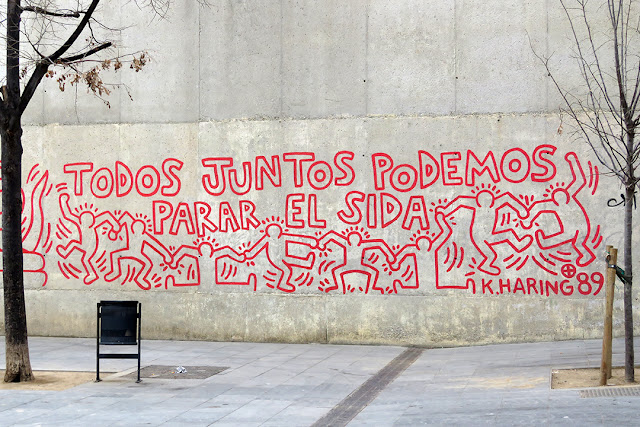
Todos juntos
“Todos juntos podemos parar el sida”
(Together We Can Stop AIDS) by Keith Haring, 1989
Plaça de Joan Coromines
Barcelona, March 2017
“Todos Juntos Podemos Parar el SIDA (English: Together We Can Stop AIDS) is a mural created by American artist and social activist Keith Haring in 1989. The mural was painted to raise awareness to the Aids epidemic. It is located next to the Museu d'Art Contemporani de Barcelona museum in the El Raval neighborhood of Barcelona.” (Todos Juntos Podemos Parar el SIDA, Wikipedia)
Subscribe to:
Posts (Atom)