Showing posts with label 2017. Show all posts
Friday, October 28, 2022
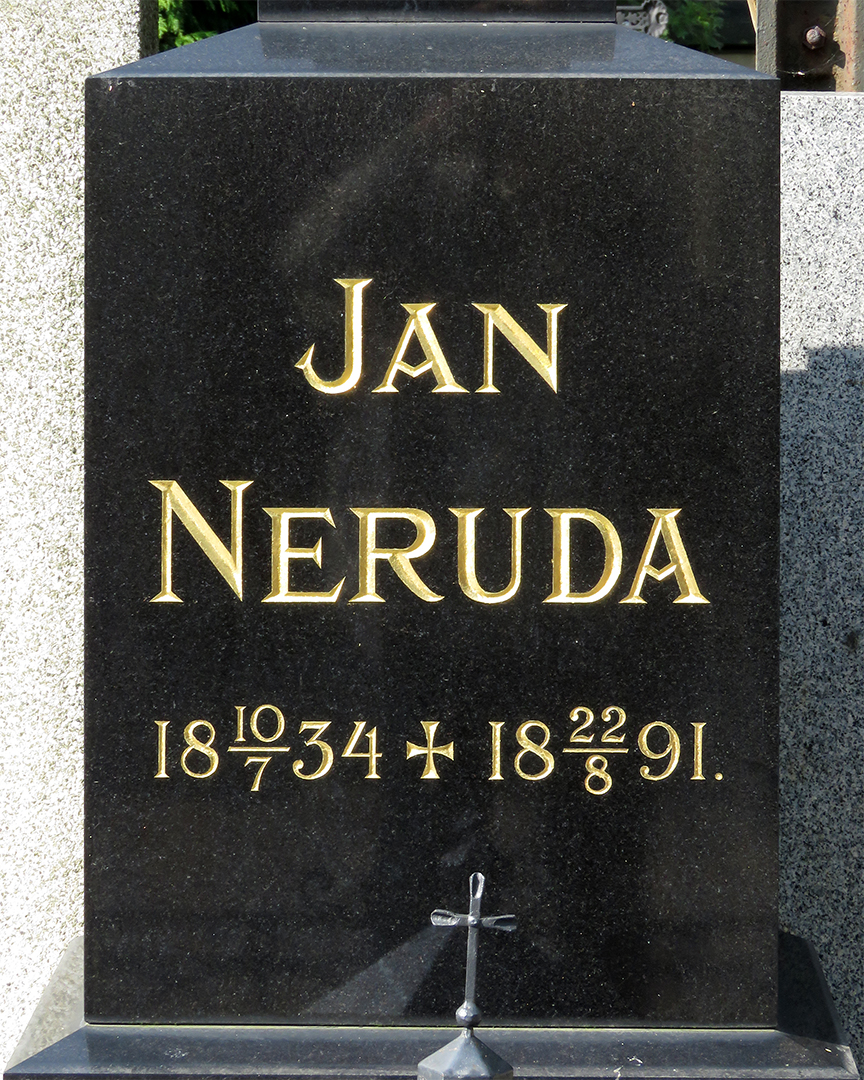
Jan Neruda
Grave of Jan Neruda (1834-1891)
Vyšehradský hřbitov (Vyšehrad Cemetery)
K Rotundě, Vyšehrad
Prague, September 2017
“Jan Nepomuk Neruda (9 July 1834 – 22 August 1891) was a Czech journalist, writer, poet and art critic; one of the most prominent representatives of Czech Realism and a member of the ‘May School’. Jan Neruda was born in Prague, Bohemia; son of a small grocer who lived in the Malá Strana district. Initially, they lived on Újezd Street and later, when he was four, moved to Ostruhová Street (now called Nerudova Street, in his honor), where they owned a house known as ‘U Dvou Slunců’ (At the Two Suns). His studies began in 1845 at the local Grammar school then, in 1850, continued at the Academic Grammar School in Clementinum. His favourite writers at the time were Heine, Byron, Shakespeare, Karel Hynek Mácha and Václav Bolemír Nebeský. After graduation he tried to study law, but he failed. He worked as a clerk for a short time, but was unhappy, so he decided to study philosophy and philology at Charles University. He then worked as a teacher until 1860, when he became a freelance journalist and writer. He started his career at Národní listy (National Sheets). Later, he worked for Obrazy života (Pictures of Life) and Čas (Time). He also contributed to Květy (Blossoms) and Lumír. He became the de facto leader of a generation of writers that included Karolina Světlá, Vítězslav Hálek, Adolf Heyduk and Karel Sabina; devoted to continuing the legacy of Karel Hynek Mácha. They published their works in the literary almanac Máj. By 1871, various groups had labeled Neruda as a ‘Traitor to the Nation’, so he decided to spend some time away; visiting Italy, Greece, France, Germany, Hungary and Egypt. He kept detailed records of these journeys, which provide an interesting testimony to his life and times, with various insights that prove him to be a good observer. From 1883 to his death he lived on Vladislavova Street, 1382/14 in Nové Město, Prague.” (Jan Neruda, Wikipedia)
Wednesday, October 26, 2022
Monday, October 24, 2022
Andromeda Tower
Andromeda Tower by Wilhelm Holzbauer, 1998
Donau-City-Straße
Donaustadt (Donau City)
Vienna, September 2017
Saturday, October 22, 2022
Szent Gellért Monument
Szent Gellért Monument by Gyula Jankovits, 1904
Gellért-hegy (Gellért Hill)
Budapest, September 2017
“Szent Gellért Monument (a.k.a. Saint Gerard Statue) is on the northeast side of Gellért Hill, rocky crag towering 235m above the Danube. The monument honors Saint Gellért Sagredo (980-1046), the first Hungarian bishop and early Christian evangelizer. Gellért was a member of a noble Venetian family who traveled to Hungary while on pilgrimage to Jerusalem. King Stephen I asked him to stay and educate of the his son, the young prince Emeric. In 1030 the king appointed Gellért first bishop of Marosvár (Csanád), where he founded a monastery, a cathedral, and a school for priests; he converted many Hungarians to Christianity. During the struggle for the throne following the death of Stephen I, Gellért was martyred in 1046. Insurgents who wanted a return to paganism captured Gellért in Buda; according to legend, he placed in a barrel pierced with nails and rolled down the steep hill. He was first buried across the river in Pest, but then his body was moved to Csanád in 1053. He was canonized in 1083 by Pope Gregory VII, and is one of the patron saints of Hungary. The Szent Gellért monument is a 12m bronze statue (1904 by sculptor Gyula Jankovits) of the bishop at the site where Gellért was killed. The statue depicts Gellért victoriously holding aloft a crucifix while at his feet a wild-looking Magyar looks up in awe at the bishop. The statue is framed by a neoclassical semi-circular colonnade, with a man-made waterfall tumbling below. The monument offers panoramic views over the Danube, Elisabeth Bridge, Pest, and the hills beyond. A nice 0.5km walk (one way) from the Pest waterfront is to cross Elisabeth Bridge and ascend the paved pathway (stairs and street lights) on the other side of the bridge to the monument. Bus 7 and Tram 19 stop at Dobrentei ter. at the foot of the hill. Gellért Monument is beautifully lit at night, and accessible at all times with no entry fee.” (Szent Gellért Monument, Tripadvisor)
Tuesday, October 18, 2022
Rabbi Loew
Rabbi Loew by Ladislav Šaloun
Nová radnice (New City Hall)
Mariánské náměstí (Virgin Mary Square)
Staré Město (Old Town)
Prague, September 2017
“Judah Loew ben Bezalel (Hebrew: יהודה ליווא בן בצלאל; between 1512 and 1526 – 17 September 1609),[1] also known as Rabbi Loew (alt. Löw, Loewe, Löwe or Levai), the Maharal of Prague (Hebrew: מהר״ל מפראג), or simply the Maharal (the Hebrew acronym of "Moreinu ha-Rav Loew", 'Our Teacher, Rabbi Loew'), was an important Talmudic scholar, Jewish mystic, and philosopher who, for most of his life, served as a leading rabbi in the cities of Mikulov in Moravia and Prague in Bohemia. Within the world of Torah and Talmudic scholarship, Loew is known for his works on Jewish philosophy and Jewish mysticism and his work Gur Aryeh al HaTorah, a supercommentary on Rashi's Torah commentary. He is also the subject of a 19th-century legend that he created the Golem of Prague, an animate being fashioned from clay.” (Judah Loew ben Bezalel, Wikipedia)
Sunday, October 16, 2022
Friday, October 14, 2022
STRABAG Kunstforum
Exhibition of the artist Bruno Gironcoli
STRABAG Kunstforum
Donau-City-Straße
Donaustadt (Donau City)
Vienna, September 2017
Wednesday, October 12, 2022
Saturday, October 8, 2022
Two dolphins
Fountain with two dolphins by František Hnátek and Rudolf Kříženecký, 1906
Kostel svatého Mikuláše (St. Nicholas Church)
Staroměstské náměstí
Staré Město (Old Town)
Prague, September 2017
Thursday, October 6, 2022
Tuesday, October 4, 2022
Sunday, October 2, 2022
István Széchenyi
Bust of István Széchenyi by Pataki Béla, 1991
Szabadság tér
Budapest, September 2017
“Count István Széchenyi de Sárvár-Felsővidék (21 September 1791 – 8 April 1860) was a Hungarian politician, political theorist, and writer. Widely considered one of the greatest statesmen in his nation's history, within Hungary he is still known to many as ‘the Greatest Hungarian’.” (István Széchenyi, Wikipedia)
Wednesday, September 28, 2022
Polibek
“Polibek” (Kiss) by Josef Mařatka, 1921
Petřínské sady (Giardini di Petřín)
Prague, September 2017
“Josef Mařatka (21 May 1874, Prague – 20 April 1937, Prague) was a Czech sculptor. His father, Wilhelm Mařatka, was a shoemaker. From 1889 to 1896, he studied at the School of Applied Arts under Celda Klouček, who was a paleontologist as well as a sculptor. In 1899, he attended the Academy of Fine Arts, where he studied with Josef Václav Myslbek. The following year, he went to Paris and was briefly employed in the studios of Auguste Rodin. His first exhibition was held in Prague in 1902. He married Zdeňka Procházková (1890–1980) in 1912. Their son, Zdeněk, became a prominent gastroenterologist. He began by responding to the influences he had absorbed from the expressionist movement, incorporating elements of symbolism and Art Nouveau. His most important work from this period is the Opuštěna Ariadna (Abandoned Ariadne, 1903). He later came under the influence of Antoine Bourdelle. After World War I, he returned to the styles he had learned from Myslbek, combining Neoclassicism with a bit of early Socialist Realism; for example, ‘Praha svým vítězným synům’ (Prague's Victorious Sons) at the Emmaus Monastery. The monument was destroyed during the German Occupation and restored in 1998. After 1920, he worked as a Professor at the Academy of Arts, Architecture and Design.” (Josef Mařatka, Wikipedia)
Monday, September 26, 2022
Lekáreň u Salvátora
Lekáreň u Salvátora (Pharmacy Salvator)
Panská
Staré Mesto (Old Town)
Bratislava, September 2017
“Pharmacy Salvator (Slovak: Lekáreň u Salvátora) is a neo-renaissance building and former pharmacy in the Old Town of Bratislava, Slovakia constructed by pharmacist Rudolf Adler in 1904. The building's facade features a stone statue of Christ the Saviour by sculptor Alojz Rigele. The ground floor is abandoned and the upper floors contain 10 flats, partially occupied by the Slovak National Theatre employees. Since 1963 the building is a culturally protected monument and it is one of the more striking examples of neo-renaissance architecture in Bratislava. Pharmacy Salvator is located across the street from the monumental St. Martin's Cathedral and it is part of most guided tours of the city. In the period from 1904 to 1995, the building housed a baroque cabinet of the rarest Jesuit pharmacy dating from 1727. These objects included a huge marble pharmaceutical desk supported by six lions, an antique cash register, gas chandelier, a set of pharmaceutical containers and various other furniture. This cabinet is unique not only for its rich Baroque decoration but it is also interesting for its engaging story.During its more than 300 years of existence, it has been moved four times. Additionally, it has been a church, private and national property, and about half of its life is closely connected with the Jesuit order.” (Pharmacy Salvator, Wikipedia)
Saturday, September 24, 2022
Thursday, September 22, 2022
Honvéd-szobor
Honvéd-szobor (Soldier's Statue) by Zala György, 1893
Disz tér
Budapest, September 2017
“Cannon metal statue of a soldier with a flag, who is honoured with a laurel wreath by Victory - a winged female figure. Bronze palm branch with on a ribbon: ‘A NEVTELEN HŐSÖKNEK’ (to the anonymous heroes); on the banner ‘SZABADSÁG VAGY HALÁL’ (Freedom or Death and on a bronze ribbon), ‘harcunk az igazak harca volt, győzelmünk a nemzet diadala’ (The real battle was to win the National triumph). Bronze palm branch with garland and text ‘MAGYAR / NOK’. Erected in memory of the freedom fighters who fought in 1848 in Buda Castle.” (Honvéd-szobor, Statues - Hither & Thither)
Sunday, September 18, 2022
Pomník obětem komunismu
Pomník obětem komunismu (Memorial to the Victims of Communism) by Olbram Zoubek, 2002
Petřín, Újezd, Malá Strana
Prague, September 2017
“The Memorial to the victims of Communism (Czech: Pomník obětem komunismu) is a series of statues in Prague commemorating the victims of the communist era between 1948 and 1989. It is located at the base of Petřín hill, Újezd street in the Malá Strana or the Lesser Town area. It was unveiled on the 22 May 2002, twelve years after the fall of communism in the Eastern Bloc, and is the work of Czech sculptor Olbram Zoubek and architects Jan Kerel and Zdeněk Holzel. It was supported by the local council and Confederation of Political Prisoners (KPV).” (Memorial to the Victims of Communism, Wikipedia)
Friday, September 16, 2022
Wednesday, September 14, 2022
Monday, September 12, 2022
Rendőrség
Rendőrség (Police) car
Tárnok utca
Budapest, September 2017
“The Rendőrség (English: Police) is the national civil law enforcement agency of Hungary and is governed by the Interior Ministry. Until 2006, the police operated under the authority of the Ministry of Interior. From 2006 to 2010, the Ministry of Justice and Law Enforcement was the governing body of the police, which absorbed the Border Guard on December 31, 2007. In 2010, the government reinstated the Interior Ministry.” (Rendőrség, Wikipedia)
Subscribe to:
Posts (Atom)


