Showing posts with label Gdansk. Show all posts

Thursday, May 19, 2022

Rossmann

Rossmann drug store, 13 ulica Grobla I, Stare Miasto (Old Town), Gdańsk

Rossmann drug store
13 ulica Grobla I
Stare Miasto (Old Town)
Gdańsk, September 2018

“The Green Gate (Polish: Brama Zielona, German: former Koggentor, now Grünes Tor) in Gdańsk, Poland, is one of the city's most notable tourist attractions. It is situated between Long Market (Długi Targ) and the River Motława. With the Golden Gate and the Highland Gate, the Green Gate spans the Long Market and Long Street, together comprising the Royal Route. The Green Gate was clearly inspired by the Antwerp City Hall. It was built 1568-71 as the formal residence of Poland's monarchs. It is a masterpiece by Regnier (or Reiner van Amsterdam), an Amsterdam architect, and reflects Flemish architectural influence in Gdańsk. Hans Kramer from Dresden was responsible for the construction plans. On 11–20 February 1646 the future Queen of Poland, Marie Louise Gonzaga, was entertained here. In the late 18th century the Nature Society was housed here, but soon moved to the Naturalists' House (Research Society House). Today the Green Gate houses the National Museum in Gdańsk. Exhibitions, meetings, conferences and shows are held here. The Gdańsk office of former Polish President Lech Wałęsa is located in one of the rooms.” (Rossmann, Wikipedia)

Thursday, April 28, 2022

Nowy Ratusz

Nowy Ratusz (New Town Hall), Wały Jagiellońskie, Gdańsk

Nowy Ratusz (New Town Hall)
Wały Jagiellońskie
Gdańsk, September 2018

“Known fondly by locals of a certain age today as ‘Żak’, this beautiful building which was renovated in the years after the turn of the century was originally built as the ‘Generalkommando’ (General Command) of the Prussian Garrison stationed in the city. Costing an eye-watering 6.2 million Marks the residence took three years to build (1898-1901) and incorporated an annex and stables all set in 1.8 hectares of parkland. The new Free City Parliament (Volkstag) wanted to take control of the building for its purposes but lost out to the League of Nations High Commissioner Sir Richard Haking and he forced the Volkstag out and commandeered it for himself. In 1938 Nazi Gauleiter Albert Forster famously promised C.J. Burkhardt (the last High Commissioner) that his residence would be turned into a casino for party dignitaries once they were rid of him although in fact it became the residence of General Max Bock and Lt. Col. Hans-Ludwig Grosser during the war. The end of the war saw the new Communist authorities take over the building but it was in the period 1957-1999 when a new legend was written for the building. The student club Klub Studentów Wybrzeża Żak or Żak for short became a cultural centre for the youth of the Tri-city as well as a hotbed of anti-communist thinking. Stars like the Polish James Dean Zbigniew Cybulski performed in the club’s theatre while the parties are reported to have been legendary. As well as performances the building featured one of the only cinemas showing independent films as well as a cafe and bar. As described by the students themselves ‘Żak was like a colourful island in a sea of gray: people banging doors and windows at all events, no matter what it was. That's when Żak was a legend.’ In 1991 the new independent city authorities, now staffed by many of Żak’s former members (Gdańsk City President Paweł Adamowicz is a self-confessed veteran) decided to create a new cultural centre here and for the next 8 years it presented music, theatre, film, exhibitions, workshops as well as becoming one of the best places to party in the entire city. The city took back the building in 1999 and returned it to its former glory turning it into the ceremonial Town Hall of the city. It honoured Irishman Sean Lester, the League of Nations' High Commissioner from 1934-37 by renaming one of the rooms in his honour in 2010. Żak, meanwhile, lives on in a new purpose built property on the main road between Wrzeszcz and Oliwa.” (New Town Hall, In Your Pocket)

Tuesday, April 19, 2022

St. Barbara's Church

St. Barbara's Church, Długie Ogrody, Gdańsk

St. Barbara's Church
Długie Ogrody
Gdańsk, September 2018

“Despite numerous devastations caused by fires and the armies of Stefan Batory and Napoleon, it was rebuilt each time. The tower, which is 40 m in height, was added to the church only in the early 17th Century. Inside the tower, there are three red-bronze bells, given by the priests of the Diocese of Magdeburg. In 1945, as a result of the war, the gables collapsed, along with the upper part of the tower and the roof, and most of the roof in the northern chapels and arcades separating the aisles. The church was rebuilt only in 1956-1967. During reconstruction, the side aisle was taken apart, and the church lost its unique shape shown in the old illustrations and paintings. The interior was furnished with contemporary elements, accompanied by historical sculptures donated by the National Museum in Gdańsk. While admiring the interior, take a closer look at the modern stained glass located on the street side of the church, created by Barbara Massalska.” (St. Barbara’s Church in Gdańsk, Pomorskie Travel)

Tuesday, March 29, 2022

Green facade

Green facade, Długie Pobrzeże, Gdańsk

Green facade
Długie Pobrzeże
Gdańsk, September 2018

Tuesday, March 8, 2022

St. Mary's Street

Ulica Mariacka, St. Mary's Street, Stare Miasto (Old Town), Gdańsk

Ulica Mariacka (St. Mary's Street)
Mariacka
Stare Miasto (Old Town)
Gdańsk, September 2018

“The most atmospheric of all Gdańsk's streets and one of Poland’s most photogenic lanes is this length of cobbles between the waterfront St Mary’s Gate and the red-brick hulk of St Mary’s Church. Almost completely re-created after WWII, mostly on the basis of old documents, photographs and illustrations, every ornamental detail unearthed from the debris, including countless scary gargoyles, was incorporated. It’s the only street with a complete row of terraces, which lends the scene enormous charm. In recent years things have really come to life, with several artisan amber jewellery shops, some great cafes and bars, and one of northern Poland’s most characterful hotels (Kamienica Gotyk). Some of the best stalls are set up here during the Dominican Fair.” (Ulica Mariacka, Lonely Planet)

Wednesday, February 9, 2022

Złota Brama

Złota Brama (Golden Gate), seen from the Targ Węglowy, Gdańsk

Złota Brama (Golden Gate)
Seen from the Targ Węglowy
Gdańsk, September 2018

“The Golden Gate (Polish: Złota Brama, German: Langgasser Tor) is a historic Renaissance city gate in Gdańsk, Poland. It is located within the Royal Route, the most prominent part of the historic city center and is one of its most notable tourist attractions. It was created in 1612–14 in place of a 13th-century gothic gate, the Brama Długouliczna (Long Street Gate). It is located at one end of Ulica Długa (Long Lane), where, together with Brama Wyżynna (Highland Gate) and Wieża Więzienna (Prison Tower), it forms a part of the old city fortifications. It was designed by architect Abraham van den Blocke and was built by Jan Strakowski. The architectural style of the gate is Dutch mannerism. Next to it is the late-gothic building of the Brotherhood of St. George. Both sides of the gate have attiques, with figures symbolizing the qualities of the ideal citizen. They were designed in 1648 by Jeremias Falck (Polonus), and reconstructed in 1878 due to the originals being damaged by weathering over time. From the West side they represent (in Latin): Pax (Peace), Libertas (Freedom), Fortuna (Wealth) and Fama (Fame). From the East (Long Lane) side they are Concordia (Agreement), Iustitia (Justice), Pietas (Piety) and Prudentia (Prudency). The Latin inscription on the gates reads: Concordia res publicæ parvæ crescunt – discordia magnæ concidunt (In agreement small republics grow, because of disagreement great republics fall). The gate was largely destroyed by Soviet shelling in World War II, but was rebuilt in 1957. Although most artifacts of Germanness were eradicated after the city became part of the Polish People's Republic in 1945,[citation needed] an original German inscription on the gate was restored in the 1990s: Es müsse wohl gehen denen, die dich lieben. Es müsse Friede sein inwendig in deinen Mauern und Glück in deinen Palästen ("They shall prosper that love thee. Peace be within thy walls, and prosperity within thy palaces." – Psalm 122)” (Golden Gate, Wikipedia)

Friday, January 7, 2022

Fort Carré

Fort Carré of the Wisłoujście Fortress with the lighthouse tower, seen from the Martwa Wisła, Gdańsk

Fort Carré of the Wisłoujście Fortress with the lighthouse tower
Seen from the Martwa Wisła
Gdańsk, September 2018

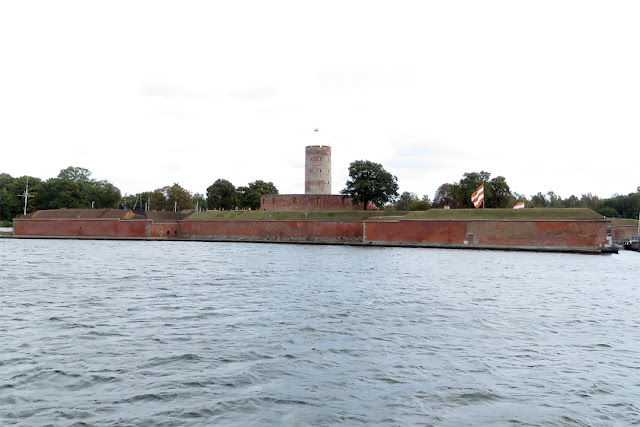
“Wisłoujście Fortress (German: Festung Weichselmünde) is an historic fortress located in Gdańsk by the Martwa Wisła river, by an old estuary of the river Vistula, flowing into the Bay of Gdańsk. The fortress is located close to the Wisłoujście borough, Westerplatte and the Port Północny (Northern Port). Different parts of the fortress are clearly in different architectural styles (predominantly Gothic) and in different styles of construction and building materials. This is the result of the fortress being rebuilt every time it was destroyed or badly damaged. The basement and foundation of the fortress is based on wooden crates (kaszyce), which are hidden underneath in the water. On top of these structures, rubble was heaped up and strengthened - providing a stable and strong base for the fortress. The heart of the fortress is based around a circular tower (currently devoid of the coping), which until 1785 was used as a lighthouse. The lighthouse is surrounded by a brick flange (also known as a circular battery), whose inner walls are sealed together with the officers' living quarters. Around the battery there is a four-bastion Fort Carré, which is led by a gatehouse with a postern from 1609. The north-western side of the fort-carré is adjoined to the Martwa Wisła river, while the rest of the fortress is separated off from land by a sconce known as the Szaniec Wschodny (Eastern Sconce). The sconce is lined up with five bastions, two of which are ravelins - one of which survived. The Fort carré as well as the Eastern Sconce are surrounded by a moat, sourced by the Martwa Wisła river. Up until 1889, the lighthouse tower was topped with a later-Baroque coping, from about 1721. After its burning, due to a fire caused by lightning, the coping was reconstructed and coated with shale, which survived up until 1945. The tower had formerly a clock, dating back to the eighteenth century. In 1945, due to artillery strikes the tower was almost completely destroyed, the coping and officers' headquarters and upper levels were also devastated. The only parts of the fortress which were left untouched, were the walls of the Fort Carré. In 1959 the tower was added to the Register of Heritage Sites, and reconstruction of the fortress began.” (Wisłoujście Fortress, Wikipedia)

Wednesday, December 8, 2021

Seven Mar

Pipe layer Seven Mar, Martwa Wisła, Port of Gdańsk

Pipe layer “Seven Mar” (IMO 9230414)
Port of Gdańsk
Martwa Wisła
Gdańsk, September 2018

Thursday, September 30, 2021

Brama Mariacka

Brama Mariacka (St. Mary's Gate), Długie Pobrzeże, Gdańsk

Brama Mariacka (St. Mary's Gate)
Długie Pobrzeże / ulica Mariacka
Gdańsk, September 2018

“If there’s a more scenic street in Gdańsk Old Town we’ve yet to find it. Mariacka is without doubt the jewel in Gdańsk’s crown, a picturesque street of gabled houses and gruesome gargoyles. Towering over it, St Mary’s Basilica, the largest brick church in the world. And there’s no better way to approach it than through Brama Mariacka, a shadowy Gothic gateway that could have been built with Dracula in mind. First mentioned in 1484 this place took a hammering in 1945, and pics from that time reveal an image not unlike Hiroshima. Painstakingly rebuilt between 1958 and 1961, after which time the side wing has served as seat of the Archaeological Museum. The gate has been renovated and the shiny polychrome you see of two lions holding the Gdańsk coat of arms aloft was restored in 2006.” (St. Mary's Gate, In Your Pocket)

Tuesday, September 21, 2021

Brama Straganiarska

Brama Straganiarska, Straganiarska Gate, Długie Pobrzeże, Gdańsk

Brama Straganiarska (Straganiarska Gate)
Długie Pobrzeże, ulica Straganiarska
Gdańsk, September 2018

Thursday, September 9, 2021

Brama Chlebnicka

Brama Chlebnicka, Długie Pobrzeże, ulica Chlebnicka, Gdańsk

Brama Chlebnicka (Bread Gate)
Długie Pobrzeże / ulica Chlebnicka
Gdańsk, September 2018

“Of all the gateways in Gdańsk, it’s this one that’s the best preserved, and that’s no small feat considering the pounding the Russians gave the city at the end of the war. Thought to have been completed in 1450, this signature piece of the Gothic-style features curved cornices and a pointy arch and, upon closer inspection on the waterfront's side, you can find the oldest coat of arms on show in the city - a crest of two silver crosses imposed on a red shield, which was added in 1457. That’s not the only piece of identification stamped on the structure. Duck through the passage and you’ll find a lily, once the symbol of the Dukes of Pomerania.” (Chlebnicka Gate, In Your Pocket)

Tuesday, August 31, 2021

Brama Żuraw

Brama Żuraw (Crane Gate), Narodowe Muzeum Morskie (National Maritime Museum), Długie Pobrzeże, Gdańsk

Brama Żuraw (Crane Gate)
Narodowe Muzeum Morskie (National Maritime Museum)
Długie Pobrzeże
Gdańsk, September 2018

“In 1958, a Museum's Friends Association was established, and with the participation of Przemysław Smolarek (employee of the National Museum, Szczecin), the Association organised an exhibition titled From a paddle to a nuclear drive in Artus Court in Gdańsk. Przemysław Smolarek lobbied for the creation of a dedicated maritime museum in Poland and his efforts were successful: in 1959, by the decision of adequate authorities (government ministers aided by the Museum of Technology, Warsaw), such a museum was formed in Gdańsk. Przemysław Smolarek was tasked with the preparation work. The Museum was officially established on 1 January 1962, and Smolarek was nominated its director. He remained at this position until his death in 1991. At first the Museum was located in the medieval Gdańsk Crane, but soon started to branch out. In 1963 the first branch – the Lighthouse Museum in the Rozewie Lighthouse – was opened, followed by the Fishery Museum on Hel Peninsula in 1972. In 1972 the institution has been renamed Polish Maritime Museum and granted the status of a national institution.” (National Maritime Museum, Wikipedia)

Thursday, August 19, 2021

Turbot pochwycony

Turbot pochwycony (Turbot Caught) by Gunter Grass, ulica Szeroka, Gdańsk

Turbot pochwycony (Turbot Caught) by Gunter Grass
ulica Szeroka
Gdańsk, September 2018

Saturday, August 7, 2021

Burmistrz

Burmistrz (Mayor) by Tomasz Radziewicz, ulica Rajska, Gdańsk

“Burmistrz” (Mayor) by Tomasz Radziewicz, 2017
ulica Rajska
Gdańsk, September 2018

Thursday, July 29, 2021

Swietopelk II the Great

Pomnik Świętopełka II Wielkiego (Monument of Swietopelk II the Great) by Wawrzyniec Samp, ulica Szeroka, Gdańsk

Pomnik Świętopełka II Wielkiego (Monument of Swietopelk II the Great) by Wawrzyniec Samp
ulica Szeroka
Gdańsk, September 2018

Tuesday, July 20, 2021

Monument to the Poles

Monument to the Poles who died for the Gdansk Polishness (1939-1945) by Wawrzyniec Samp, ulica Podwale Staromiejskie, Gdańsk

Monument to the Poles who died for the Gdansk Polishness (1939-1945) by Wawrzyniec Samp, 1969
ulica Podwale Staromiejskie
Gdańsk, September 2018

Thursday, July 8, 2021

Hotel Fahrenheit

Hotel Fahrenheit, ulica Grodzka, Gdańsk

Hotel Fahrenheit
ulica Grodzka
Gdańsk, September 2018

Tuesday, June 29, 2021

John III Sobieski Monument

Pomnik króla Jana III Sobieskiego (John III Sobieski Monument) by Tadeusz Barącz, Targ Drzewny, Gdańsk

Pomnik króla Jana III Sobieskiego (John III Sobieski Monument) by Tadeusz Barącz, 1898
Targ Drzewny
Gdańsk, September 2018

“King John III Sobieski Monument in Gdańsk (Polish: Pomnik króla Jana III Sobieskiego w Gdańsku) is an equestrian statue of the King of Poland John III Sobieski (1629-1696). Originally built in Lviv in 1898, the monument was transferred to Gdańsk in 1965. The monument was funded by the city of Lviv, Kingdom of Galicia and Lodomeria (part of the Austro-Hungarian Empire). It was officially unveiled on 20 November 1898. The equestrian statue of the Polish king was designed by sculptor Tadeusz Barącz and cast in bronze by the Viennese company owned by Artur Krupp. The large Neo-Baroque pedestal of the monument made of grey Ternopil sandstone was created in Julian Markowski's sculpture studio in Lviv. The design of the king was modelled on a Lviv entrepreneur Marian Stipal. It was erected at a garden square along the Wały Hetmańskie Avenue (currently Freedom Avenue), one of the most representational pedestrian boulevards of the city. At present, a monument dedicated to Taras Shevchenko is located in that place.” (John III Sobieski Monument in Gdańsk, Wikipedia)

Sunday, June 20, 2021

Antyk Galeria

Antyk Galeria, Podbielańska, Gdańsk

“Antyk” Galeria
Podbielańska
Gdańsk, September 2018

Tuesday, June 8, 2021

Gdańsk Główny

Clock tower, Gdańsk Główny railway station, Podwale Grodzkie, Gdańsk

Clock tower
Gdańsk Główny railway station
Podwale Grodzkie
Gdańsk, September 2018

“Gdańsk Główny (Polish for Gdańsk main station) is the chief railway station serving the city of Gdańsk, in the Pomeranian Voivodeship, Poland. The station opened in 1900 and is located on the Warsaw–Gdańsk railway, Gdańsk–Stargard railway, the parallel Gdańsk Śródmieście–Rumia railway, Gdańsk Główny–Gdańsk Zaspa Towarowa railway and Gdańsk Główny–Gdańsk Nowy Port railway. The train services are operated by PKP, Polregio and SKM Tricity. Koleje Mazowieckie trains operate here during the summer.” (Gdańsk Główny railway station, Wikipedia)