Showing posts with label Warsaw. Show all posts
Monday, May 16, 2022
The Wishing Bell
The “Wishing Bell” by Daniel Tym, 1646
Kanonia
Stare Miasto (Old Town)
Warsaw, September 2018
“St John’s Cathedral in Old Town is a lovely little church; but more interesting is the tiny little square behind the church, called the Canon Square, which is home to an unusual monument. Overlooked by houses and apartment buildings, the square houses a massive bronze bell, called the Wishing Bell of Warsaw, made in 1646. It has been designed by the same artist who designed Sigismund’s Column, Daniel Tym. According to popular lore, people who circle the bell and make a wish have it come true. Interestingly, the bell itself has been polished to a fine sheen by people rubbing it.” (Wishing Bell of Warsaw, Times of India)
Monday, April 25, 2022
Plac Teatralny
Teatr Wielki w Warszawie (Grand Theatre in Warsaw)
plac Teatralny, Śródmieście
Warsaw, September 2018
“Theatre Square (Plac Teatralny) is a major square in the Śródmieście district of Warsaw, Poland. It spans from the Great Theatre building to the Senatorska Street. The origins of the square date back to the beginning of the 19th century, when a small square was established in 1818. From 1825 to 1832 the Great Theatre building was constructed. When the city administration was relocated to the Jabłonowski Palace, the square became a centre of city life. Various patriotic demonstrations took place there, including at the time of the failed January Uprising and the Revolution of 1905. In September 1939, the civilian defense of the city was located in the city hall. During the Warsaw Uprising of 1944 the square witnessed heavy fighting between the Nazi German soldiers and the Home Army partisans. Most of the surrounding buildings were heavily damaged or completely destroyed. After the war several buildings were restored, excluding the pre-war city hall with its notable clock tower. It was rebuilt according to the original architectural plans only in the late 1990s.” (Theatre Square, Wikipedia)
Saturday, April 16, 2022
Wodozbiór
Wodozbiór (Water Tower)
Ogród Saski (Saxon Garden)
Warsaw, September 2018
“In the northwest part of the Saxon Garden, is situated by the ornamental lake surrounded by willows. This classicist water tower in the shape of a Roman monopteros was modelled on the Temple of Vesta in Tivoli. It was designed in 1852 by the architect Henryk Marconi.” (Saxon Garden, Wikipedia)
Monday, April 4, 2022
Akademia Teatralna
Akademia Teatralna im. Aleksandra Zelwerowicza
(Aleksander Zelwerowicz National Academy of Dramatic Art)
Ulica Miodowa
Warsaw, September 2018
“The Aleksander Zelwerowicz National Academy of Dramatic Art in Warsaw (Polish: Akademia Teatralna im. Aleksandra Zelwerowicza) is a public higher education institution in Warsaw, Poland. Its focus is on the theatre arts. It is headquartered in the Collegium Nobilium, an eighteenth-century building which formerly housed an elite boarding secondary school run by Piarist monks. It was founded in Łódź in 1946 and moved to Warsaw in 1949.[1] It continues the tradition of the National Institute of Theatre Arts (Państwowy Instytut Sztuki Teatralnej) established in Łódź in 1932. It was founded as the National Higher School of Theatre (Państwowa Wyższa Szkoła Teatralna) and received a patron (Aleksander Zelwerowicz) in 1955. In 1962 it received certification as a higher education institution. It received its current name in 1996.” (Aleksander Zelwerowicz National Academy of Dramatic Art in Warsaw, Wikipedia)
Saturday, March 26, 2022
Smoleńsk Air Disaster Monument
Smoleńsk Air Disaster Monument, 2018
plac marsz. Józefa Piłsudskiego
Warsaw, September 2018
“On 10 April 2018, exactly eight years after the 2010 Smoleńsk air disaster in which 96 people died, including the then President of Poland, Lech Kaczyński, and his wife Maria, a new monument was finally unveiled to commemorate those who died in the tragedy. After years of deliberation, Piłsudski Square was chosen as the location from among other potential candidates, with the Presidential Palace (among others) at one point being suggested. The form and design of the monument was not known until the day of the unveiling, having been hidden from view under a white tent during its construction. The black granite monument, built to look like the gangway stairs of a plane, has inevitably led to suggestions that it looks like a 'stairway to heaven'. A few months later, on 10 November, a monument to late President Lech Kaczyński was also unveiled, overlooking the square.” (Smoleńsk Air Disaster Monument, In Your Pocket)
Thursday, March 17, 2022
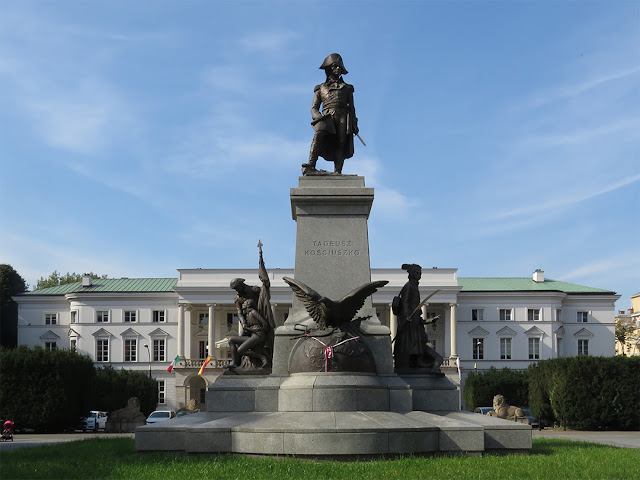
Tadeusz Kościuszko Monument
Tadeusz Kościuszko Monument by Antoni Popiel, 1910
Plac Żelaznej Bramy
Warsaw, September 2018
“The Tadeusz Kościuszko Monument in Warsaw (Polish: Pomnik Tadeusza Kościuszki w Warszawie) is a statue dedicated to commemorate the national hero of Poland, Lithuania, Belarus, and the United States, general Tadeusz Kościuszko (1746–1817), and situated on the Iron-Gate Square in front of the Lubomirski Palace. It stands on the main axis of the historical city centre of Warsaw, the Saxon Axis. The monument is an exact copy of the Statue of Tadeusz Kościuszko at Lafayette Square in Washington, D.C. unveiled on 9 May 1910, and designed by the Polish sculptor Antoni Popiel (1865–1910). The monument replaced the former monument of the ‘Dead in the Service and Defense of the Polish People's Republic’, erected in the 1980s by the Communist government and demolished 1991. The investment was financed by the Citi Bank Handlowy and the Warsaw City Council. The bronze elements of the monument were moulded by the Technical Appliance Works at Gliwice. The copying of the Washington monument was executed by Kraków sculptors Anna and Wojciech Siek. The monument was unveiled on 16 November 2010. The monument shows the figure of Tadeusz Kościuszko in the uniform of an American general, holding drawings of the West Point garrison defenses in his hand. On the right side of the monument stands a figure symbolizing the Battle of Racławice and on the left side a figure symbolizing the Battle of Saratoga.” (Tadeusz Kościuszko Monument, Wikipedia)
Saturday, March 5, 2022
Thursday, February 24, 2022
Kościół Nawiedzenia Najświętszej Marii Panny
Kościół Nawiedzenia Najświętszej Marii Panny (Church of the Visitation of the Blessed Virgin Mary)
ulica Przyrynek
Warsaw, September 2018
“The Church of the Visitation of the Most Blessed Virgin Mary (Polish: Kościół Nawiedzenia Najświętszej Marii Panny), otherwise known as St. Mary's Church (Kościół Mariacki) is a church in Warsaw, Poland. It is one of oldest buildings and one of the few surviving examples of Gothic architecture in the city. It is located at ulica Przyrynek 2. St. Mary's Church stands on the site of an ancient pagan place of worship.[1] The church's foundation stone was laid by Janusz I the Old, Duke of Masovia and his wife, Danutė of Lithuania, in 1409. The church was consecrated in 1411. It has been modified, demolished and rebuilt several times. Originally it had one nave, was made of bricks, had a ceiling and an arch presbytery, before the end of the 15th century it was transformed into a three nave basilica.” (Church of the Visitation of the Blessed Virgin Mary, Wikipedia)
Tuesday, February 15, 2022
Ignacy Jan Paderewski
Pomnik Ignacego Jana Paderewskiego (Monument of Ignacy Jan Paderewski) by Michał Kamieński, 1978
Park Ujazdowski
Warsaw, September 2018
“The monument to Ignacy Jan Paderewski is located in Warsaw's Ujazdowski Park. Born in Kuryłówka in 1860, Paderewski is fondly remembered as a politician, patriot and musician. Having entered the Warsaw Conservatorium at the age of 12 he worked as a piano tutor after graduation. The death of his wife, just a year after they married, spurred him to commit his life to music and in 1887 he made his public debut in Vienna. His talent was obvious and his growing popularity saw him storm both Europe and the States, not just as a pianist, but a masterful composer as well. He was based in Paris during WWI and it was during this time he became actively involved in politics, becoming spokesman for the Polish National Committee. With the end of the war he sought a return to his homeland where, having played a key role in the Wielkopolska Uprising (which saw Poznań merged into the newly reformed Polish state), he was elected Poland’s third ever prime minister. It was he who signed for Poland’s part in the 1919 Treaty of Versailles, though his fall from grace was just around the corner. Many thought he had sold Poland short and in the face of growing public discontent he resigned from office in December 1919. A short stint as Poland’s representative in the League of Nations followed before he opted to resume his musical career. Aside from being a skilled musician, the mop haired Paderewski was also a popular public speaker, known for his devastating wit. One anecdote recalls him being introduced to a polo player with the words: ‘You are both leaders in your spheres, though the spheres are very different’. Not one to miss a beat Paderewski deadpanned ‘Not so very different, you are a dear soul who plays polo, and I am a poor Pole who plays solo’. During WWII he became an eminent figure in the London based exiled Polish Parliament, though died in 1941 with the country of his birth still under occupation.” (Ignacy Jan Paderewski Monument, In Your pocket)
Sunday, February 6, 2022
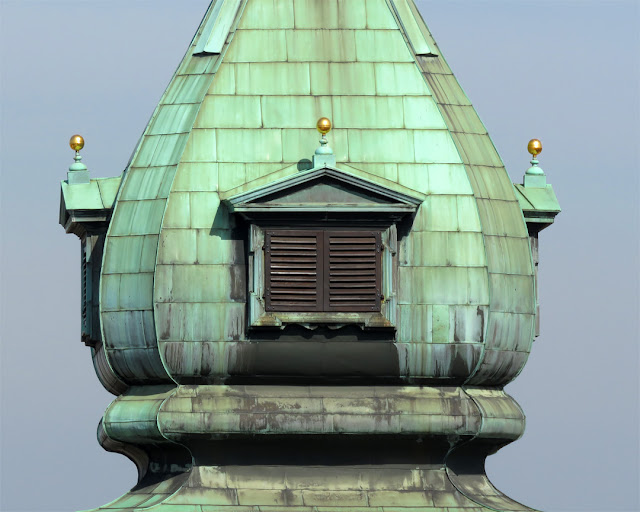
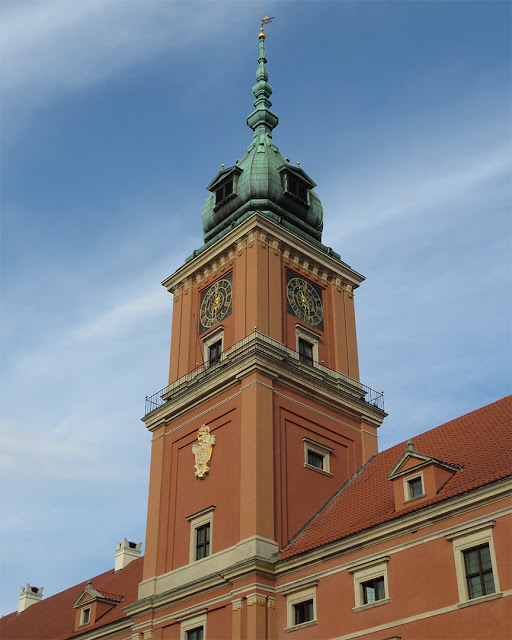
Clock Tower
Detail of the Wieża Zegarowa (Clock Tower)
Zamek Królewski (Royal Castle)
plac Zamkowy
Warsaw, September 2018
Friday, January 28, 2022
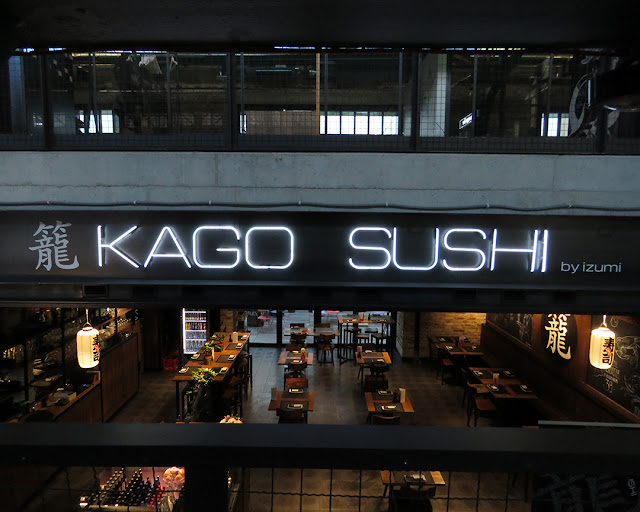
Kago Sushi
Kago Sushi
Hala Koszyki (Koszyki Hall)
ulica Koszykowa
Warsaw, September 2018
“Hala Koszyki was purchased in 2009 by Avestus Real Estate which hoped to revitalize the object. It was subsequently demolished, with the exception of the two side wings and the northern wall of the arcade facing Koszykowa Street. Its complete redevelopment and reconstruction began after Griffin Group purchased the site in 2012. The market hall was redesigned by JEMS Architekci and reopened in October 2016. All of the original structural elements were reincorporated into the new mixed-use building. The venue inside offers restaurants specializing in haute cuisine, bars, pubs, cafeterias, bookstores and designer shops.” (Hala Koszyki, Wikipedia)
Sunday, January 16, 2022
Koszyki Hall
Hala Koszyki (Koszyki Hall)
ulica Koszykowa
Warsaw, September 2018
“The exterior was decorated with sculptures and carved cartouches featuring the mermaid, a symbol of Warsaw, and animal or food-related themes. The main central hall was 77 meters in length by 27 meters in width at the time of its completion. The two entrance wings were 15 meters by 15 meters each. The building was considered extremely modern for its time and possessed all the necessary conveniences; the steel-framed arcade had booths and cubicles specifically designed for each individual trade – butchers were provided with marble tabletops for cutting meat, fishmongers with pools and grocers were equipped with cold rooms and coolers. Despite this, little space was designated in the 'cour d'honneur' for horse carts and wagons which transported the stock food to the Hall. A considerable problem was also the size of Koszykowa Street, which was narrow and soon became overcrowded, thus limiting access to the market.” (Hala Koszyki, Wikipedia)
Tuesday, January 4, 2022
Hala Koszyki
Hala Koszyki (Koszyki Hall)
ulica Koszykowa
Warsaw, September 2018
“Hala Koszyki (pronounced Ko-shi-kee), also known as Koszyki Hall in English, is a historic market and food hall located on 63 Koszykowa Street in south-central Warsaw, Poland. Initially opened in 1909, it has been since redeveloped into a mixed-use retail and commercial facility with offices, bookstores, elegant bars and gourmet restaurants. The heritage shopping arcade was designed in an Art Nouveau style.” (Hala Koszyki, Wikipedia)
Sunday, December 26, 2021
Friday, December 17, 2021
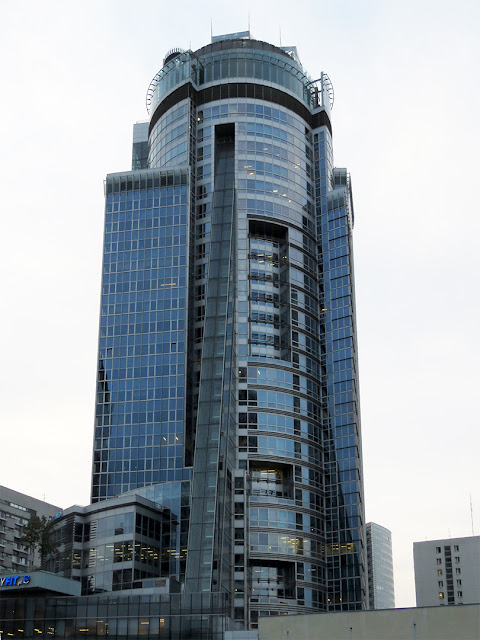
Spektrum Tower
Spektrum Tower, 2003
Twarda, Warszawa-Śródmieście
Warsaw, September 2018
“The Spektrum Tower (formerly TP S.A. Tower) is a highrise office tower in Warsaw, the capital of Poland. It is located at 14/16 Twarda Street in the Warszawa-Śródmieście central business district of the city and used to house the headquarters of its investor, the telecom operator Telekomunikacja Polska S.A. (TP S.A.), with some space being leased to other companies. The building of the tower was initially contracted to PIA Piasecki S.A. on 1 August 1997, originally due to be completed 30 June 2002. In 2002, however, the contractor was found unable to complete the structure due to strained financial standing, and the investor turned to PORR Polska S.A. (who has completed a number of other office buildings and towers in Warsaw) to finish the construction. The Tower was finally completed in December 2003. The Tower was built using the ‘top-down’ technology, with both the over- and underground parts of the structure being constructed simultaneously. During the excavation for the foundation of the Tower, a 580 kg artillery shell from World War II was discovered 8 metres below ground level. The Tower was designed by architects from Apar-Projekt and Arca A&C bureaus, and consists of a composition of cylinders and cuboids. The structural design was the responsibility of TMJ Tomasz Ziętała. The Tower has 30 overground and 5 underground floors, extending 16.5 metres below ground level and rising to 128 metres above ground. The building comprises almost 50,000 m2 of space, over 41,000 of which is usable. Unique features of the building include the helipad on the roof and the external elevator shaft, sloped 14°, which connects the street level with one of the higher office floors with an elevator cabin travelling at 2.5 m/s. Apart from it, there are seven other straight-up elevator shafts in the building core. The Tower is a modern intelligent building, fitted with building automation systems. In July 2008 it was sold to Danish investment fund Baltic Property Trust Optima which sold it in 2012 to a London-based Europa Capital LLP fund.” (Spektrum Tower, Wikipedia)
Sunday, December 5, 2021
Wojciech Bogusławski
Pomnik Wojciecha Bogusławskiego (Monument to Wojciech Bogusławski)
plac Teatralny
Warsaw, September 2018
“Wojciech Romuald Bogusławski (9 April 1757 – 23 July 1829) was a Polish actor, theater director and playwright of the Polish Enlightenment. He was the director of the National Theatre, Warsaw, (Teatr Narodowy), during three distinct periods, as well as establishing a Polish opera. He is considered the ‘Father of Polish theatre.’” (Wojciech Bogusławski, Wikipedia)
Friday, November 26, 2021
Stanisław Moniuszko
Pomnik Stanisława Moniuszki (Monument to Stanisław Moniuszko)
plac Teatralny
Warsaw, September 2018
“Stanisław Moniuszko (May 5, 1819 – June 4, 1872) was a Polish composer, conductor and teacher. He wrote many popular art songs and operas, and his music is filled with patriotic folk themes of the peoples of the former Polish–Lithuanian Commonwealth (mainly Poles, Lithuanians and Belarusians). He is generally referred to as "the father of Polish national opera". Since the 1990s Stanisław Moniuszko is being recognized in Belarus as an important figure of Belarusian culture.” (Stanisław Moniuszko, Wikipedia)
Wednesday, November 17, 2021
Józef Poniatowski
Statue of Prince Józef Poniatowski by Bertel Thorvaldsen, 1817
Pałac Prezydencki (Presidential Palace)
Krakowskie Przedmieście
Warsaw, September 2018
“The Prince Józef Poniatowski Monument in Warsaw (Polish: Pomnik księcia Józefa Poniatowskiego w Warszawie) is a monument currently located at 46/48 Krakowskie Przedmieście in the courtyard of the Presidential Palace. Created by Rome-based Danish sculptor Bertel Thorvaldsen in 1829, it depicts Józef Poniatowski (1763–1813) riding and horse and dressed as Roman general. The statue depicts Prince Józef Poniatowski (1763–1813) riding a horse and holding a sword in his right hand. The figure of the prince is modeled on the monument of Marcus Aurelius from the Roman Capitoline Hill. The monument's creation was at the behest of Polish aristocracy. Polish aristocrat and diarist Anna Potocka obtained permission from the Tsar to place the monument in front of the Governor's Palace (which is now the Presidential Palace). The monument was commissioned in 1817 from Danish sculptor Bertel Thorvaldsen. In 1829, in Warsaw, he presented a life-size plaster model in classicist form. The project was not well received by critics and the public who were expecting to see the warrior clad in the armour of a soldier, while Thorvaldsen introduced him as a half-naked Roman general. Based on the model, Klaudiusz and Emil Gregoire's foundry in Długa Street in Warsaw made a bronze cast which was completed in August, 1832. Meanwhile, as a result of the failed November Uprising, Russian consent for the placement of the monument had been withdrawn as part of the Tsar's sanctions against Poland, which was confirmed by a special order in 1834. The finished cast was first taken to the Modlin Fortress, where the sculpture was originally regarded as the patron of the fortress, St. George. In 1836, the monument was dismantled and placed in 10 boxes in the fortress. In 1840, the monument was assembled again, and during an inspection of the fortress by Tsar Nicholas I, it was decided to scrap the monument, but he changed his mind. Later in 1840, the statue was taken to Dęblin, and in 1842 to the Paskevich Palace in Gomel. The monument adorned the palace in Gomel from 1842 to 1922. In Warsaw, a monument to Ivan Paskevich (by sculptors Nikolai Pimienov and Aleksander von Bock) was unveiled in 1870, at the site where Prince Józef Poniatowski's monument was meant to be. Paskevich's statue was pulled down in 1917, when Poland regained independence. The monument to Prince Józef Poniatowski returned to independent Poland in 1922, as part of the recovery of monuments and works of art under the Treaty of Riga. It originally stood in the courtyard of the Royal Castle, and from 1923, in Saxon Square, on a pedestal designed by Aleksander Bojemski in front of the Saxon Palace and the Tomb of the Unknown Soldier. The unveiling ceremony for the monument was associated with the arrival and appointment of Ferdinand Foch as a Marshal of Poland. The monument was blown up on December 16, 1944, on the orders of German General Erich von dem Bach-Zelewski. A new cast of the sculpture, made from 1948 to 1951, based on a model at the Thorvaldsen Museum in Copenhagen, was made by Poul Lauritz Rasmussen, and donated to Warsaw by the Kingdom of Denmark. On February 23, 1952, the monument was placed in front of the Old Orangery (Stara Pomarańczarnia) in Łazienki Park, and in 1965 it was moved to the courtyard of the Presidential Palace where it is today. The remains of the original sculpture, found in April 1945, in the ruins of the Lilpop factory, are exhibited in the Freedom Park at the Warsaw Uprising Museum. Thorvaldsen's original plaster model is on display in the Thorvaldsen Museum in Copenhagen.” (Józef Poniatowski Monument, Wikipedia)
Friday, November 5, 2021
InterContinental Warsaw
ulica Emilii Plater
Warsaw, September 2018
“The building is characterised by its unusual shape and is finished in pea-green tones, like the adjacent Warsaw Financial Center. The building houses 414 rooms of various standards, including the presidential suite, 76 luxury suites with kitchenettes, and has 13 conference rooms. The building also has a ballroom, two bars, two restaurants, an E. Wedel chocolate fountain, sauna, fitness club, spa, and solarium. A modern swimming pool, located on the 43rd and 44th floors (150 meters above the ground) is the highest indoor swimming pool in Europe.” (InterContinental Warsaw, Wikipedia)
Wednesday, October 27, 2021
Subscribe to:
Posts (Atom)