Showing posts with label r1909. Show all posts
Saturday, April 23, 2022
Ettore e Andromaca
“Ettore e Andromaca” (Hector and Andromache) by Giorgio de Chirico, 1966 (copy)
Museo Carlo Bilotti
Viale Fiorello La Guardia
Rome, September 2019
Monday, April 11, 2022
Saint Nicholas of Tolentino
San Nicola da Tolentino agli Orti Sallustiani
(Saint Nicholas of Tolentino in the Gardens of Sallust)
Via di San Nicola da Tolentino,
Rome, September 2019
“San Nicola da Tolentino agli Orti Sallustiani (Saint Nicholas of Tolentino in the Gardens of Sallust) is a church in Rome. It is one of the two national churches of Armenia. The church was built for the Discalced Augustinians in 1599, and originally dedicated to the 13th century Augustinian monk, St. Nicholas of Tolentino (also called San Niccolò or Nicolò da Tolentino). The interior was rebuilt 1614–1620 by Carlo Buti and Martino Longhi, supported by patronage by the Pamphilj family. The Milanese architect Francesco Buzio was also involved in the redesign. Starting in 1654, it was rebuilt by Giovanni Maria Baratta, one of the main pupils of Alessandro Algardi. In 1883, the church was given to the Pontifical Armenian College by Pope Leo XIII. The Armenian Catholic Church is in full communion with the Roman Catholic Church.” (San Nicola da Tolentino, Wikipedia)
Tuesday, April 5, 2022
Percy Bysshe Shelley
The grave of Percy Bysshe Shelley (1792–1822)
Cimitero acattolico (Non-Catholic Cemetery)
Via Caio Cestio
Rome, September 2019
“On 1 July, Shelley and Edward Williams sailed in Shelley's new boat the Don Juan to Livorno where Shelley met Leigh Hunt and Byron in order to make arrangements for a new journal, The Liberal. After the meeting, on 8 July, Shelley, Williams and their boat boy sailed out of Livorno for Lerici. A few hours later, the Don Juan and its inexperienced crew were lost in a storm. The vessel, an open boat, had been custom-built in Genoa for Shelley. Mary Shelley declared in her ‘Note on Poems of 1822’ (1839) that the design had a defect and that the boat was never seaworthy. In fact the Don Juan was overmasted; the sinking was due to a severe storm and poor seamanship of the three men on board. Shelley's badly-decomposed body washed ashore at Viareggio ten days later and was identified by Trelawny from the clothing and a copy of Keats's Lamia in a jacket pocket. On 16 August, his body was cremated on a beach near Viareggio and the ashes were buried in the Protestant Cemetery of Rome. The day after the news of his death reached England, the Tory London newspaper The Courier printed: ‘Shelley, the writer of some infidel poetry, has been drowned; now he knows whether there is God or no.’ Shelley's ashes were reburied in a different plot at the cemetery in 1823. His grave bears the Latin inscription Cor Cordium (Heart of Hearts), and a few lines of ‘Ariel's Song’ from Shakespeare's The Tempest:
Nothing of him that doth fade
But doth suffer a sea change
Into something rich and strange.
” (Percy Bysshe Shelley, Wikipedia)
Wednesday, March 30, 2022
Santa Maria dell'Umiltà
Via dell'Umiltà
Rome, September 2019
“This is a small church, on a simple rectangular plan with a little square apse and four side niches functioning as chapels, two on each side. The exterior is inserted into one wing of the convent, and so is invisible from the street. There is a campanile, erected in 1655 over the right hand side wall. It is in the form of two little triumphal arches, one on top of the other; the lower has two archways, and the upper just one. Over the upper arch is a little triangular pediment. The three bells fit into the arches.” (Santa Maria dell'Umiltà, Churches of Rome Wiki)
Thursday, March 24, 2022
Piazza Navona
Church of Sant'Agnese in Agone
Piazza Navona
Rome, September 2019
“Piazza Navona is a public open space in Rome, Italy. It is built on the site of the Stadium of Domitian, built in the 1st century AD, and follows the form of the open space of the stadium. The ancient Romans went there to watch the agones (games), and hence it was known as ‘Circus Agonalis’ (competition arena). It is believed that over time the name changed to in avone to navone and eventually to navona.” (Santa Maria in Trastevere, Wikipedia)
Friday, March 18, 2022
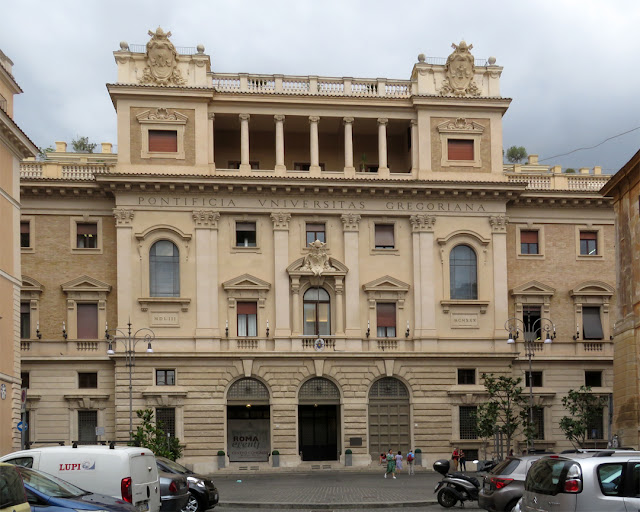
Università Gregoriana
Pontificia Università Gregoriana (Pontifical Gregorian University)
Piazza della Pilotta
Rome, September 2019
“The Pontifical Gregorian University (Italian: Pontificia Università Gregoriana; also known as the Gregorian or Gregoriana) is a higher education ecclesiastical school (pontifical university) located in Rome, Italy. The Gregorian originated as a part of the Roman College, founded in 1551 by Ignatius of Loyola, and included all grades of schooling. Its chairs of philosophy and theology received given Papal approval in 1556, making it the first institution founded by the Society of Jesus (Jesuits). In 1584, the Roman College was given a new home by Pope Gregory XIII, after whom it was renamed the Gregorian University. It had distinguished scholars in ecclesiastical fields as well as in natural science and mathematics. Only the theology and philosophy departments of the Gregorian survived the political turmoil in Italy after 1870. Today, the Gregorian has an international faculty and around 2,750 students from over 150 countries.” (Pontifical Gregorian University, Wikipedia)
Sunday, March 6, 2022
Altare della Patria
Altare della Patria (Altar of the Fatherland) by Giuseppe Sacconi, 1911
Piazza Venezia
Rome, September 2019
“The Victor Emmanuel II National Monument (Italian: Monumento Nazionale a Vittorio Emanuele II), also known as the Mole del Vittoriano or simply Vittoriano, is a large national monument built between 1885 and 1935 to honour Victor Emmanuel II, the first king of a unified Italy, in Rome, Italy. It occupies a site between the Piazza Venezia and the Capitoline Hill. It is currently managed by the Polo Museale del Lazio and is owned by the Ministry of Cultural Heritage and Activities. From an architectural perspective, it was conceived as a modern forum, an agora on three levels connected by stairways and dominated by a portico characterized by a colonnade. The complex process of national unity and liberation from foreign domination carried out by King Victor Emmanuel II of Savoy, to whom the monument is dedicated, has a great symbolic and representative value, being architecturally and artistically centred on the Italian unification—for this reason the Vittoriano is considered one of the national symbols of Italy. It also preserves the Altar of the Fatherland (Italian: Altare della Patria), first an altar of the goddess Rome, then also a shrine of the Italian Unknown Soldier, thus adopting the function of a lay temple consecrated to Italy. Because of its great representative value, the entire Vittoriano is often called the Altare della Patria, although the latter constitutes only a part of the monument.” (Victor Emmanuel II Monument, Wikipedia)
Monday, February 28, 2022
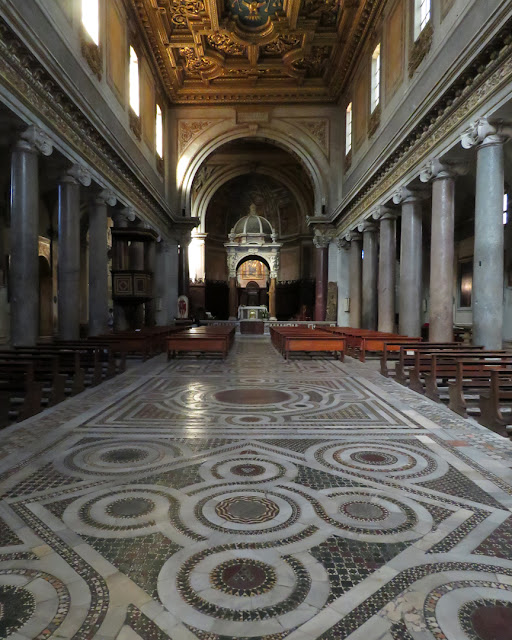
San Crisogono
Basilica di San Crisogono (Basilica of Saint Chrysogonus)
Piazza Sidney Sonnino
Rome, September 2019
“San Crisogono is a church in Rome (rione Trastevere) dedicated to the martyr Saint Chrysogonus. It was one of the tituli, the first parish churches of Rome, and was probably built in the 4th century under Pope Sylvester I (314–335), rebuilt in the 12th century by John of Crema, and again by Giovanni Battista Soria, funded by Scipione Borghese, in the early 17th century. The area beneath the sacristy was investigated by Fr. L. Manfredini and Fr. C. Piccolini in 1907. They found remains of the first church (see below). After they had made this discovery, the area was excavated and studied. The church is served by Trinitarians. Among the previous Cardinal Priests was Vincenzo Gioacchino Raffaele Luigi Pecci (1853–1878), elected Pope Leo XIII.” (San Crisogono, Wikipedia)
Tuesday, February 22, 2022
Invisible Man
Invisible Man by Yinka Shonibare, 2018
MAXXI - Museo nazionale delle arti del XXI secolo
(MAXXI - National Museum of 21st Century Art)
Via Guido Reni
Rome, September 2019
Wednesday, February 16, 2022
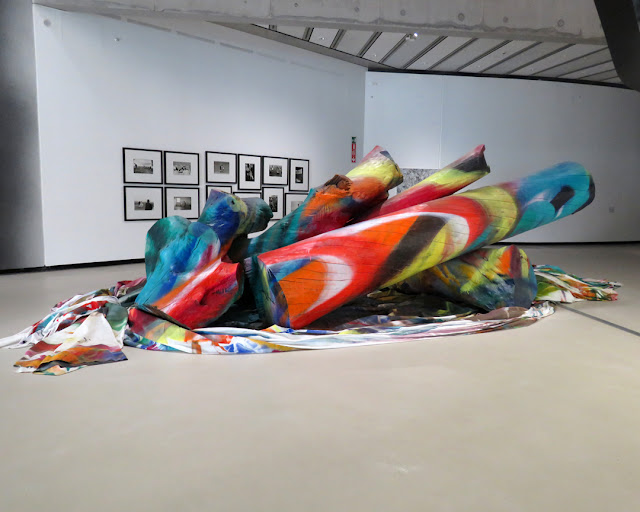
Ingres Wood Seven
Ingres Wood Seven by Katharina Grosse, 2018
MAXXI - Museo nazionale delle arti del XXI secolo
(MAXXI - National Museum of 21st Century Art)
Via Guido Reni
Rome, September 2019
Thursday, February 10, 2022
Mareo Merz
Mareo Merz by Elisabetta Benassi, 2013
MAXXI - Museo nazionale delle arti del XXI secolo
(MAXXI - National Museum of 21st Century Art)
Via Guido Reni
Rome, September 2019
Saturday, January 29, 2022
Painting and piano
“Cosmosi” by Pablo Echaurren
Auditorium Parco della Musica
Via de Coubertin
Rome, September 2019
“Pablo Echaurren (Rome, 22 January 1951) is an Italian painter, comics artist and writer. He is the son of Chilean surrealist painter Roberto Matta and Italian actress Angela Faranda. His surname stems from a clerical error in the civil registry office, which was eventually corrected, but Echaurren continued to use the name professionally. Despite being Roberto Matta's son, Gianfranco Baruchello was Echaurren’s real art mentor. Baruchello introduced him to Arturo Schwarz who became his first manager. Since the early 1970s, Echaurren has exhibited his work in Italy and abroad. In the 1980s and 1990s he produced numerous avant-garde comics such as Caffeina d’Europa (a work devoted to Marinetti’s life, and one of his first graphic novels), Majakovskij, Nivola vola, Futurismo contro, Vita disegnata di Dino Campana, Evola in Dada, Vita di Pound, Dada con le zecche.” (Pablo Echaurren, Wikipedia)
Sunday, January 23, 2022
Ad tenendam propositam spem
“Ad tenendam propositam spem” (Let us hold fast the confession of our hope)
(From the ‘Epistle to the Hebrews’)
Santa Croce in Via Flaminia
Via Guido Reni
Rome, September 2019
“Santa Croce in Via Flaminia is a basilica church dedicated to the Holy Cross on the Via Flaminia in Rome, Italy. Sacred Military Constantinian Order of Saint-George has its seat there.It was first built in 1913 by the architect Aristide Leonori for Pope Pius X, in celebration of the 1600th anniversary of the Edict of Milan. In the style of a Roman basilica, it has a mosaic-decorated facade, a portico with six Doric columns and a mosaic by Biagio Biagetti, a five-storey bell tower and a three-aisled nave divided by six columns of Bavarian granite on each side. It was opened for worship on 12 July 1914, and granted to the Congregation of the Sacred Stigmata (Stigmatines), but was not consecrated until 1918 (by Giuseppe Pallica, Titular Archbishop of Philippi). In 1954, Pope Pius XII made it an alternative station church for Friday of the Fifth Week of Lent. Pope Paul VI elevated it to the status of Minor Basilica in 1964.” (Santa Croce in Via Flaminia, Wikipedia)
Monday, January 17, 2022
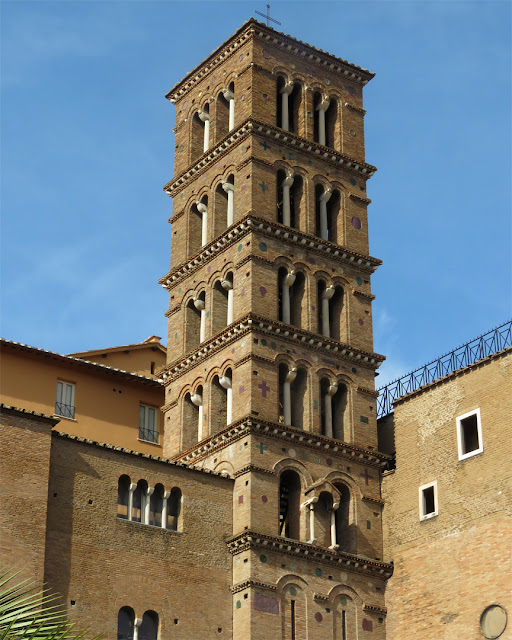
Medieval belfry
The tallest medieval belfry in Rome
Basilica of Saint Mary in Cosmedin
Piazza della Bocca della Verità
Rome, September 2019
“In the portico of the church, on the north side, can be found La Bocca della Verità, an ancient sculpture thought to be a drain covering. A legend states that, if a person places his hand inside the mouth (bocca) and then swears falsely, the mouth will close and sever the hand. There is no attested case of such an event taking place. The church's bell tower is the tallest medieval belfry in Rome. The current interior of S. Maria in Cosmedin has a nave with two aisles: these are divided by four pilasters and eighteen ancient columns. Built into the side walls, some of the old columns of the Statio Annonae are visible. Other fragments of the ancient building can be seen in the crypt. Paintings from the 8th-12th centuries, in three layers, are preserved in the upper part of the nave and in the triumphal arch. The church has a very fine Cosmatesque pavement. The schola cantorum is from the 13th century, while the main altar is a red granite piece from 1123. The Easter candelabrum is also from the 13th century.” (Santa Maria in Cosmedin, Wikipedia)
Tuesday, January 11, 2022
MAXXI
MAXXI - Museo nazionale delle arti del XXI secolo
(MAXXI - National Museum of 21st Century Art)
Via Guido Reni
Rome, September 2019
“MAXXI (Italian: Museo nazionale delle arti del XXI secolo, "national museum of 21st-century arts") is a national museum of contemporary art and architecture in the Flaminio neighborhood of Rome, Italy. The museum is managed by a foundation created by the Italian ministry of cultural heritage. The building was designed by Zaha Hadid, and won the Stirling Prize of the Royal Institute of British Architects in 2010.” (MAXXI, Wikipedia)
Wednesday, January 5, 2022
Bell tower
Bell tower
Basilica of Saints John and Paul on the Caelian Hill
Piazza dei Santi Giovanni e Paolo
Rome, September 2019
“The Basilica of Saints John and Paul on the Caelian Hill is an ancient basilica church in Rome, located on the Caelian Hill. The church was built in 398, by will of the senator Pammachius, over the home of two Roman soldiers, John and Paul, martyred under the emperor Julian in 362. The church was thus called the Titulus Pammachii and is recorded as such in the acts of the synod held by Pope Symmachus in 499. The church was damaged during the sack by Alaric I (410) and because of an earthquake (442), restored by Pope Paschal I (824), sacked again by the Normans (1084), and again restored, with the addition of a monastery and a bell tower.” (Santi Giovanni e Paolo al Celio, Wikipedia)
Thursday, December 30, 2021
Piazza del Parlamento
Staircase with marble groups by Domenico Trentacoste, 1913
Palazzo Montecitorio
Piazza del Parlamento
Rome, September 2019
“The return of the Chamber of Deputies to the palace followed extensive renovations, which left only the facade intact. The architect, Ernesto Basile, was an exponent of Art nouveau, known in Italy as Liberty style. He reduced the courtyard, demolished the wings and rear of the palace, constructing a new structure dominated by four red-brick and travertine towers at the corners. Basile also added the so-called Transatlantico, the long and impressive salon which surrounds the debating chamber and now acts as the informal centre of Italian politics.” (Palazzo Montecitorio, Wikipedia)
Friday, December 24, 2021
Deer head
Deer head with a cross by Paolo Morelli
Basilica di Sant'Eustachio (Basilica of Saint Eustace)
Piazza di Sant'Eustachio
Rome, September 2019
“On top is a triangular pediment with in its middle a circular window surrounded with palm branches and surmounted by a crown. On top of the pediment stands a deer head with a cross between the antlers (done by the sculptor Paolo Morelli († 1719), in reference to the legend of Saint Eustace.” (Sant'Eustachio, Wikipedia)
Saturday, December 18, 2021
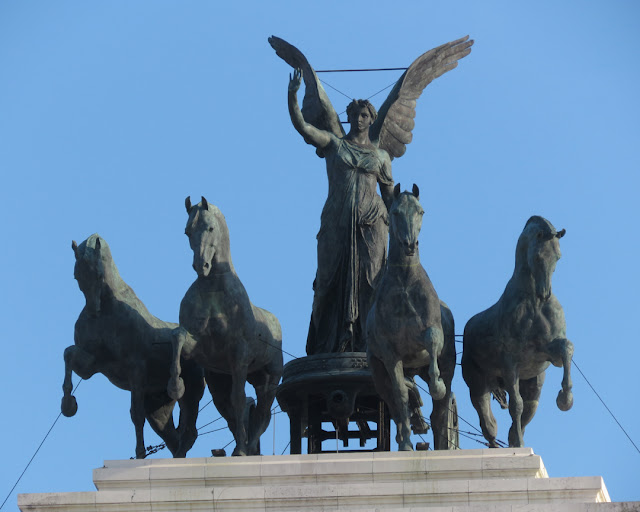
The Quadriga of Liberty
The Quadriga of Liberty by Luigi Bartolini, 1927
Victor Emmanuel II Monument
Piazza Venezia
Rome, June 2019
“At 11 metres tall, the Quadriga soars over the western propylaeum of the monument, its silhouette, inspired by ancient Greek models, stands out against the Roman sky. The Quadriga of Liberty, which is over 11 metres tall, was made of bronze by the Roman sculptor Paolo Bartolini. After winning the special competition in 1907, Bartolini began working on the piece in 1909. However, final delivery and assembly of the work of art were not completed until 1927. Liberty is represented as a Victory with outstretched wings, her head surrounded by a band, known as a taenia, with a laurel wreath in one hand and a spear in the other; she is standing on a wagon pulled by four majestic horses. The model for the female figure is the Lemnian Athena, which, since antiquity, has been considered the masterpiece of the great Greek sculptor Fidia: Bartolini was able to study it closely through a cast of the preserved copy in Dresden.” (The Quadriga of Liberty, Vittoriano)
Sunday, December 12, 2021
The Quadriga of Unity
The Quadriga of Unity by Carlo Fontana, 1927
Victor Emmanuel II Monument
Piazza Venezia
Rome, June 2019
“All of Rome at your feet: this is the Terrace of the Quadrigae. At the end of an exciting ride, the panoramic lifts take you to the top of the Vittoriano, with a 360° view of the Eternal City. The terrace takes its name from the two 11-metre-high bronze quadrigae located on the top of the two propylaea. The Quadriga of Unity, to the east, was made of bronze by the sculptor from Carrara, Carlo Fontana (1909-1927). Unity is represented as a classical Victory with outstretched wings and a laurel wreath, standing on a chariot pulled by four horses that stride forward in a dignified manner. The western end is dominated by the Quadriga of Liberty made of bronze by the Roman sculptor, Paolo Bartolini (1909-1927). Liberty is also represented as a Victory with outstretched wings, her head surrounded by a band, known as a taenia, with a laurel wreath in one hand and a spear in the other; she is standing on a chariot pulled by four majestic horses.” (Terrace of the Quadrigae, Vittoriano)
Subscribe to:
Posts (Atom)