Showing posts with label Barcelona. Show all posts

Saturday, April 30, 2022

Homenatge a Picasso

Homenatge a Picasso (Tribute to Picasso) by Antoni Tàpies, Passeig de Picasso, Barcelona

“Homenatge a Picasso” (Tribute to Picasso) by Antoni Tàpies, 1981
Passeig de Picasso
Barcelona, March 2017

“In 1981, Antoni Tàpies was commissioned by Barcelona City Council to create a monument to Picasso, which was to stand at the junction of Passeig de Picasso and the pedestrian area that links the Santa Maria del Mar area with Ciutadella Park. To this end, the artist designed an assemblage of furniture in a modernista style-a piece of furniture that is a sofa, mirror and cupboard combined, cut through by iron beams painted white, that calls to mind the period that Picasso spent living in Barcelona-that suggest the industrial Barcelona of the time. The conformist nature of a well-to-do society and the rebellion of another society in the throes of change are contrasted, thereby alluding in a symbolic way to Picasso's non-conformism. Chairs piled on top of each other, tied together with ropes, white blankets laid out that carry quotations by Picasso at the bottom-in particular, the phrase that reads ‘a painting is not intended to decorate a drawing room but is instead a weapon of attack and defence against the enemy’, a declaration of principles that Tàpies adopts as his own in this monument and in his entire oeuvre-complete the work. A glass cube measuring 4 metres along each side covers the sculpture to protect it from the elements and seems to emerge from a square pool measuring 11 metres along each edge that acts as a base. Water emerges from the top of the cube and runs down its sides.” (Tribute to Picasso, Fundació Antoni Tàpies)

Sunday, April 24, 2022

Evocació marinera

Evocació marinera (Evocation of Seafaring) by Josep Maria Subirachs, Plaça del Mar, Barceloneta, Barcelona

“Evocació marinera” (Evocation of Seafaring) by Josep Maria Subirachs, 1960
Plaça del Mar, Barceloneta
Barcelona, March 2017

“His leap into full-on abstraction—a development that, while well underway beyond Spain’s borders, represented nothing less than profanity to the tightly controlled, Neo-Classical aesthetic of Francoist Spain—came with Forma 212 (Form 212, 1957), the first abstract sculpture to be displayed publicly in Barcelona. It is installed outside Llars Mundet, close to Joan Brossa’s Visual Poem. Being fairly well out of the public eye, that sculpture ducked any polemic; so it was his second abstract work, Evocació marinera (Evocation of Seafaring), begun in 1958, which attracted the ire of the conservatives. The piece was originally sited in front of the Naval Authority—akin to kicking the hornet’s nest of the ageing Francoist dictatorship, so it was quickly moved to its current location. The piece is not meant to be a simple evocation of the sea, but of our seafaring past. Hence it aims to do more than just replicate marine motifs but rather pay tribute to human beings’ fight for survival in and dominance of this vital environment. So its spiked forms conjure ships’ prows, sails and peaking waves which threaten to break over fragile craft, while the sculpture’s surface texture recalls the degradation of bleached timbers, rotted by the elements.” (Controversy in every angle, Barcelona Free Art)

Monday, April 18, 2022

Fuente de Santa Eulalia

Fuente de Santa Eulalia, Plaça del Pedró, El Raval, Barcelona

Fuente de Santa Eulalia, 1673
Plaça del Pedró, El Raval
Barcelona, March 2017

Tuesday, April 12, 2022

Sala Hipóstila

Sala Hipóstila or Sala de las Cien Columnas, Parc Güell (Park Güell), Carmel Hill, Barcelona

Sala Hipóstila or Sala de las Cien Columnas
Parc Güell (Park Güell)
Carmel Hill
Barcelona, March 2017

“Following the stairs you go through a large porch that have eighty-six columns that supports a large square. The roof is covered with brittle and white uniform, but it is not plain, is sinking between column and column. In the middle there are fourteen brittle, spread unevenly. In spaces where there is no brittle medallions. The columns are also covered with white brittle at the bottom. There is no column with a right angle respect the soil, anyone has the same inclination. But not only support for the square, also serve as drains, all the rainwater that collects the square, is filtered, going through the columns and go to a chamber that serves as a reservoir, under the room. Where it is stored. The porch had been thought as a market of the garden city, but was never opened, not even build. Above the porch is a square of sand enclosed by a bank of style completely Gaudínian, which is shaped like a snake and is completely covered with brittle. This place has good views over Barcelona.” (Nature square and the Hipostila room, Park Güell)

Wednesday, April 6, 2022

Casa Batlló

Detail of the facade, Casa Batlló by Antoni Gaudí, Passeig de Gràcia, Barcelona

Detail of the facade
Casa Batlló by Antoni Gaudí, 1909
Passeig de Gràcia
Barcelona, March 2017

“The façade has three distinct sections which are harmoniously integrated. The lower ground floor with the main floor and two first-floor galleries are contained in a structure of Montjuïc sandstone with undulating lines. The central part, which reaches the last floor, is a multicolored section with protruding balconies. The top of the building is a crown, like a huge gable, which is at the same level as the roof and helps to conceal the room where there used to be water tanks. This room is currently empty. The top displays a trim with ceramic pieces that has attracted multiple interpretations.” (Casa Batlló, Wikipedia)

Thursday, March 31, 2022

Carrer de les Egipcíaques

Carrer de les Egipcíaques, El Raval, Barcelona

Carrer de les Egipcíaques
El Raval
Barcelona, March 2017

“On Egipcíaques Street, there was established, in 1670, a convent for women of ‘bad reputation’ which, having had a libertine life, hoped to distance themselves from vice and live out a life of exemplary conduct, as did Saint Mary Egipcíaca from whom the convent got its name. In 1679, the Casa de les Egipcíaques (House of the Egipcíaques) was also referred to as the ‘monastery of damsels’ or ‘room of damsels’ and used as a women's prison. Today, the building in Egipcíaques street dates from 1952 and 1954 and it is the headquarters of the Spanish Scientific Reasearch Council in Catalonia.” (Convent de les Egipcíaques, Route You)

Friday, March 25, 2022

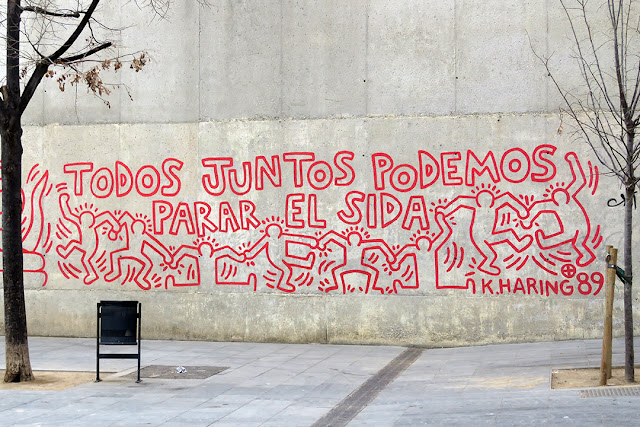
Todos juntos

Todos juntos podemos parar el sida (Together We Can Stop AIDS) by Keith Haring, Plaça de Joan Coromines, Barcelona

“Todos juntos podemos parar el sida”
(Together We Can Stop AIDS) by Keith Haring, 1989
Plaça de Joan Coromines
Barcelona, March 2017

“Todos Juntos Podemos Parar el SIDA (English: Together We Can Stop AIDS) is a mural created by American artist and social activist Keith Haring in 1989. The mural was painted to raise awareness to the Aids epidemic. It is located next to the Museu d'Art Contemporani de Barcelona museum in the El Raval neighborhood of Barcelona.” (Todos Juntos Podemos Parar el SIDA, Wikipedia)

Saturday, March 19, 2022

Santa Maria de Montalegre

Santa Maria de Montalegre, Carrer de Valldonzella, Barcelona

Santa Maria de Montalegre
Carrer de Valldonzella
Barcelona, March 2017

“The construction of the church was carried out in 1901-1902 on the site of the old chapel. The opening of the shrine took place to commemorate the centenary of the House of Mercy. During the Spanish Civil War, the church was damaged and used as a hospital and grocery store. Then the restoration of the shrine was carried out, and the opening took place in 1940. In 1952, on the occasion of the 150th anniversary of the Casa de la Caritate and the 50th anniversary of the church, the current image of the presbytery, created by Jaume Busquets y Mollera, was installed. Today the church has a Roman cross in the plan. It stands out with rosette windows and a monumental arched portal (entrance). Casa de la Caritat is a renovated complex of buildings in a modernist style with a courtyard. The premises currently house a cultural complex consisting of various institutions.” (Church of St. Mary in Barcelona, life-globe.com)

Sunday, March 13, 2022

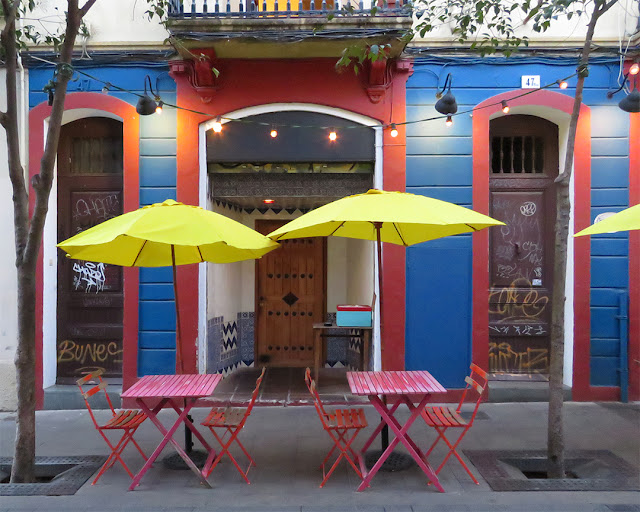
Cantina Machito

Cantina Machito, Carrer de Torrijos, Gràcia, Barcelona

Cantina Machito
Carrer de Torrijos, Gràcia
Barcelona, March 2017

Monday, March 7, 2022

Llibreria Pròleg

Llibreria Pròleg (Bookstore), Carrer de Sant Pere Més Alt, Barcelona

Llibreria Pròleg (Bookstore)
Carrer de Sant Pere Més Alt
Barcelona, March 2017

“The Llibreria Pròleg bookshop is Barcelona's epicenter of feminism and the struggle for equal rights and opportunities for women in the city. Since 2009 it has occupied this location in Carrer Sant Pere Més Alt. Pròleg is much more than a bookstore with books about women and by women. Open and critical in its approach, here we can find books for children and young people that are free of sexist criteria, an exhaustive essay section, and even interesting workshops and collective activities.” (Llibreria Pròleg, Visit Barcelona)

Tuesday, March 1, 2022

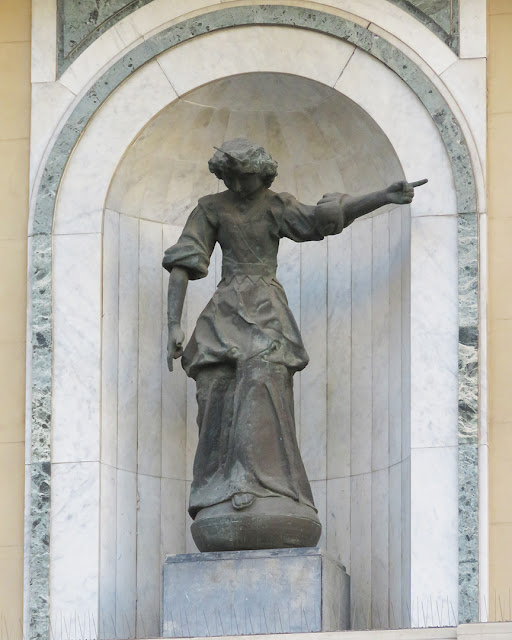
Ángel

Ángel (The Angel) by Felip Ros, Copy by Ángel Ferrant, Plaça de l'Àngel, Barcelona

Ángel (The Angel) by Felip Ros, 1618
Copy by Ángel Ferrant, 1966
Plaça de l'Àngel
Barcelona, March 2017

Wednesday, February 23, 2022

A López y López

A López y López (El Negro Domingo) by Venancio Vallmitjana, Replica made in the 1940s by Frederic Marès, removed in 2018, Plaça d'Antonio López (Now Plaça d’Idrissa Diallo i Correus), Barcelona

A López y López (El Negro Domingo) by Venancio Vallmitjana, 1884
Replica made in the 1940s by Frederic Marès, removed in 2018
Plaça d'Antonio López (Now Plaça d’Idrissa Diallo i Correus)
Barcelona, March 2017

Thursday, February 17, 2022

Antoni Rovira i Trias

Antoni Rovira i Trias by Joaquim Camps, Plaça de Rovira i Trias, Barcelona

Antoni Rovira i Trias by Joaquim Camps, 1990
Plaça de Rovira i Trias
Barcelona, March 2017

“Antoni Rovira i Trias (1816 in Barcelona – 1889 in Barcelona) was a Catalan architect, urban planner and founder of several associations, among them Societat Filomàtica de Barcelona. He is known as the architect of several buildings in Barcelona, among them the markets of Barceloneta (1873), La Concepció (1885; on career d'Aragó), El Born (1876) and Sant Antoni (1879). He is also responsible for the Passatge del Comerç (1855), Teatre Circ Barcelonès (1853) and the construction of the loggia of Palau Moja (1856) and, vital to the development of the city, the demolition of the Ciutadella, the 18th-century military citadel. His radial urban plan for Barcelona, under the name Le tracé d’une ville est oeuvre du temps plutôt que d’architecte rivalled with Ildefons Cerdà's, and won the 1859 municipal contest by city council's decree, but the central Spanish government in Madrid favoured Cerdà's over his, and construction started the following year. Eventually, however, Cerdà's plan would remain unfulfilled. Rovira's plan, and to a large degree himself too, were long forgotten until recently, when a book was published focusing on Rovira's egalitarian approach to urban planning, and small but meaningful details for which he was responsible.” (Antoni Rovira i Trias, Wikipedia)

Friday, February 11, 2022

MNAC

Museu Nacional d'Art de Catalunya, Palau Nacional, Montjuïc, Barcelona

Museu Nacional d'Art de Catalunya
(National Art Museum of Catalonia)
Palau Nacional, Montjuïc
Barcelona, March 2017

“The Museu Nacional d'Art de Catalunya (National Art Museum of Catalonia), abbreviated as MNAC, is a museum of Catalan visual art located in Barcelona, Catalonia, Spain. Situated on Montjuïc hill at the end of Avinguda de la Reina Maria Cristina, near Pl Espanya, the museum is especially notable for its outstanding collection of romanesque church paintings, and for Catalan art and design from the late 19th and early 20th centuries, including modernisme and noucentisme. The museum is housed in the Palau Nacional, a huge, Italian-style building dating to 1929. The Palau Nacional, which has housed the Museu d'Art de Catalunya since 1934, was declared a national museum in 1990 under the Museums Law passed by the Catalan Government. That same year, a thorough renovation process was launched to refurbish the site, based on plans drawn up by the architects Gae Aulenti and Enric Steegmann, who were later joined in the undertaking by Josep Benedito. The Oval Hall was reopened in 1992 on the occasion of the Olympic Games, and the various collections were installed and opened over the period from 1995 (when the Romanesque Art section was reopened) to 2004. The Museu Nacional d'Art de Catalunya (Museu Nacional) was officially inaugurated on 16 December 2004. It is one of the largest museums in Spain.” (Museu Nacional d'Art de Catalunya, Wikipedia)

Saturday, February 5, 2022

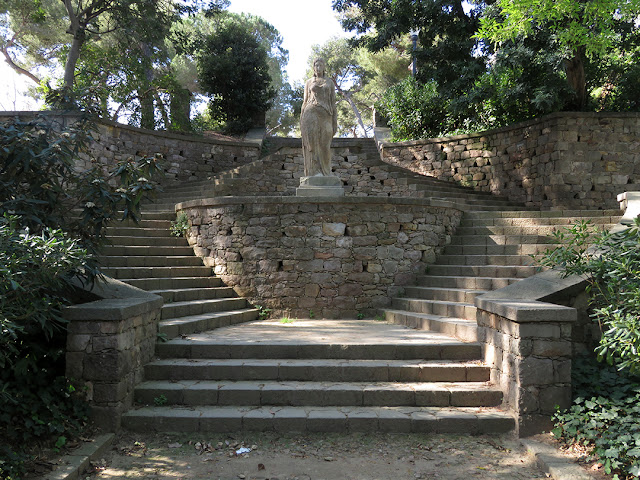
Staircase by Forestier

Staircase by Jean-Claude Nicolas Forestier, Jardins de Laribal, Montjuïc, Barcelona

Staircase by Jean-Claude Nicolas Forestier
Jardins de Laribal, Montjuïc
Barcelona, March 2017

“Jean-Claude Nicolas Forestier (9 January 1861 in Aix-les-Bains – 26 October 1930 in Paris) was a French landscape architect, who trained with Adolphe Alphand and became conservator of the promenades of Paris. He developed an arboretum at Vincennes and the gardens of the Champ-de-Mars below the Eiffel Tower. In 1925 he became Inspector of Gardens for the International Exhibition of Decorative Arts and undertook projects in the Americas.” (Jean-Claude Nicolas Forestier, Wikipedia)

Sunday, January 30, 2022

4 ales

4 ales (4 wings) by Alexander Calder, Joan Miró Foundation, Jardins de Laribal, Montjuïc, Barcelona

“4 ales” (4 wings) by Alexander Calder, 1972
Joan Miró Foundation
Jardins de Laribal, Montjuïc
Barcelona, March 2017

Monday, January 24, 2022

Personnage

Personnage by Joan Miró, Joan Miró Foundation, Jardins de Laribal, Montjuïc, Barcelona

“Personnage” by Joan Miró, 1970
Joan Miró Foundation
Jardins de Laribal, Montjuïc
Barcelona, March 2017

Tuesday, January 18, 2022

Statue of Dante

Statue of Dante Alighieri by Cesare Zocchi, Jardins de Joan Brossa, Plaça de Dante, Montjuïc, Barcelona

Statue of Dante Alighieri by Cesare Zocchi
Jardins de Joan Brossa
Plaça de Dante, Montjuïc
Barcelona, March 2017

Wednesday, January 12, 2022

Esdeveniments Esferic Barcelona

Esdeveniments Esferic Barcelona, Jardins de Joan Brossa, Plaça de Dante, Montjuïc, Barcelona

Esdeveniments Esferic Barcelona
Jardins de Joan Brossa
Plaça de Dante, Montjuïc
Barcelona, March 2017

Thursday, January 6, 2022

Telefèric de Montjuïc

Telefèric de Montjuïc (Montjuïc Cable Car), Montjuïc, Barcelona

Telefèric de Montjuïc (Montjuïc Cable Car)
Montjuïc
Barcelona, March 2017

“The Montjuïc Cable Car (officially Telefèric de Montjuïc, in Catalan) is a gondola lift in Barcelona, Catalonia, Spain. The cable car runs from a lower terminus adjacent to the Montjuïc Park upper station of the Montjuïc funicular, and climbs higher up the Montjuïc hill to a terminal near the Montjuïc Castle on the summit of the hill. At its midpoint, the line executes a 90 degree turn and the cabins pass through Mirador station, although only down-bound cabins stop at this point. The cable car was originally put into service in 1970, replacing a former upper stage of the Montjuïc funicular. As built, it used a fleet of open cars. It was closed between October 2004 and May 2007, for a complete overhaul in order to increase capacity. At the same time the open cars were replaced by 55 new closed cabins. The cable car line is 752 m (2,467 ft) in length, and climbs a vertical distance of 84.55 m (277.4 ft) at a speed of 2.5 m/s (8.2 ft/s). The cars slow to a crawl as they pass through the station to allow passengers to board or exit. Two cars are equipped with the facility to carry wheelchairs. The line is operated by Transports Metropolitans de Barcelona (TMB) but, unlike the Montjuïc funicular, it is not part of Autoritat del Transport Metropolità (ATM) integrated fare network. Separate tickets must be purchased prior to boarding. Access to the castle is also available from the top funicular station via the 150 bus which is included in the ATM integrated fare network. The Montjuïc Cable Car should not be confused with the Port Vell Aerial Tramway, which crosses Port Vell, Barcelona's old harbour, and connects the Montjuïc hill with the seaside suburb of Barceloneta.” (Montjuïc Cable Car, Wikipedia)