Tuesday, September 14, 2021

Font de Santa Ana

Font de Santa Ana (Fountain of Santa Ana), Carrer dels Arcs, Barcelona

Font de Santa Ana (Fountain of Santa Ana), 1356
Carrer dels Arcs
Barcelona, March 2017

“El Font de Santa Ana dates back to 1356 and is the oldest fountain in Barcelona. Installed in a small square next to the Portal dels Orbs. Initially, it was just a large stone trough used to water animals. In 1375 a fountain was added to supply drinking water to the city’s human population. The hexagonal stone structure which stands today was built in 1819. The decorative blue and white tiles and green ceramic vases were added in 1918. Nowadays drinking water comes from two brass taps but originally it would have spouted from the carved stone faces on each side of the fountain.” (Medieval Fountains, Barcelona Lowdown)

Monday, September 13, 2021

Brass head

Brass head on a front door, Via Castiglione 13, Bologna

Brass head on a front door
Via Castiglione
Bologna, June 2015

Sunday, September 12, 2021

Crash

Car crashed into a traffic sign, Franz-Josefs-Kai, Vienna

Car crashed into a traffic sign
Franz-Josefs-Kai
Vienna, June 2018

Saturday, September 11, 2021

Window flower box

Window flower box, Old Church Street, Chelsea, London

Window flower box
Old Church Street, Chelsea
London, September 2014

Friday, September 10, 2021

Genova Piazza Principe

Genova Piazza Principe railway station, seen from Ponte Umberto Pini, Genoa

Genova Piazza Principe railway station
Seen from Ponte Umberto Pini
Genoa, April 2016

“Genova Piazza Principe railway station (commonly called Genova Principe or incorrectly Genova Porta Principe) is the central station of Genoa and is located on Piazza Acquaverde, occupying the entire north side of Via Andrea Doria—where the station entrance is located—in the town centre and a short distance from the Palazzo del Principe, from which it takes its name. It is used by about 66,000 passengers per day and 24,000,000 per year. The first temporary station was opened in 1854 at the end of the line from Turin. Lines were later opened to Milan, Rome and the French border at Ventimiglia.” (Genova Piazza Principe railway station, Wikipedia)

Thursday, September 9, 2021

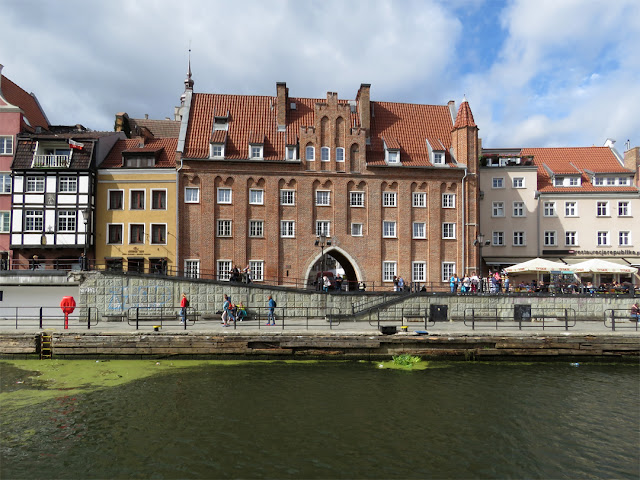
Brama Chlebnicka

Brama Chlebnicka, Długie Pobrzeże, ulica Chlebnicka, Gdańsk

Brama Chlebnicka (Bread Gate)
Długie Pobrzeże / ulica Chlebnicka
Gdańsk, September 2018

“Of all the gateways in Gdańsk, it’s this one that’s the best preserved, and that’s no small feat considering the pounding the Russians gave the city at the end of the war. Thought to have been completed in 1450, this signature piece of the Gothic-style features curved cornices and a pointy arch and, upon closer inspection on the waterfront's side, you can find the oldest coat of arms on show in the city - a crest of two silver crosses imposed on a red shield, which was added in 1457. That’s not the only piece of identification stamped on the structure. Duck through the passage and you’ll find a lily, once the symbol of the Dukes of Pomerania.” (Chlebnicka Gate, In Your Pocket)

Wednesday, September 8, 2021

St. Francis de Sales

Church of Sant Francesc de Sales by Joan Martorell, Passeig de Sant Joan, Barcelona

Church of Sant Francesc de Sales by Joan Martorell, 1885
Passeig de Sant Joan
Barcelona, March 2017

“In the middle of Passeig de Sant Joan Avenue, between the Valencia and Aragó streets, stands majestically one of the most beautiful examples of neogothic architecture in Barcelona. The current church of Sant Francesc de Sales was built between 1878 and 1885 as part of the convent of the Order of the Visitation of Holy Mary. After the abandonment of the convent in 1936 by the Salesian nuns, the building was converted into a religious college and later into a parish church. This construction of great elegance and beauty is considered as the most important work of the architect Joan Martorell y Montells (1833-1906), born in Barcelona and Antoni Gaudí's teacher.The church has a single nave with the shape of a Latin cross, polygonal apse and a protruding dome. The materials used are very diverse: bricks, stone, ceramics. Highlights” (Sant Francesc de Sales Church, Turismo en Catalunya)