Showing posts with label gate. Show all posts

Thursday, July 9, 2026

Puerta de Alcalá

Puerta de Alcalá, Plaza de la Independencia, Madrid

Puerta de Alcalá
Plaza de la Independencia
Madrid, September 2025

“The Puerta de Alcalá is a Neo-classical gate in the Plaza de la Independencia in Madrid, Spain. It was a gate of the former Walls of Philip IV. It stands near the city center and several meters away from the main entrance to the Parque del Buen Retiro. The square is bisected by Alcalá Street, although the street does not cross through the monument, and it is the origin of the Alfonso XII, Serrano and Olózaga streets. Its name originates from the old path from Madrid to the nearby town of Alcalá de Henares. Madrid in the late 18th century still looked like a somewhat drab borough, surrounded by medieval walls. Around the year 1774, King Charles III commissioned Francesco Sabatini to construct a monumental gate in the city wall through which an expanded road to the city of Alcalá was to pass, replacing an older, smaller, gate that stood nearby. It was inaugurated in 1778. The ornamental details were sculpted by Francisco Gutiérrez and Roberto Michel, and made of white stone from Colmenar. The architectural elements are chiefly made of granite from Segovia.” (Puerta de Alcalá, Wikipedia)

Sunday, June 14, 2026

Porta Leoni

Porta Leoni (Gate of the Lions), Via Leoni, Verona

Porta Leoni (Gate of the Lions)
Via Leoni
Verona, May 2025

“Porta Leoni (Gate of the Lions) is an ancient Roman gate in Verona, northern Italy. The gate was built during the Roman Republic by P. Valerius, Q. Caecilius, Q. Servilius and P. Cornelius, and restructured in imperial times. It was connected to the road which led to Bologna and Aquileia. The original Roman name is unknown. During the Middle Ages it was called Porta San Fermo, due to the nearby church, while in the Renaissance it was known as ‘Arco di Valerio’. The current name derives from a Roman tomb decorated with two lions (Italian: leoni), now moved near Ponte Navi. The gate has a square structures, with a double façade and two towers which looked towards the countryside. Now only half of the inner façade, covered with white stone in the imperial age, and the foundings are visible. The original decorations are all lost. The lower part is similar to that of Porta Borsari (also in Verona), while the upper part has an exedra with twisted columns.” (Porta Leoni, Wikipedia)

Monday, April 20, 2026

Puerta de San Vicente

Puerta de San Vicente, Glorieta de San Vicente, Madrid

Puerta de San Vicente
Glorieta de San Vicente
Madrid, September 2025

“The Puerta de San Vicente is a monumental gate located in the Glorieta de San Vicente in Madrid (Spain). Since 1995, it has occupied the space where the original door, designed by architect Francesco Sabatini, was located between 1775 and 1892. Throughout Madrid's history there have been several doors that have received the same name. In 1726, the Marquis of Vadillo, the town's mayor, commissioned Pedro de Ribera to build a monumental gate in the city's fence to replace a previous gate, which was in a dilapidated state and was called ‘del Parque’. The gate, which consisted of three arches, was decorated with a statue of San Vicente, which is why it was given that name, although it would also be known later as the gate of La Florida. It was demolished in 1770, due to the remodelling of the Cuesta de San Vicente (1767–1777), as part of the reorganisation of the western accesses to the Royal Palace and its connection with the Camino de El Pardo. Shortly afterwards, King Carlos III commissioned Francesco Sabatini to build a new gate to replace the previous one as the entrance to the city from the new Paseo de La Florida. The work was completed in 1775 and Sabatini placed an ornamental fountain next to it, popularly known as the Fuente de los Mascarones. The new gate was in its current location, closer to the river than the previous one. It consisted of an arch and two shutters (or portholes) and was built of granite and limestone from Colmenar de Oreja. The arch was decorated with two Doric columns on the outside and two pilasters, also Doric, on the inside. It was crowned by a triangular frontispiece finished with a military trophy. The lateral shutters were also crowned by military trophies. In front of it there were two buildings that also disappeared: the aforementioned Mascarones fountain, between 1775 and 1871, and the Washerwomen's Asylum promoted by María Victoria dal Pozzo, from 1872 to 1938.” (Puerta de San Vicente, Wikipedia)

Wednesday, April 1, 2026

Porta Ognissanti

Porta Ognissanti, Porta Portello, Via del Portello, Padua

Porta Ognissanti (Porta Portello)
Via del Portello
Padua, May 2025

“The Porta Ognissanti (Omnium Sanctorum in Latin, also called Portello Nuovo or Venezia, commonly Porta Portello) is one of the gates still existing within the sixteenth-century walls of Padua, built by the Serenissima Republic. It rises in the area of the city called Portello (that is ‘small port’, because this area hosted a sort of arrival - restored - for the boats that connected along the Riviera del Brenta Padua with Venice, but the recent hypothesis in deriving it from the fact that, previously to the current gate, there was a ‘Portello’ (a simple pedestrian gate or almost). The gate dates back to 1519, the year in which it took the place of the Portello Vecchio gate, located in today's Via San Massimo.” (Porta Ognissanti, Wikipedia)

Wednesday, March 4, 2026

Porta Borsari

Porta Borsari, Corso Porta Borsari, Verona

Porta Borsari
Corso Porta Borsari
Verona, May 2025

“Porta Borsari is an ancient Roman gate in Verona, northern Italy. The gate dates to the 1st century AD, though it was most likely built over a pre-existing gate from the 1st century BC. An inscription dating from emperor Gallienus' reign reports another reconstruction in 265 AD. The Via Postumia (which here became the decumanus maximus) passed through the gate, which was the city's main entrance and was therefore richly decorated. It also originally had an inner court, now disappeared. The gate's Roman name was Porta Iovia, as it was located near a small temple dedicated to Jupiter lustralis. In the Middle Ages it was called Porta di San Zeno, while the current name derives from the guard soldiers which were paid the dazio (Latin bursarii). The façade, in local white limestone, has two arches flanked by semi-columns with Corinthian capitals which supports entablature and pediment. In the upper part is a two-floor wall with twelve arched windows, some of which are included in small niches with triangular pediment.” (Porta Borsari, Wikipedia)

Friday, November 14, 2025

Kronentor

Kronentor (Crown Gate), Ostra-Allee, Dresden

Kronentor (Crown Gate)
Ostra-Allee
Dresden, September 2024

“The Kronentor is a pavilion and, alongside the Wallpavillon, the most well-known part of the Dresden Zwinger and is often depicted as the symbol. With its long galleries on either side, its frontage rests on the old fortress wall; however, the gate and galleries form a slight angle to it. The Crown Gate originally provided access from outside the city through the fortress wall via the Wallgraben Bridge. Therefore, there was no stone bridge over the Zwinger Moat to the Crown Gate, commensurate with the structure's importance, but only a narrow wooden footbridge, which would have been quickly dismantled in the event of an attack. It was rebuilt in this form when the Zwinger Moat was exposed and expanded in the 20th century.” (Kronentor, Wikipedia)

Tuesday, May 6, 2025

Schinkeltor

Schinkeltor (Schinkel Gate), Augustusplatz, Leipzig

Schinkeltor (Schinkel Gate)
Augustusplatz
Leipzig, September 2024

“The Schinkeltor (Schinkel Gate) at the west entrance to the New Augusteum of the University of Leipzig is the only surviving building fragment of the university complex on Augustusplatz from the 19th century. It is named after the Prussian architect Karl Friedrich Schinkel (1781–1841). It is a listed building.” (Schinkeltor, Wikipedia)

Sunday, April 13, 2025

Antica Porta San Donato

Antica Porta San Donato (Old San Donato's Gate), Piazzale San Donato, Lucca

Antica Porta San Donato (Old San Donato's Gate)
Piazzale San Donato
Lucca, June 2024

"The Antica Porta San Donato is a westward gateway in the ancient Walls of Lucca. Located on the left side of today's Piazzale Verdi, the gate was built in 1590 to a design by Matteo Civitali. The architect added to the construction a massive bulwark, since the medieval wall in this part of the city was considered weak. On the upper sides of the façade there are two marble statues of lions. The outer moat, that is still partially visible, was once fitted with a drawbridge. The fortification had a relatively short service life – only about 50 years, when the city's defensive system was expanded and the new Porta San Donato was built, between 1629 and 1639, leaving the old gate enclosed within the walls." (Old San Donato's Gate, GPSMyCity)

Saturday, March 22, 2025

Porta Camollìa

Porta Camollìa (Camollia Gate), Via Camollia, Siena

Porta Camollìa (Camollia Gate)
Via Camollia
Siena, April 2024

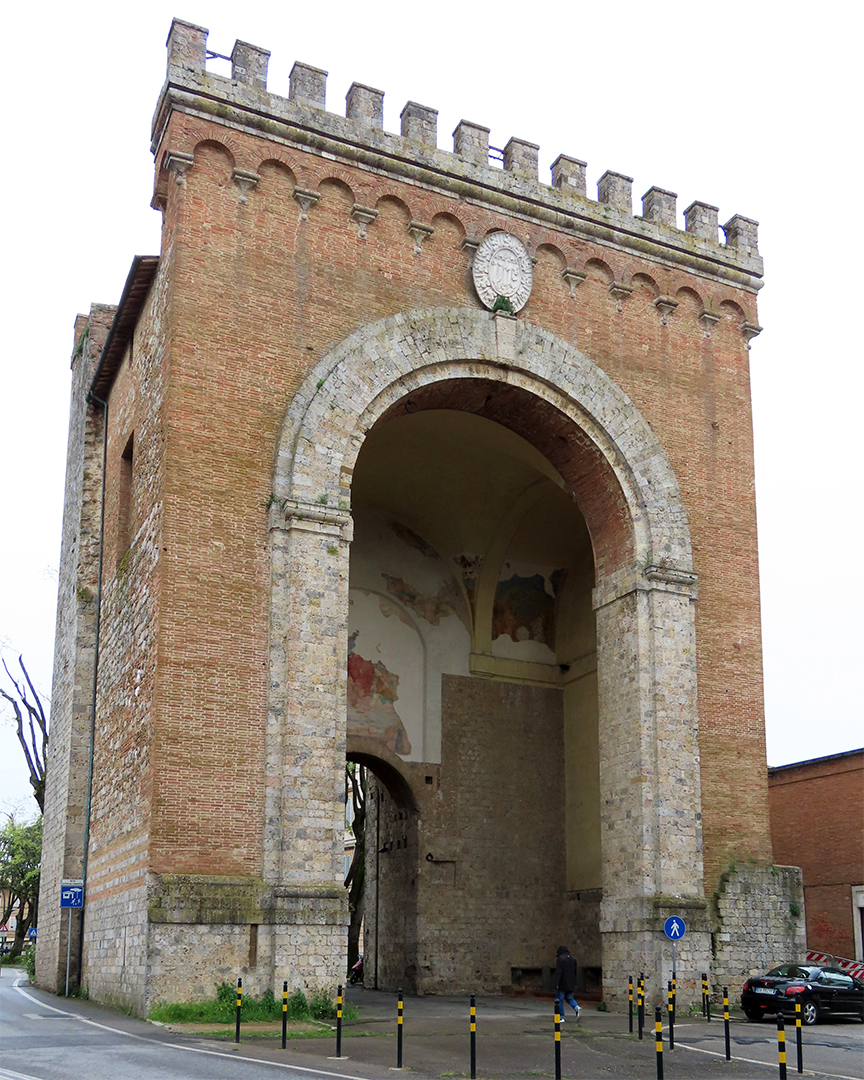
“Porta Camollìa is one of the northern portals in the medieval walls of Siena. It is located on via Camollia and opens inside the city into the Contrada of Istrice. Consisting of three arches; the inner arch is surmounted by a circular marble bas-relief with the Roman Catholic IHS Christogram inside a sun symbol (San Bernardino Christogram). The outer facade has the Medici heraldic shield with a stone arch added in 1604 by Alessandro Casolani and decorated by Domenico Cafaggi. The inscription was placed to record the entry of Ferdinand I de' Medici into Siena, and states ‘Cor magis tibi sena pandit’ (Siena shows a heart that is bigger than this gate). The two central figures hold the Medici coat of arms.” (Porta Camollia, Wikipedia)

Wednesday, March 12, 2025

Antiporto di Camollìa

Antiporto di Camollìa, Viale Vittorio Emanuele II, Siena

Antiporto di Camollìa
Viale Vittorio Emanuele II
Siena, April 2024

“Porta Camollia was not the only fortification built to defend the northern side of the city, always the most subject to attacks from the rival city of Florence. These two other fortresses were the Torrazzo di Mezzo and the Antiporto. The outermost gate of the city, also known as ‘Portone’ (gate) or ‘Portone dipinto’ (painted gate), now commonly called ‘Antiporto di Camollia’, according to documentary sources, was begun around 1270. It has long been believed that there was a fresco by Simone Martini inside the building. However, several petitions over the years, as early as 1300, have never highlighted works in this regard. The works of Giuseppe Nasini were absolutely real: in this grandiose portico he represented a sort of magical forest with the branches of the plants that, intertwining, formed circles with the coats of arms of the 17 districts inside. Despite the bombing of 1944 and the considerable damage suffered, these coats of arms of the districts survived, but what was not damaged by the war, was damaged did the man. With an ‘inappropriate’ restoration not many years ago, these drawings were definitively cancelled.” (Antiporto of Camollia, Nice Places)

Wednesday, March 27, 2024

Puerta de Bisagra Nueva

View from the inside, Puerta de Bisagra Nueva (New Bisagra Gate), Calle Real del Arrabal, Toledo

View from the inside
Puerta de Bisagra Nueva (New Bisagra Gate)
Calle Real del Arrabal
Toledo, September 2022

“The Puerta de Bisagra Nueva (The New Bisagra Gate) is the best known city gate of Toledo, Spain. The gate is of Moorish origin, but the main part was built in 1559 by Alonso de Covarrubias. It carries the coat of arms of the emperor Charles V. It superseded the Puerta Bisagra Antigua as the main entrance to the city.” (Puerta de Bisagra Nueva, Wikipedia)

Monday, December 25, 2023

Porta del Ponte

Porta del Ponte (Gate of the Bridge), Arch of Alberico I Cybo-Malaspina, Via San Martino, Massa

Porta del Ponte (Gate of the Bridge)
Arch of Alberico I Cybo-Malaspina
Via San Martino
Massa, April 2022

Saturday, September 23, 2023

Puerta del Cambrón

Puerta del Cambrón, Paseo Recaredo, Toledo

Puerta del Cambrón
Paseo Recaredo
Toledo, September 2022

“The Puerta del Cambrón is a gate located in the west sector of the Spanish city of Toledo, in Castile-La Mancha. Also called previously ‘Gate of the Jews’ or ‘Gate of Saint Leocadia’, has been speculated The possibility that the name of the gate, del Cambrón, had its origin in the growth of a thorn bush or plant at the top of the ruins of one of the towers, before the last reconstruction of the gate, In 1576. It has the cataloging of Bien de Interés Cultural. Of Renaissance style, has two pairs of towers and two arches, being built of stone and brick. It underwent two renovations in the early-1570s and in 1576. Hernán González, Diego de Velasco and Juan Bautista Monegro would sculpt a figure of Leocadia in the gate. The gate was little damaged during the Spanish Civil War.” (Puerta del Cambrón, Wikipedia)

Sunday, July 30, 2023

Porta Martana

Porta Martana, Piazza Martana, Massa

Porta Martana
Piazza Martana
Massa, April 2022

Friday, July 21, 2023

Puerta del Puente

Puerta del Puente (Gate of the Bridge), Plaza del Triunfo, Córdoba

Puerta del Puente (Gate of the Bridge)
Plaza del Triunfo
Córdoba, September 2022

“The Puerta del Puente (Gate of the Bridge) is a Renaissance gate in Córdoba, Andalusia. Built in the 16th century to commemorate a visit to the city by King Philip II, the gateway is located on the site of the previous Roman gates, linking the city with the Roman bridge and the Via Augusta. Since 1931, the gate, together with the Roman bridge and the Calahorra tower, has been declared a Bien de Interés Cultural in the monument category. It also part of the historic centre of Cordoba, declared a World Heritage Site in 1984.” (Puerta del Puente, Wikipedia)

Thursday, July 6, 2023

Arco del Salvatore

Arco del Salvatore (Arch of the Savior), Via Palestro, Massa

Arco del Salvatore (Arch of the Savior)
Via Palestro
Massa, April 2022

“The Arch of the Savior is an ‘improper’ gate, probably replacing an older one, which, as shown by the seventeenth-century iconography, was unusually placed a little externally with respect to the wall perimeter. It is located on the western edge of the city route, and its original function remains uncertain. The architectural layout is dominated by a ‘rustic’ language characterized by powerful projecting ashlars; above the camber of the arch there is a marble coat of arms, also scalloped. The upper part is characterized by a thick gable on which the statue of the Savior rests centrally, attributable to a prestigious Carrara workshop of the late seventeenth century. On the sides stand four small pyramids, also in white marble like the large plaque that recalls the embellishment of the door by Carlo II Cybo, in 1690, probably precisely through the insertion of the aforementioned marble elements.” (Arch of the Savior, Massa Carrara Live)

Thursday, March 30, 2023

Porta a Selci

Porta a Selci, Viale Vittorio Veneto, Volterra

Porta a Selci
Viale Vittorio Veneto
Volterra, September 2021

“The gate which leads to Siena, with a simple pointed arch was built in the 16th century to replace the earlier gate, known as the Sun Gate, destroyed when the fortress was erected in the 15th century.” (The Medieval Wall and the Gates, Volterra Online)

Friday, March 24, 2023

Porta San Jacopo

Porta San Jacopo (San Jacopo Gate), Via Folgore da San Giminiano, San Gimignano

Porta San Jacopo (San Jacopo Gate)
Via Folgore da San Giminiano
San Gimignano, September 2021

Saturday, March 18, 2023

Porta San Francesco

Porta San Francesco, Via San Lino, Volterra

Porta San Francesco
Via San Lino
Volterra, September 2021

“This gate is also known as the Gate of Santo Stefano or the Pisan Gate as it leads to Pisa through the Era valley. It is the only gate that still preserves traces of the original frescoes painted in the vaults and an engraving of the Pisan canna, a unit of length, slightly longer than that of Volterra engraved on the façade of the Palazzo dei Priori” (The Medieval Wall and the Gates, Volterra Online)

Wednesday, March 1, 2023

Torres de Serranos

Torres de Serranos (Serranos Towers), Plaza de los Fueros, Valencia

Torres de Serranos (Serranos Towers)
Plaza de los Fueros
Valencia, September 2022

“Under the supervision of Pere Balaguer, construction began in 1392. The towers were designed to be defensive structures at one of the busiest city gates. They were saved from demolition when the city walls were knocked down in 1865 and used as a prison for the nobility between 1586 and 1887. The back of the towers have been opened so that the pointed arches and the vaulted domes can now be seen from the Plaza de los Fueros. The Towers represent an excellent example of gothic architecture.” (Serranos Towers, Visit Valencia)