Showing posts with label railway. Show all posts
Friday, November 25, 2022
Estación de Madrid Atocha
Estación de Madrid Atocha (Madrid Atocha railway station)
Plaza del Emperador Carlos V
Madrid, September 2022
“Madrid Atocha (Estación de Madrid Atocha), also named Madrid Puerta de Atocha, is the first major railway station in Madrid. It is the largest station serving commuter trains (Cercanías), regional trains from the south and southeast, intercity trains from Navarre, Cádiz and Huelva (Andalusia) and La Rioja, and the AVE high speed trains from Girona, Tarragona and Barcelona (Catalonia), Huesca and Zaragoza (Aragon), Sevilla, Córdoba, Málaga and Granada (Andalusia), Valencia, Castellón and Alicante (Levante Region). These train services are run by Spain's national rail company, Renfe. As of 2019, this station has daily services to Marseille, France.” (Madrid Atocha railway station, Wikipedia)
Thursday, September 8, 2022
Praha hlavní nádraží
Praha hlavní nádraží (Prague Main Station)
Wilsonova, Vinohrady
Prague, September 2017
“Praha hlavní nádraží (IATA: XYG) is the largest railway station in Prague, Czech Republic. It opened in 1871 as Franz Josef Station, after Franz Joseph I of Austria. During the First Republic and from 1945 to 1948 the station was called Wilson Station (Czech: Wilsonovo nádraží), after the former President of the United States Woodrow Wilson. In 2014, the station served 224,505 trains (610 daily) and more than 53,000,000 passengers. The Art Nouveau station building and station hall were built between 1901 and 1909, designed by Czech architect Josef Fanta on the site of the old dismantled Neo-Renaissance station designed by Czech architects Antonín Viktor Barvitius and Vojtěch Ignác Ullmann.” (Praha hlavní nádraží, Wikipedia)
Monday, December 17, 2018
Liverpool Street station
Liverpool Street
City of London
London, September 2015
“Liverpool Street station, also known as London Liverpool Street, is a central London railway terminus and connected London Underground station in the north-eastern corner of the City of London, in the ward of Bishopsgate Without. It is one of the busiest railway stations in London, serving as the terminus of: the West Anglia Main Line to Cambridge; the busier Great Eastern Main Line to Norwich, local and regional commuter trains serving east London and destinations in the East of England; and the Stansted Express service to Stansted Airport. The station opened in 1874, as a replacement for Bishopsgate station as the Great Eastern Railway's main London terminus. By 1895, it had the most platforms of any London terminal station. During the First World War, an air raid on the station killed 16 on site, and 146 others in nearby areas. In the build-up to the Second World War, the station served as the entry point for thousands of child refugees arriving in London as part of the Kindertransport rescue mission. The station was damaged by the 1993 Bishopsgate bombing and, during the 7 July 2005 bombing, seven passengers were killed when a bomb exploded aboard an Underground train, just after it had departed from Liverpool Street. Liverpool Street was built as a dual-level station, with provision for the Underground. A tube station opened in 1875 for the Metropolitan Railway; it is now served by the Central, Circle, Hammersmith & City and Metropolitan lines. It is in fare zone 1.” (Liverpool Street station, Wikipedia)
Saturday, October 27, 2018
Rue Dunkerque
Gare du Nord (North Station)
Rue Dunkerque
Quartier Saint-Vincent-de-Paul, 10th arrondissement
Paris, July 2005
“Like other Parisian railway stations, the Gare du Nord rapidly proved to be too small to handle persistence increases in railway traffic. Accordingly, the station has been periodically reconfigured. During 1884, engineers were able to install five supplementary tracks. During 1889, the station's interior was completely rebuilt, while an extension was constructed along its eastern side to serve the suburban rail lines. Further rounds of expansion work were carried out between the 1930s and the 1960s.” (Gare du Nord, Wikipedia)
Tuesday, October 9, 2018
Gare du Nord
Gare du Nord (North Station)
Place Napoléon-III
Quartier Saint-Vincent-de-Paul, 10th arrondissement
Paris, July 2005
“The Gare du Nord (North station), officially Paris-Nord, is one of the six large mainline railway station termini in Paris, France. The station accommodates trains between the capital and Northern France via the Paris–Lille railway, as well as to international destinations in Belgium, Germany, the Netherlands and the United Kingdom. Located in the northern part of Paris near the Gare de l'Est in the 10th arrondissement, the Gare du Nord offers connections with several urban transport lines, including Paris Métro, RER and buses. It is the busiest railway station in Europe by total passenger numbers; in 2015, the Gare du Nord saw an excess of 700,000 passengers per day. The current Gare du Nord was designed by French architect Jacques Ignace Hittorff, while the original complex was constructed between 1861 and 1864 on behalf of the Chemin de Fer du Nord company. The station replaced an earlier and much smaller terminal sharing the same name, which had been operational between 1846 and 1860. The majority of its passengers have been commuters travelling between the northern suburbs of Paris and outlying towns. A substantial refurbishment programme being performed during the late 2010s and early 2020s shall greatly redesign the Gare du Nord. This shall involve a significant expansion of the station's footprint and ability to handle passengers, expanding onsite amenities and establishing a new departure terminal in preparation for the 2024 Summer Olympics. As a consequence of this redevelopment, the Gare du Nord will become the largest railway station in Europe.” (Gare du Nord, Wikipedia)
Friday, April 27, 2018
London, Chatham and Dover Railway
Badge of the London, Chatham and Dover Railway
from the first Blackfriars Railway Bridge
London, September 2016
“The London, Chatham and Dover Railway (LCDR) was a railway company in south-eastern England created on 1 August 1859, when the East Kent Railway was given Parliamentary approval to change its name. Its lines ran through London and northern and eastern Kent to form a significant part of the Greater London commuter network. The company existed until 31 December 1922 when its assets were merged with those of other companies to form the Southern Railway as a result of the grouping determined by the Railways Act 1921. The railway was always in a difficult financial situation and went bankrupt in 1867, but was able to continue to operate. Many of the difficulties were caused by the severe competition and duplication of services with the South Eastern Railway (SER). However, in 1898 the LCDR agreed with the SER to share the operation of the two railways, work them as a single system (as the South Eastern and Chatham Railway) and pool receipts: but it was not a full amalgamation. The SER and LCDR remained separate companies with separate shareholders until both becoming constituents of the Southern Railway on 1 January 1923.” (London, Chatham and Dover Railway, Wikipedia)
Monday, March 26, 2018
Keleti pályaudvar
Keleti pályaudvar
Eastern railway station
Kerepesi út
Budapest, September 2017
“The station stands where Rákóczi út splits to become Kerepesi Avenue and Thököly Avenue. Keleti pályaudvar translates to Eastern Railway Terminus. Its name in 1891 originates not only for its position as the easternmost of the city's rail termini, but for its original role as a terminus of the lines from eastern Hungary including Transylvania, and the Balkans. In contrast, the Nyugati (western) railway station used to serve lines toward Vienna and Paris. The building was designed in eclectic style by Gyula Rochlitz and János Feketeházy and constructed between 1881 and 1884. The main façade is adorned with two statues depicting James Watt and George Stephenson. Inside the station are frescos by Karoly Lotz.” (Wikipedia)
Thursday, May 5, 2016
Saturday, April 4, 2015
Overhead Wires
Overhead wires and lines near the main railway station
Seen from the Boboli Gardens
Florence, October 2013
Thursday, November 7, 2013
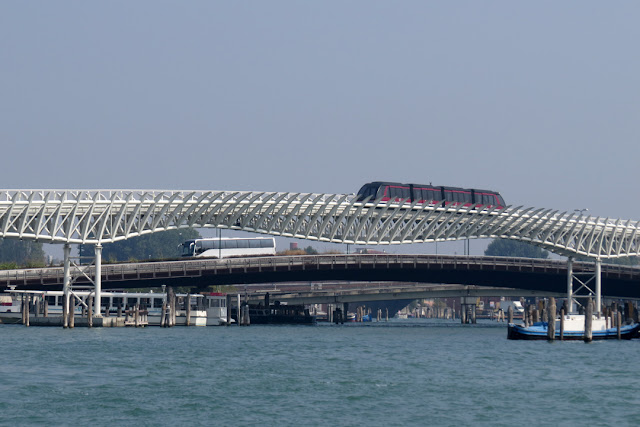
Venice People Mover
Venice People Mover going towards Tronchetto
Venice, September 2013
“The new public transportation service moves along a 857 metres long circuit which is completely above ground level. Each train will have a maximum capacity of 200 people with an hourly capacity of 3 thousand passengers. The initial estimated budget was €16 billion but due to unexpected works that became necessary during construction, the budget reached € 22 billion.” (People Mover is Working, MyVenice.org)
Subscribe to:
Posts (Atom)