Showing posts with label 2022. Show all posts

Sunday, May 12, 2024

Tabernacolo di via dei Malcontenti

Tabernacolo (Gothic-style shrine), Via dei Malcontenti / Via delle Casine, Florence

“Tabernacolo” (Gothic-style shrine)
Via dei Malcontenti / Via delle Casine
Florence, January 2023

“The large tabernacle of via dei Malcontenti, or of Sant'Onofrio, is located at the intersection of via dei Malcontenti, via delle Casine and via San Giuseppe in Florence. It was formerly part of the Spedale dei Tintori.” (Tabernacolo di via dei Malcontenti, Wikipedia)

Thursday, May 9, 2024

Family Group

Family Group by Henry Moore, San Miniato al Monte, Via delle Porte Sante, Florence

“Family Group” by Henry Moore, 1949
San Miniato al Monte
Via delle Porte Sante
Florence, December 2022

“Family Group (LH 269) is a sculpture by Henry Moore. It was his first large-scale bronze sculpture, and his first large bronze with multiple castings. Made for Barclay School in Stevenage, it evolved from drawings in the 1930s, through a series of models to bronze castings in 1950–51. It also one of the last important sculptures that Moore developed from preliminary drawings: in future, he worked mainly from found objects, maquettes and models. The sculpture depicts a group of three human figures, a stereotypical nuclear family comprising a man, a woman and a small child. The two adults are sitting on a bench, holding the child between them. The figures are slightly smaller than life size. Three of the five castings from the 1950s are still owned by the original owners, Barclay School, the Tate Gallery, and the Museum of Modern Art in New York. The others are held by the Hakone Open-Air Museum in Japan, and the Norton Simon Museum in Pasadena, with a later cast at the Henry Moore Foundation in Perry Green, Hertfordshire.” (Family Group, Wikipedia)

Monday, May 6, 2024

Cappella Corsini

Cappella Corsini (Corsini Chapel), Santa Maria del Carmine, Florence

Cappella Corsini (Corsini Chapel)
Santa Maria del Carmine
Florence, December 2022

“The Corsini, one of the richest families in Florence during the 17th–18th centuries, had this chapel built in 1675–1683, to hold the remains of an ancestral member of the family, St Andrea Corsini (1301–1374), who became a Carmelite friar and the Bishop of Fiesole, and who was canonized in 1629. The architect Pier Francesco Silvani choose for it the Baroque style then popular in Rome. The altar has a marble bas-relief depicting the Glory of St Andrea Corsini, sculpted by Foggini, and above a God the Father sculpted by Carlo Marcellini. On the sides of the altar are two more Foggini marble bas-reliefs: one depicts Sant'Andrea descends girded with sword to lead the Florentines to victory during the Battle of Anghiari and the other recalls a Miraculous vision of the Virgin by a young Sant'Andrea (occurring in the church of the Convent delle Selve). The small dome was frescoed by Giordano in 1682. The frescoes suffered in the great church fire, and were restored by Stefano Fabbrini.” (Santa Maria del Carmine, Wikipedia)

Friday, May 3, 2024

Cosimo Ridolfi

Monument to Cosimo Ridolfi by Raffaello Romanelli, Piazza Santo Spirito, Florence

Monument to Cosimo Ridolfi by Raffaello Romanelli, 1898
Piazza Santo Spirito
Florence, December 2022

“As cars, buses and motorbikes hurtle by in via San Agostino, a white marble monument seems defenceless as it stands precariously on the southern tip of Florence’s piazza Santo Spirito. Deep in thought, with one hand under his chin and the other resting on a book perched on top of a draped pedestal, the elegantly dressed man in the statue seems oblivious to any impending danger surrounding him. Placed in the piazza in 1898, the sculpture is the work of Raffaello Romanelli, one of a still-existing dynasty of Florentine sculptors whose work includes the bust of Benvenuto Cellini on the Ponte Vecchio. The inscription on pink marble at the base of statue tells us we are looking at the agronomist and politician Cosimo Ridolfi, who was ‘an outstanding teacher of the great agrarian disciplines and the untiring promoter of Italian farmers.’ Cosimo Ridolfi, the son of Marchese Luigi Ridolfi and his wife, Anastasia Frescobaldi, was born in Florence on November 28, 1794, into an old and privileged aristocratic family. When Cosimo was six, his father died. His mother not only oversaw his academic education but ensured that the boy spent time out in the open air on the family estate at Meleto, near Castelfiorentino in Val d’Elsa. There he quickly developed a love of the land and under the tutelage of the estate manager, Agostino Testaferrata, learnt the basics of agronomy, which he soon supplemented by studying physics, chemistry, botany, economics and geography.” (The statue of Cosimo Ridolfi, The Florentine)

Tuesday, April 30, 2024

Santa Trinita cormorant

Cormorant on the Arno, Ponte di Santa Trinita, Florence

Cormorant on the Arno
Ponte di Santa Trinita
Florence, December 2022

“Outside the breeding season, it frequents a wide range of wetlands as long as they are rich in fish and the water level is not too low. Their basic diet consists of various species of fish they catch during the day by diving up to 10 metres deep. Until about ten years ago, Cormorants could sometimes be observed in inland Tuscany. Today the species regularly over-winters along the River Arno Basin and over a hundred individuals daily use the Fucecchio Marshes Nature Reserve as their feeding ground. Over the last few years, the species has begun to nest again in Peninsular Italy and since 2009 has been breeding at Fucecchio Marshes.” (Cormorant, Zone Umide Toscane)

Saturday, April 27, 2024

Piazza di San Pancrazio

Façade of the church of San Pancrazio, Museo Marino Marini (Marino Marini Museum), Piazza di San Pancrazio, Florence

Façade of the church of San Pancrazio
Now Museo Marino Marini (Marino Marini Museum)
Piazza di San Pancrazio
Florence, December 2022

“San Pancrazio is a church in Florence, Italy, in Piazza San Pancrazio, behind Palazzo Rucellai. With the exception of the Rucellai Chapel, it is deconsecrated and is home to the museum dedicated to the sculptor Marino Marini. The Rucellai Chapel contains the Rucellai Sepulchre or Tempietto del Santo Sepolcro. Since February 2013 it has been possible to visit the chapel from within the Marini museum.” (San Pancrazio, Wikipedia)

Wednesday, April 24, 2024

Quadrante astronomico

Quadrante astronomico by Ignazio Danti, Basilica of Santa Maria Novella, Piazza di Santa Maria Novella, Florence

Quadrante astronomico (Astronomical quadrant) by Ignazio Danti, 1575
Basilica of Santa Maria Novella
Piazza di Santa Maria Novella
Florence, December 2022

“For much of his time in Florence, Danti resided at the convent of Santa Maria Novella, and designed the quadrant and the armillary sphere that appear on the end blind arches of the lower facade of the church in 1572 and 1574, on the right and left respectively. He also designed a large-scale gnomon for the church which allowed a thin beam of light to enter the church at noon each day through a hole just beneath the facade's rose window, although it probably was not completed by the time Danti left Florence.” (Ignazio Danti, Wikipedia)

Sunday, April 21, 2024

Sfera armillare

Sfera armillare by Ignazio Danti, Basilica of Santa Maria Novella, Piazza di Santa Maria Novella, Florence

Sfera armillare (Armillary sphere) by Ignazio Danti, 1575
Basilica of Santa Maria Novella
Piazza di Santa Maria Novella
Florence, December 2022

“For much of his time in Florence, Danti resided at the convent of Santa Maria Novella, and designed the quadrant and the armillary sphere that appear on the end blind arches of the lower facade of the church in 1572 and 1574, on the right and left respectively. He also designed a large-scale gnomon for the church which allowed a thin beam of light to enter the church at noon each day through a hole just beneath the facade's rose window, although it probably was not completed by the time Danti left Florence.” (Ignazio Danti, Wikipedia)

Thursday, April 18, 2024

Tramvia di Firenze

Tramvia di Firenze (Florence tramway network), Piazza Unità Italiana, Florence

Tramvia di Firenze (Florence tramway network)
Piazza Unità Italiana
Florence, December 2022

“During the early 2000s, the Florence administration decided to restore the tram service. Works on the first line started in December 2005. Construction works were expected to last for 1,000 days, but eventually it took more than 1,800 days to complete the line. Line 1 started operation on 14 February 2010. The first part of Line 1, at Scandicci, was the first rail public transport service in the area. During the first 10 months of service, the total passenger served were 7 million, a result considered a success. On 16 July 2018 the line was extended from Florence Santa Maria Novella railway station to the current northern terminus, Careggi.” (Trams in Florence, Wikipedia)

Monday, April 15, 2024

Marble and mischio

Marble and mischio horses, fountain of Neptune by Bartolomeo Ammannati, Piazza della Signoria, Florence

Marble and mischio horses
Fountain of Neptune by Bartolomeo Ammannati
Piazza della Signoria
Florence, December 2022

“Ammannati's Neptune was unique because of its incredibly large scale and even though there were several Neptune fountains around Italy at the time, none of them had Neptune atop a horse-drawn chariot. The fountain was being built to celebrate the marriage of Francesco and Joanna, and the association of chariots with festivals and pageants could be the reason for Bandinelli's unusual incorporation of a horse-chariot. Because the fountain's scale was so large, it forced Ammannati to make some innovative choices when constructing his giant Neptune. Two of the horses were white marble, but the other two were made of mischio, a marble discovered near the Duke's excavation site in Seravezza. This new marble was a type of breccia and had a variety of colors including red, yellow and purple. Because this was a new medium, its qualities were unknown to sculptors at the time and the hard, brittle quality of the mischio made Ammannati's task even more difficult. Due to the brittle quality of mischio the columns of stone broke in transit, creating delays in the fountain's completion. Ammannati was finally able to carve the remainder of the horse and complete the fountain in 1574. The project was intended to be completed by 1565 for the celebration of Francesco de' Medici I and Joanna of Austria's wedding, but due to a myriad of delays in sourcing supplies for the fountain's completion, Ammannati was forced to come up with a temporary solution for the arrival of Johanna of Austria. Through the use of stucco and paint, Ammannati was able to create the illusion of a finished product. The combination of the Neptune as the subject matter and Ammannati's use of the duke's newly found stone (mischio) made the fountain symbolic of the duke's reign over the Mediterranean and the mountains.” (Fountain of Neptune, Wikipedia)

Friday, April 12, 2024

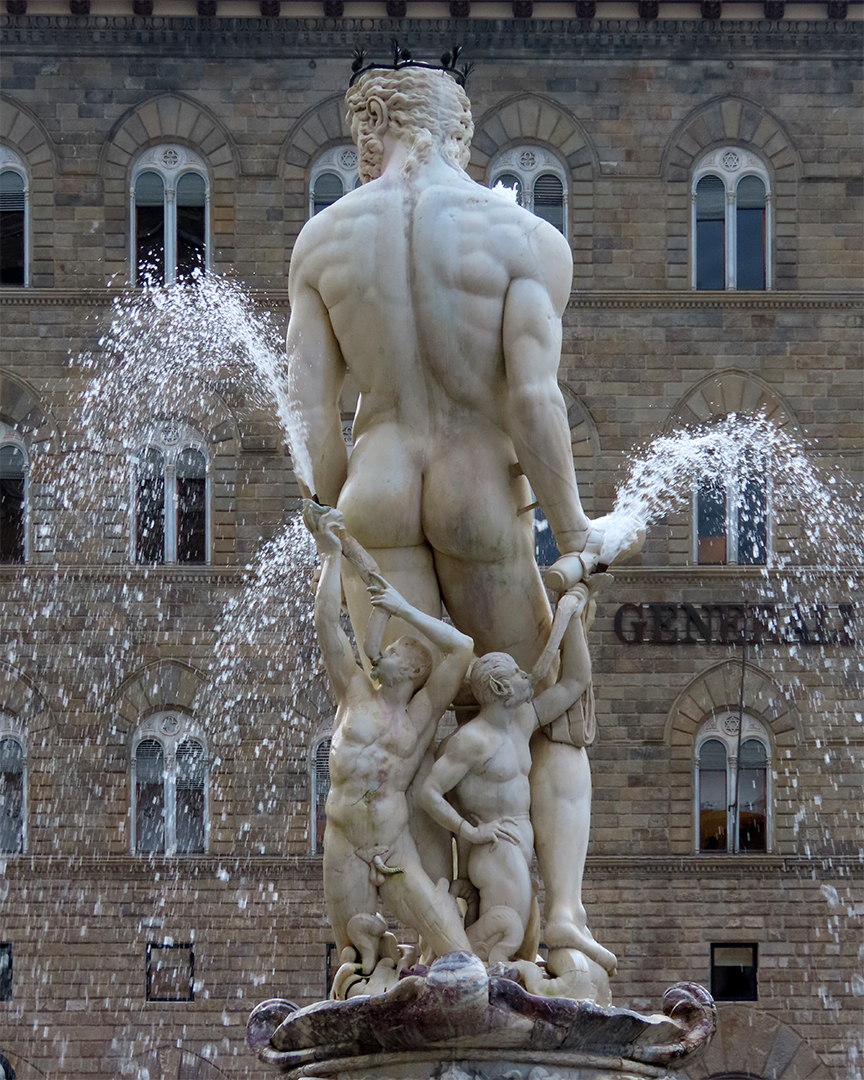
Neptune from behind

Neptune from behind, Fountain of Neptune by Bartolomeo Ammannati, Piazza della Signoria, Florence

Fountain of Neptune by Bartolomeo Ammannati
Piazza della Signoria
Florence, December 2022

“The Fountain of Neptune in Florence, Italy, (Fontana del Nettuno) is situated in the Piazza della Signoria (Signoria square), in front of the Palazzo Vecchio. The fountain was commissioned by Cosimo I de' Medici in 1559 to celebrate the marriage of Francesco de' Medici I to Grand Duchess Joanna of Austria. Cosimo I de' Medici was the Duke of Florence from 1537-1569 and responsible for a vast number of architectural and artistic elements in Florence that still exist today. The fountain was designed by Baccio Bandinelli, but created by Bartolomeo Ammannati with the assistance of several other artists between 1560 and 1574. It incorporates a series of mythological figures and iconographies that symbolize both Cosimo I de' Medici's power and the union of Francesco and Joanna. It has sustained a great deal of damage over the years due to vandalism and general mistreatment but underwent a major restoration completed in 2019 that restored it to its original glory.” (Fountain of Neptune, Wikipedia)

Tuesday, April 9, 2024

A dead planet

Fa più rumore una finsestra sporca di un pianeta morto, Via dei Servi, Florence

“Fa più rumore una finsestra sporca di un pianeta morto”
(Makes more noise a dirty window than a dead planet)
Via dei Servi
Florence, December 2022

Saturday, April 6, 2024

Bell tower by Baccio d'Agnolo

Bell tower by Baccio d'Agnolo, Basilica of Saint Mark, Piazza San Marco, Florence

Bell tower by Baccio d'Agnolo, 1512
Basilica of Saint Mark
Piazza San Marco
Florence, December 2022

“The church seems to then have been in constant renovations and restoration for the next two centuries. Some of the changes include: in 1512, the bell tower was re-built on the design of Baccio d'Agnolo.” (The Church of San Marco, Visit Florence)

Wednesday, April 3, 2024

Pax tibi Marce

Winged lion on the facade, Basilica of Saint Mark, Piazza San Marco, Florence

Winged lion on the facade
Basilica of Saint Mark
Piazza San Marco
Florence, December 2022

“Mark the Evangelist's symbol is the winged lion, the Lion of Saint Mark. Inscription: ‘Pax tibi Marce evangelista meus’ (peace be upon you, Mark, my evangelist). The same lion is also the symbol of Venice.” (Mark the Evangelist, Wikipedia)

Sunday, March 31, 2024

Large Interior Form

Large Interior Form by Henry Moore, Piazza della Signoria, Florence

“Large Interior Form” by Henry Moore, 1982
Piazza della Signoria
Florence, December 2022

“It was produced in a bronze edition of six, which was first created as part of a larger work in the 1950s, and only cast as a separate work from 1981 onwards, and catalogued as LH 297b. It began as the interior component of the artist's Large Upright Internal/External Form (LH 297a), but Moore much later decided the piece worked well by itself. The artist's copy was lent in 2011 by the Henry Moore Foundation to the Snape Maltings, in Suffolk. Others are at the Art Institute of Chicago, in an outdoor setting at the Nelson-Atkins Museum in Kansas City, MO. These sculptures measure 16 feet 3 inches × 561⁄4 inches × 561⁄4 inches (495.3 × 142.88 × 142.88 cm). Moore used to take pride in viewing his sculptures in the open air environment. Kunsthalle Würth at Schwabisch Hall in Germany and Trinity University in Texas are among the other locations that have Large Interior Form on public display outdoors.” (Large Interior Form, 1953–54, Wikipedia)

Saturday, March 30, 2024

Reina Mariana

Reina Mariana by Manolo Valdés, Calle de San Vicente Mártir, Valencia

“Reina Mariana” by Manolo Valdés, 2005
Calle de San Vicente Mártir
Valencia, September 2022

“Spanish artist Manolo Valdés began his artistic career at age of 15, using Spain’s rich history of art, influenced by European and African forms, to shape his early works. During the 1960s, he co-founded Equipo Crónica, an artistic team that used Pop Art to question the dictatorship of Francisco Franco, who suppressed his country’s social and cultural life between 1939 and 1975. After the group dissolved in 1981, as Spain awoke from its enforced slumber, Valdés reinvented his work creating the figurative, expressive style centered on art historical motifs in drawing, painting, printmaking and sculpture. Reina Mariana (Queen Mariana) is part of Valdés’s most famous series of sculptures, based on Spanish artist Diego Velázquez’s Queen Mariana (1652-1653), a portrait of the second wife of Felipe IV. Velázquez was the chronicler of court life for the King and his family, capturing them at a time when Spain’s imperial power stretched across the globe. Mariana, from the Austrian Hapsburg family, was well known to be an unhappy participant in her adopted country’s life. The voluminous and starched costume of the regal Spanish aristocracy holds her upright and rigid, like a bird caught in a cage. Valdés pays homage to one of his country’s most iconic painters and subjects, while commenting upon the life of those who serve subservient roles in history.” (Reina Mariana, Google Arts & Culture)

Thursday, March 28, 2024

Chianineria

Chianineria - Trattoria dall'Oste, Via dei Cerchi, Florence

Chianineria - Trattoria dall'Oste
Via dei Cerchi
Florence, December 2022

Wednesday, March 27, 2024

Puerta de Bisagra Nueva

View from the inside, Puerta de Bisagra Nueva (New Bisagra Gate), Calle Real del Arrabal, Toledo

View from the inside
Puerta de Bisagra Nueva (New Bisagra Gate)
Calle Real del Arrabal
Toledo, September 2022

“The Puerta de Bisagra Nueva (The New Bisagra Gate) is the best known city gate of Toledo, Spain. The gate is of Moorish origin, but the main part was built in 1559 by Alonso de Covarrubias. It carries the coat of arms of the emperor Charles V. It superseded the Puerta Bisagra Antigua as the main entrance to the city.” (Puerta de Bisagra Nueva, Wikipedia)

Monday, March 25, 2024

Santissima Annunziata

Basilica della Santissima Annunziata (Basilica of the Most Holy Annunciation), Piazza Santissima Annunziata, Florence

Basilica della Santissima Annunziata (Basilica of the Most Holy Annunciation)
Piazza Santissima Annunziata
Florence, December 2022

“The Basilica della Santissima Annunziata (Basilica of the Most Holy Annunciation) is a Renaissance-style, Catholic minor basilica in Florence, region of Tuscany, Italy. This is considered the mother church of the Servite Order. It is located at the northeastern side of the Piazza Santissima Annunziata near the city center.” (Santissima Annunziata, Wikipedia)

Sunday, March 24, 2024

Museo de América

Museo de América (Museum of America), Avenida de los Reyes Católicos, Madrid

Museo de América (Museum of America)
Avenida de los Reyes Católicos
Madrid, September 2022

“The Museo de América (Museum of America) is a Spanish national museum of arts, archaeology and ethnography in Madrid. Its collections cover the whole of the Americas and range from the Paleolithic period to the present day. It is owned by the Spanish State and its initial pieces came from the former collection of American archaeological and ethnographic artifacts from the National Archaeological Museum, also exhibiting a number of unrelated donations, deposits and purchases. The institution was founded via a decree from 19 April 1941 and opened in 1944 inside the building hosting the National Archaeological Museum. After all the initial pieces were moved to a newly built premises in the Ciudad Universitaria, the building was thus inaugurated on 12 October 1965. After a series of refurbishment works on the building (previously shared with a number of unrelated institutions), the museum was reopened on 12 October 1994, this time while holding the exclusivity on the use of the building. As part of preparation for the re-opening, a collecting programme was established, with Dominican and Haitian artefacts sourced by the anthropologist Soraya Aracena.” (Museo de América, Wikipedia)