Showing posts with label obelisk. Show all posts
Tuesday, July 29, 2025
Obelisk of Tutankhamun
Obelisk of Tutankhamun by Rita McBride, 2017
Breslauer Platz
Cologne, September 2024
“By calling her sculpture ‘Obelisk of Tutankhamun,’ she puts the work in a class with the obelisks of ancient Egypt. At the same time, no ruler of ancient Egypt is more famous than King Tut, who has made it into pop culture. The obelisk as such has become the epitome of sculpture in public space: from St. Petersburg to Stockholm, from Buenos Aires to Bangkok, there are countless obelisks all over the world, multiplying like mushrooms across all continents. What city can call itself a world city without having an obelisk? Now Cologne is also part of the club. Rita McBride has created a monolith similar to the one used by the ancient Egyptians. However, she replaced the heavy reddish Aswan granite of the originals with a light, high-tech material that is used for airplanes and cars: carbon fiber.” (Obelisk of Tutankhamun, Stiftung der Sparda-Bank West)
Friday, June 6, 2025
Francis and Adelgunde
Obelisk by Pietro Marchelli, 1843
Piazza Gioberti
Reggio Emilia, May 2024
“In 1842 the piazza at the northern end of Corso Giuseppe Garibaldi, just north of Palazzo Ducale, was named Piazza Adelgonda in honour of Queen Adelgunde (wife of King Francis I); it was renamed Piazza Gioberti in 1859. When Francis and Adelgunde visited Reggio in May 1842, Piazza Adelgonda was decorated with arches, obelisks, and Chinese pagodas for the occasion. In 1843 a granite obelisk designed by Pietro Marchelli was erected in the middle of the piazza in honour of Francis and Adelgunde. The obelisk is 17.75 metres high and is surmounted by a five-pointed gilt metal star.” (Obelisk in Piazza Gioberti, A Jacobite Gazetteer)
Saturday, October 14, 2023
Saturday, June 4, 2022
Flaminio Obelisk
Flaminio Obelisk
Piazza del Popolo
Rome, May 2019
“The Nineteenth Dynasty Pharaoh Sety I quarried this obelisk from granite quarries in Aswan. Before his death, artists inscribed one face of the obelisk, which Sety intended to erect in the Temple of Re in Heliopolis. Sety's son and successor Ramesses II completed its inscriptions and set it up in Heliopolis; it was brought to Rome in 10 BC by command of Augustus, together with the Obelisk of Montecitorio, and placed on the spina of the Circus Maximus, followed three centuries later by the Lateran Obelisk. Like most Egyptian obelisks, the Flaminio Obelisk was probably one of a pair, but no trace of its mate has ever been found. In Sety I's dedicatory inscription on one side of the shaft, the king boasts that he would ‘fill Heliopolis with obelisks.’ The obelisk was discovered in 1587, broken into three pieces, together with the Lateran Obelisk; and it was erected in the Piazza del Popolo by Domenico Fontana in 1589, at the command of Pope Sixtus V. Sixtus had the Septizodium demolished to provide the travertine for the obelisk's pedestal, among other building projects. In 1823, Giuseppe Valadier embellished it with a base having four circular basins and stone lions, imitating the Egyptian style.” (Flaminio Obelisk, Wikipedia)
Saturday, October 3, 2020
Boboli obelisk
Boboli obelisk
Boboli Gardens
Florence, January 2020
“The Boboli obelisk, previously called the Obelisco Mediceo, is an ancient Egyptian granite obelisk, which was moved in the 18th century from Rome to Florence, where it was erected in the Boboli Gardens. The granite from which the obelisk is carved comes from Aswan and the inscriptions are dedicated to Atum, the deity of the city of Heliopolis. It is suspected to have been first erected in that city during the reign of Ramesses II. In the first century AD, it was moved to Rome by Domitian and placed in the Temple of Isis in the Campus Martius, along with three other obelisks still in Rome: the Obelisk at the Monument to those fallen at Dogali, the Obelisk of Piazza of the Pantheon, and the obelisk in front of Santa Minerva.” (Boboli obelisk, Wikipedia)
Friday, September 21, 2018
Obélisque de la place des Fêtes
Obélisque de la place des Fêtes by Zoltán Zsakó, 1996
Place des Fêtes
Quartier d'Amérique, 19th arrondissement
Paris, July 2005
Thursday, December 29, 2016
Fontana dei Dioscuri
Fontana dei Dioscuri by by Raffaele Stern, 1818
Piazza del Quirinale
Rome, April 2013
“The Fontana dei Dioscuri is the fountain set opposite the Palazzo del Quirinale, the official residence of the President of the Italian Republic in the Piazza del Quirinale. The original fountain, which no longer exists, commissioned by Pope Sixtus V in 1588, had the Dioscuri, Castor and Pollux statues, from Constantine I of Rome's Baths, moved to the piazza, from the site, thought to have been nearby, flanking it. In the late 1780s by Antinori, was commissioned by Pope Pius VI, to make a better layout for the piazza and had the fountain and the Dioscuri moved, and included the large Obelisk which had been moved from the Campus Martius in the design. Some time between, that original fountain was lost, and, in 1818 a new one, which can be seen today, was commissioned by Pope Pius VII and was designed by Raffaele Stern using an ancient granite Roman shell that had been found in the 16th century supported on top of a large basin. It was sited in front of the two statues with the obelisk between them.” (Fontana dei Dioscuri, Wikipedia)
Tuesday, August 4, 2015
Worth Monument
Worth Monument (1857) and Commodore Criterion building
General Worth Square / Madison Square
New York, September 2007
“Not too long ago I was giving an architectural walking tour in the Madison Square Park area when somebody asked me ‘what's going on with the Commodore Criterion building?’ If you've been by the park you've probably seen the building at the intersection of Fifth Avenue, 25th Street, and Broadway with its name fixed atop the tall stone parapet. I had no answer to the question, except that the Christmas display over the front door had not come down in years, meaning the building was most likely vacant. What I did not know at the time was that Spanish tile/kitchen/bath company Porcelanosa bought the building last summer. Since my tour I've also learned that Porcelanosa hired Foster + Partners to transform the six-story building into their US/NYC flagship showroom.” (From Commodore Criterion to Porcelanosa, A Daily Dose of Architecture)
Monday, November 10, 2014
Cleopatra's Needle
Cleopatra's Needle
Victoria Embankment
London, September 2014
“On erection of the obelisk in 1878 a time capsule was concealed in the front part of the pedestal, it contained : A set of 12 photographs of the best looking English women of the day, a box of hairpins, a box of cigars, several tobacco pipes, a set of imperial weights, a baby's bottle, some children's toys, a shilling razor, a hydraulic jack and some samples of the cable used in erection, a 3' bronze model of the monument, a complete set of British coins, a rupee, a portrait of Queen Victoria, a written history of the strange tale of the transport of the monument, plans on vellum, a translation of the inscriptions, copies of the bible in several languages, a copy of John 3:16 in 215 languages, a copy of Whitaker's Almanack, a Bradshaw Railway Guide, a map of London and copies of 10 daily newspapers.” (The London needle, Wikipedia)
Wednesday, January 15, 2014
Villa Medici Obelisk
The Egyptian obelisk from Villa Medici in Rome
Giardino di Boboli (Boboli Gardens)
Florence, October 2013
“The main treasure the Grand Dukes moved to Boboli from Villa Medici is the Egyptian obelisk which once stood in Isaeum/Serapeum Campense a large complex of Temples dedicated to the Egyptian gods Isis (hence Isaeum) and Serapis (hence Serapeum) in Campus Martius (see a page on the obelisks of Rome). The obelisk was originally erected by Ramses II in Heliopolis. A copy now stands in Villa Medici.” (Florentine Recollections - in Boboli Gardens, A Rome Art Lover's Web Page)
Friday, September 13, 2013
Matteiano Obelisk
Matteiano Obelisk
Villa Celimontana (previously known as Villa Mattei)
Rome, May 2012
“The obelisk is a small example given to the Mattei in 1582. Its lower part is made up of parts of several obelisks and is of unknown origin, but the top part (2.68m high) has hieroglyphics of Rameses II, derives from the Temple of the Sun at Heliopolis, and was (like those now in piazza della Minerva and via delle Terme di Diocleziano) brought to Rome in antiquity to adorn the Temple of Isis (in the area of the present via di Pie' di Marmo). In the 14th century it was placed on the steps of the Campidoglio - legend holds that the globe placed on its tip held the ashes of Augustus and that the obelisk was raised on the Campidoglio by Cola di Rienzo as a symbol of Roman liberty.” (Obelisk, Villa Celimontana)
See also: Obelisk of Montecitorio - Macuteo Obelisk - Quirinale Obelisk - Pulcino della Minerva - Minerveo Obelisk - Esquiline Obelisk - Sallustian Obelisk
External links: List of obelisks in Rome (Wikipedia)
Thursday, August 8, 2013
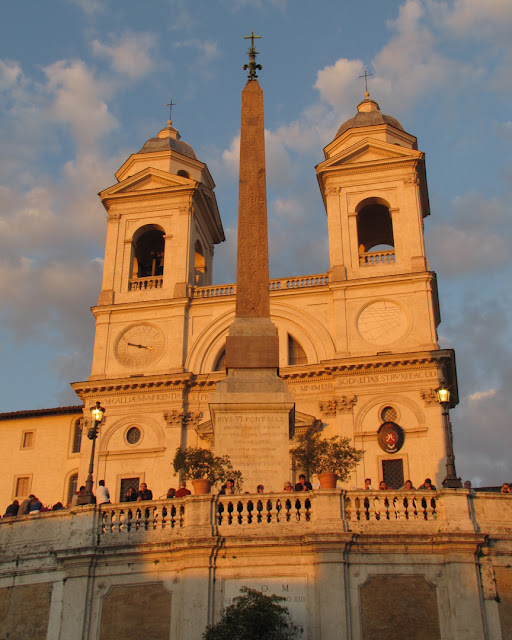
Sallustian Obelisk
Sallustian Obelisk
Church of the Santissima Trinità dei Monti
Piazza della Trinità dei Monti
Rome, April 2013
“In front of the church stands the Obelisco Sallustiano, one of the many obelisks in Rome, moved here in 1789. It is a Roman obelisk in imitation of Egyptian ones, originally constructed in the early years of the Roman Empire for the Gardens of Sallust near the Porta Salaria. The hieroglyphic inscription was copied from that on the obelisk in the Piazza del Popolo.” (Trinità dei Monti, Wikipedia)
See also: Obelisk of Montecitorio - Macuteo Obelisk - Quirinale Obelisk - Pulcino della Minerva - Minerveo Obelisk - Esquiline Obelisk
External links: List of obelisks in Rome (Wikipedia)
Sunday, June 2, 2013
Pyramidion
The 20th Century pyramidion of the Luxor Obelisk
Place de la Concorde
Quartier des Champs-Élysées, 8th arrondissement
Paris, July 2012
See also: Obélisque de Louxor
Thursday, May 9, 2013
Obélisque de Louxor
The Obélisque de Louxor (Luxor Obelisk)
Place de la Concorde
Quartier des Champs-Élysées, 8th arrondissement
Paris, July 2011
“The Luxor Obelisk is over 3,000 years old and was originally situated outside of Luxor Temple, where its twin remains to this day. It first arrived in Paris on December 21, 1833, having been shipped from Luxor via Alexandria and Cherbourg, and three years later, on October 25, 1836, was moved to the center of Place de la Concorde by King Louis-Phillipe. It was gifted to France by Muhammad Ali, Ruler of Egypt. In August 1832, the French paddle ship Sphinx sailed to Alexandria to rendezvous there with the barge Louqsor, which was to load the Luxor Obelisk and bring it to Paris. Sphinx then towed Louqsor back to France. The ships departed on 1 April 1833 and reached Toulon on 10 May. The ships arrived at Cherbourg on 12 August 1833.” (Luxor Obelisk, Wikipedia)
Friday, September 14, 2012
Esquiline Obelisk
Esquiline Obelisk
Piazza dell'Esquilino
Rome, May 2010
See also: Obelisk of Montecitorio - Macuteo Obelisk - Quirinale Obelisk - Pulcino della Minerva - Minerveo Obelisk
External links: List of obelisks in Rome (Wikipedia)
Sunday, July 8, 2012
Minerveo Obelisk
Minerveo Obelisk or “Pulcino della Minerva” by Gian Lorenzo Bernini
Piazza della Minerva
Rome, May 2012
See also: Obelisk of Montecitorio - Macuteo Obelisk - Quirinale Obelisk - Pulcino della Minerva
External links: Bernini’s Elephant Obelisk (Art History Presentation Archive) - List of obelisks in Rome (Wikipedia)
Friday, June 22, 2012
Pulcino della Minerva
Detail of the elephant, “Pulcino della Minerva” (Minerva’s little chick) by Gian Lorenzo Bernini
Piazza della Minerva
Rome, May 2012
External links: Pulcino della Minerva (Art History Presentation Archive) - Hypnerotomachia Poliphili (Wikipedia)
Wednesday, May 23, 2012
Quirinale Obelisk
Quirinale Obelisk
Piazza del Quirinale
Rome, May 2012
See also: Obelisk of Montecitorio - Macuteo Obelisk - Minerveo Obelisk
External links: List of obelisks in Rome (Wikipedia)
Friday, April 27, 2012
Macuteo Obelisk
Macuteo obelisk
Fountain by Filippo Barigioni
Piazza della Rotonda
Rome, September 2010
See also: Obelisk of Montecitorio - Quirinale Obelisk - Minerveo Obelisk External links: List of obelisks in Rome
Saturday, March 24, 2012
Bronze Turtle
Bronze turtle by Giambologna
Obelisk by Bartolomeo Ammannati
Piazza Santa Maria Novella
Florence, December 2009
Subscribe to:
Posts (Atom)