Showing posts with label r1905. Show all posts
Tuesday, August 13, 2024
Nymphaea
Nymphaea
Istituto Svizzero
Villa Maraini
Via Ludovisi
Rome, May 2019
“Nymphaea is a genus of hardy and tender aquatic plants in the family Nymphaeaceae. The genus has a cosmopolitan distribution. Many species are cultivated as ornamental plants, and many cultivars have been bred. Some taxa occur as introduced species where they are not native, and some are weeds. Plants of the genus are known commonly as water lilies, or waterlilies in the United Kingdom. The genus name is from the Greek νυμφαία, nymphaia and the Latin nymphaea, which mean ‘water lily’ and were inspired by the nymphs of Greek and Latin mythology.” (Nymphaea, Wikipedia)
Saturday, August 10, 2024
Wednesday, August 7, 2024
Sunday, August 4, 2024
Thursday, August 1, 2024
Lioness
Lioness by Davide Rivalta, 2017
Galleria Nazionale d'Arte Moderna e Contemporanea
(National Gallery of Modern and Contemporary Art)
Viale delle Belle Arti
Rome, May 2019
“Davide Rivalta’s majestic bronze lions that have been surveying Villa Borghese from the museum steps will no doubt have struck anyone lucky enough to have already visited this gorgeous gallery. Well, this summer this regal pack have become five and accompanying Rivalta’s vast lion drawings in the hallway connecting the North-East and North-West wings. In another reference to Time is Out of Joint, these magnificent beasts are said to act as an acknowledgment to the Museum’s history whilst also being symbolic of art’s unchartered territories.” (Brand-New Exhibits, Romeing)
Monday, July 29, 2024
Ignara mali
“Ignara mali” (Unaware of the evil) by Adalberto Cencetti, 1893
Galleria Nazionale d'Arte Moderna e Contemporanea
(National Gallery of Modern and Contemporary Art)
Viale delle Belle Arti
Rome, May 2019
Friday, July 26, 2024
La sognatrice
“La sognatrice” (The dreamer) by Antonietta Raphaël Mafai, 1946
Galleria Nazionale d'Arte Moderna e Contemporanea
(National Gallery of Modern and Contemporary Art)
Viale delle Belle Arti
Rome, May 2019
Tuesday, July 23, 2024
Ultima cena
“Ultima cena” (The last supper) by Mario Ceroli, 1965
Galleria Nazionale d'Arte Moderna e Contemporanea
(National Gallery of Modern and Contemporary Art)
Viale delle Belle Arti
Rome, May 2019
“In a solo exhibition at the Galleria La Tartaruga in 1966, the artwork was purchased at the price of 600,000 lire in the same year, together with others by young artists of the period such as Adami, Del Pezzo, Castellani, Pascali, Costa, Kunellis and Colombo.” (Ultima cena, La Galleria Nazionale)
Saturday, July 20, 2024
Le tre sorelle
“Le tre sorelle” (The three sisters) by Antonietta Raphaël Mafai, 1936
Galleria Nazionale d'Arte Moderna e Contemporanea
(National Gallery of Modern and Contemporary Art)
Viale delle Belle Arti
Rome, May 2019
“Le tre sorelle (The three sisters) is a theme she often returns to. The concrete version, now in the Galleria Nazionale in Rome, was exhibited with the title of Composition at the Sindacale of 1937. The group consists of the portrait of her three daughters: Miriam, the oldest, reads. Simona and Giulia listen. They appear as a single body, a generative nucleus, a gemmation.” (The Only Authentic Italian Sculptor, La Galleria Nazionale)
Wednesday, July 17, 2024
Gisleni monument
The lower part of the Gisleni monument
Santa Maria del Popolo
Piazza del Popolo
Rome, May 2019
“The tomb of Giovanni Battista Gisleni, an Italian Baroque architect and stage designer who worked for the Polish royal court during the years 1630–1668, is probably the most macabre funeral monument in the basilica. It is set between a wooden booth and a stone half-column on the right side of the counterfaçade. The memorial was designed and installed by the architect himself in 1670 two years before his death. The upper part of the monument is a stone plaque with a long inscription and the portrait of the deceased in a tondo which was painted by a Flemish portraitist, Jacob Ferdinand Voet. There is a painted canopy supported by angels on the wall. The lower part is more interesting: a skeleton is peeping through a window behind an iron grill. The sinister, shrouded figure is facing towards the viewer with his bony hands clutched on his breast. The stone frame of the window is decorated with a coat-of-arms and two bronze medallions. The left one shows a tree with its branches cut but sprouting new shoots and containing a caterpillar spinning its cocoon, while the right one shows the metamorphosis of the caterpillar into a moth. These are the symbols of death and resurrection. The inscriptions convey the same message: In nidulo meo moriar (‘in my nest I die’ i.e. in the city of Rome) and Ut phoenix multiplicabo dies (‘as a phoenix I multiply my days’). There are two enigmatic inscriptions on the upper and lower part of the monument: Neque hic vivus and Neque illic mortuus (Neither living here, nor dead there). On this tomb the skeleton is not the personification of Death as in other Baroque tombs but a representation of the deceased (the transi image) on his way towards the resurrection and due to this ‘death became a symbol for life’.” (Santa Maria del Popolo, Wikipedia)
Sunday, July 14, 2024
Guerriero sannita
Samnite warrior by Giuseppe Guastalla, 1922
Museo Nazionale Romano
Terme di Diocleziano
Viale Einaudi
Rome, May 2019
“The Samnites (Oscan: Safineis) were an ancient Italic people who lived in Samnium, which is located in modern inland Abruzzo, Molise, and Campania in south-central Italy. An Oscan-speaking people, who originated as an offshoot of the Sabines, they formed a confederation consisting of four tribes: the Hirpini, Caudini, Caraceni, and Pentri. Ancient Greek historians considered the Umbri as the ancestors of the Samnites. Their migration was in a southward direction, according to the rite of ver sacrum.” (Samnites, Wikipedia)
Thursday, July 11, 2024
Risen Christ
Cristo della Minerva (Christ of the Minerva) by Michelangelo Buonarroti, 1521
Basilica of Santa Maria sopra Minerva (Saint Mary Above Minerva)
Piazza della Minerva
Rome, May 2019
“The Risen Christ, Cristo della Minerva in Italian, also known as Christ the Redeemer or Christ Carrying the Cross, is a marble sculpture by the Italy High Renaissance master Michelangelo, finished in 1521. It is in the church of Santa Maria sopra Minerva in Rome, to the left of the main altar. The work was commissioned in June 1514, by the Roman patrician Metello Vari, who stipulated only that the nude standing figure would have the Cross in his arms, but left the composition entirely to Michelangelo. Michelangelo was working on a first version of this statue in his studio in Macello dei Corvi around 1515, but abandoned it in roughed-out condition when he discovered a black vein in the white marble, remarked upon by Vari in a letter, and later by Ulisse Aldrovandi. A new version was hurriedly substituted in 1519–1520 to fulfil the terms of the contract. Michelangelo worked on it in Florence, and the move to Rome and final touches were entrusted to an apprentice, Pietro Urbano; the latter, however, damaged the work and had to be quickly replaced by Federico Frizzi at the suggestion of Sebastiano del Piombo.” (Risen Christ, Wikipedia)
Monday, July 8, 2024
Tomb of Pope Julius II
Funerary monument of Julius II by Michelangelo and others, 1545
San Pietro in Vincoli
Piazza di San Pietro in Vincoli
Rome, May 2019
“The Tomb of Pope Julius II is a sculptural and architectural ensemble by Michelangelo and his assistants, originally commissioned in 1505 but not completed until 1545 on a much reduced scale. Originally intended for St. Peter's Basilica, the structure was instead placed in the church of San Pietro in Vincoli on the Esquiline in Rome after the pope's death. This church was patronized by the Della Rovere family from which Julius came, and he had been titular cardinal there. Julius II, however, is buried next to his uncle Sixtus IV in St. Peter's Basilica, so the final structure does not actually function as a tomb. Hypothetical reconstruction of the first project for the tomb of Julius II (1505) according to a new interpretation by Adriano Marinazzo (2018). As originally conceived, the tomb would have been a colossal structure that would have given Michelangelo the room he needed for his superhuman, tragic beings. This project became one of the great disappointments of Michelangelo's life when the pope, for unexplained reasons, interrupted the commission, possibly because funds had to be diverted for Bramante's rebuilding of St. Peter's. The original project called for a freestanding, three-level structure with some 40 statues. After the pope's death in 1513, the scale of the project was reduced step-by-step until, in April 1532, a final contract specified a simple wall tomb with fewer than one-third of the figures originally planned. The most famous sculpture associated with the tomb is the figure of Moses, which Michelangelo completed during one of the sporadic resumptions of the work in 1513.[citation needed] Michelangelo felt that this was his most lifelike creation. Legend has it that upon its completion he struck the right knee commanding, "now speak!" as he felt that life was the only thing left inside the marble. There is a scar on the knee thought to be the mark of Michelangelo's hammer.” (Tomb of Pope Julius II, Wikipedia)
Friday, July 5, 2024
Reggimento corazzieri
Detail of gate of the barracks
Reggimento corazzieri (Cuirassiers Regiment)
Via Venti Settembre
Rome, May 2019
“The Cuirassiers Regiment (Reggimento corazzieri) is a Carabinieri cavalry regiment acting as guard of honour of the President of the Italian Republic. Their motto is Virtus in periculis firmior. From 1948 to 1965, the regiment was officially called Squadrone Carabinieri Guardie (Squadron of Carabineer Guards); from 1965 to 1990, Comando Carabinieri Guardie del Presidente della Repubblica (Carabineer Command of the Guards of the President of the Republic); and from 1990 to 1992, Reggimento Carabinieri Guardie della Repubblica (Carabineer Regiment of the Guards of the Republic).” (Cuirassiers Regiment, Wikipedia)
Tuesday, July 2, 2024
Cantoria
Detail of the Choir gallery by Mattia de' Rossi
Santa Maria della Vittoria (Our Lady of Victory)
Via Venti Settembre
Rome, May 2019
“The choir gallery is by Mattia de' Rossi, who worked with Bernini. Notice the angels holding it aloft, and also the angels supporting the cornice and vault.” (Churches of Rome, Chris Nyborg)
Tuesday, June 28, 2022
Silvio Spaventa
Monument to Silvio Spaventa by Giulio Tadolini, 1898
Ministry of Economy and Finances
Via Cernaia
Rome, May 2019
“Silvio Spaventa (12 May 1822 – 20 June 1893) was an Italian journalist, politician and statesman who played a leading role in the unification of Italy, and subsequently held important positions within the newly formed Italian state.” (Silvio Spaventa, Wikipedia)
Saturday, June 4, 2022
Flaminio Obelisk
Flaminio Obelisk
Piazza del Popolo
Rome, May 2019
“The Nineteenth Dynasty Pharaoh Sety I quarried this obelisk from granite quarries in Aswan. Before his death, artists inscribed one face of the obelisk, which Sety intended to erect in the Temple of Re in Heliopolis. Sety's son and successor Ramesses II completed its inscriptions and set it up in Heliopolis; it was brought to Rome in 10 BC by command of Augustus, together with the Obelisk of Montecitorio, and placed on the spina of the Circus Maximus, followed three centuries later by the Lateran Obelisk. Like most Egyptian obelisks, the Flaminio Obelisk was probably one of a pair, but no trace of its mate has ever been found. In Sety I's dedicatory inscription on one side of the shaft, the king boasts that he would ‘fill Heliopolis with obelisks.’ The obelisk was discovered in 1587, broken into three pieces, together with the Lateran Obelisk; and it was erected in the Piazza del Popolo by Domenico Fontana in 1589, at the command of Pope Sixtus V. Sixtus had the Septizodium demolished to provide the travertine for the obelisk's pedestal, among other building projects. In 1823, Giuseppe Valadier embellished it with a base having four circular basins and stone lions, imitating the Egyptian style.” (Flaminio Obelisk, Wikipedia)
Friday, February 4, 2022
Odescalchi lion
Detail of the monument of Maria Flaminia Odescalchi Chigi, 1772
Santa Maria del Popolo
Piazza del Popolo
Rome, May 2019
“The little monument clearly shows the influence of Bernini (in particular Bernini's monument to Maria Raggi in S. Maria sopra Minerva and the two gigantic coats of arms of Alexander VII over the organ in S. Maria del Popolo, with oak branches and leaves coming out the pipes) and the experience gained by Posi in designing ephemeral machines. In the lower part of the monument a lion (Odescalchi) is climbing a mountain (Chigi); to the right of the mountain one can see an incense burner (Odescalchi) and even the twists of the smoke.” (The Last Baroque Tomb, Rome Art Lover)
Wednesday, October 13, 2021
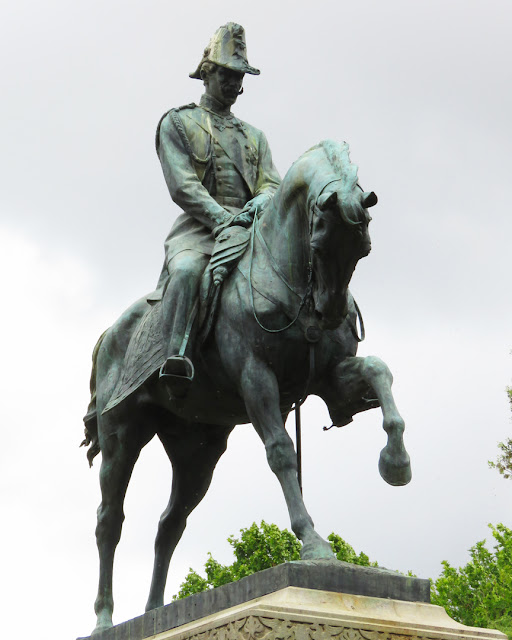
Carlo Alberto
Monument to Carlo Alberto by Raffaele Romanelli, 1900
Giardino del Quirinale
Via del Quirinale
Rome, May 2019
“Charles Albert (Carlo Alberto I; 2 October 1798 – 28 July 1849) was the King of Sardinia from 27 April 1831 until 23 March 1849. His name is bound up with the first Italian constitution, the Albertine Statute, and with the First Italian War of Independence (1848–1849).” (Charles Albert of Sardinia, Wikipedia)
Thursday, October 7, 2021
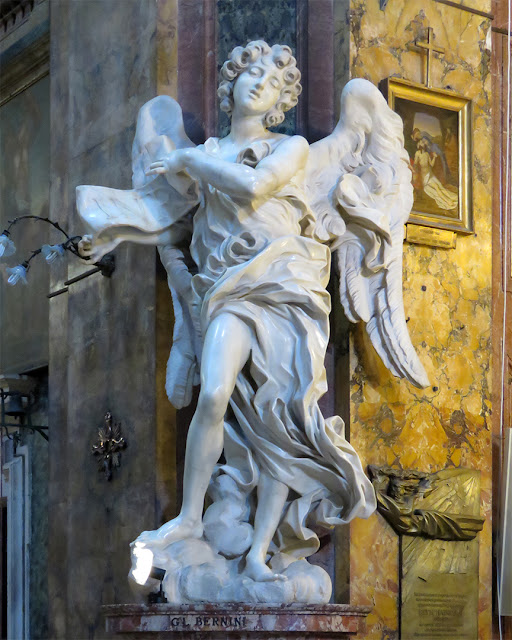
Angel with the Superscription
Angel with the Superscription by Gian Lorenzo Bernini, 1669
Sant'Andrea delle Fratte (Saint Andrew of the Thickets)
Via di Sant'Andrea delle Fratte
Rome, May 2019
“Angel with the Superscription is a statue by Italian artist Gian Lorenzo Bernini. Originally commissioned by Pope Clement IX for the Ponte Sant'Angelo project, the statue was replaced with a copy and the original was moved to Sant'Andrea delle Fratte in Rome, Italy. The statue was started in 1667 and completed in 1669. It might seem that in this late work Bernini is not inspired by ancient works, instead the body (not the drapery) derives from Belvedere Antinoo (now Ermes): a figure studied by many other artists such as Algardi, Duquesnoy and Poussin. Bernini will say the students of the Academy of France in Paris that he was inspired many times by this statue, from his youth, considering it an ‘oracle’.” (Angel with the Superscription, Wikipedia)
Subscribe to:
Posts (Atom)