Showing posts with label Siena. Show all posts
Saturday, March 22, 2025
Porta Camollìa
Porta Camollìa (Camollia Gate)
Via Camollia
Siena, April 2024
“Porta Camollìa is one of the northern portals in the medieval walls of Siena. It is located on via Camollia and opens inside the city into the Contrada of Istrice. Consisting of three arches; the inner arch is surmounted by a circular marble bas-relief with the Roman Catholic IHS Christogram inside a sun symbol (San Bernardino Christogram). The outer facade has the Medici heraldic shield with a stone arch added in 1604 by Alessandro Casolani and decorated by Domenico Cafaggi. The inscription was placed to record the entry of Ferdinand I de' Medici into Siena, and states ‘Cor magis tibi sena pandit’ (Siena shows a heart that is bigger than this gate). The two central figures hold the Medici coat of arms.” (Porta Camollia, Wikipedia)
Wednesday, March 12, 2025
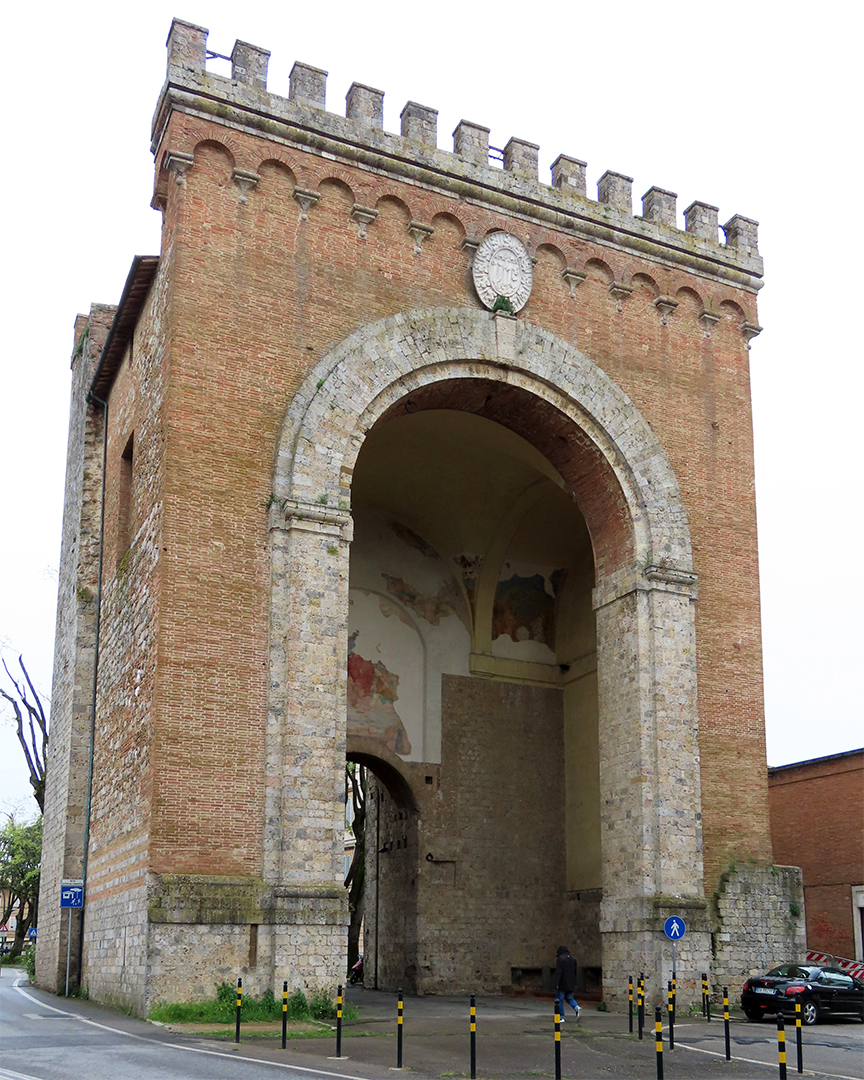
Antiporto di Camollìa
Viale Vittorio Emanuele II
Siena, April 2024
“Porta Camollia was not the only fortification built to defend the northern side of the city, always the most subject to attacks from the rival city of Florence. These two other fortresses were the Torrazzo di Mezzo and the Antiporto. The outermost gate of the city, also known as ‘Portone’ (gate) or ‘Portone dipinto’ (painted gate), now commonly called ‘Antiporto di Camollia’, according to documentary sources, was begun around 1270. It has long been believed that there was a fresco by Simone Martini inside the building. However, several petitions over the years, as early as 1300, have never highlighted works in this regard. The works of Giuseppe Nasini were absolutely real: in this grandiose portico he represented a sort of magical forest with the branches of the plants that, intertwining, formed circles with the coats of arms of the 17 districts inside. Despite the bombing of 1944 and the considerable damage suffered, these coats of arms of the districts survived, but what was not damaged by the war, was damaged did the man. With an ‘inappropriate’ restoration not many years ago, these drawings were definitively cancelled.” (Antiporto of Camollia, Nice Places)
Sunday, March 2, 2025
Colonna del Portogallo
Viale Vittorio Emanuele II
Siena, April 2024
“The Column of Portugal is a monument in Siena, located in Viale Vittorio Emanuele II, between Porta Camollia and the Antiporto di Camollia. The column commemorates the meeting that took place here on 24 February 1452 between Frederick III of Habsburg and Eleonora of Portugal, accompanied by 400 Sienese ladies, in the presence of the then bishop of Siena Enea Silvio Piccolomini. The scene had such an impact on the society of the time that it was also depicted by Pinturicchio in the Piccolomini Library. The column is surmounted by a plaque commemorating the event and by the coats of arms of the Empire and the House of Portugal.” (Colonna del Portogallo, Wikipedia)
Thursday, February 20, 2025
Fontana dell'Istrice
Istrice (Porcupine) fountain by Vico Consorti, 1962
Via Malta
Siena, April 2024
“Istrice occupies the north-westernmost edge of Siena and contains the San Vincenzo e Anastasio church, home of the city's oldest surviving fresco and burial place of Pinturicchio. Traditionally, its residents were blacksmiths. Istrice's symbol is a porcupine. Its colours are white, red, blue and black.” (Contrade of Siena, Wikipedia)
Monday, February 10, 2025
Madonna del Rosario
Chapel of the Madonna del Rosario
Via del Pignattello
Siena, April 2024
“The Chapel of the Madonna del Rosario is a small, Baroque style, originally Roman Catholic, but now deconsecrated oratory or church located between via San Marco and via della Diana in the contrada of the Chiocciola (snail), in the city of Siena, Tuscany, Italy. It association with the neighborhood also gained the scenic building the name of the Chapel of the Chiocciola. The chapel is located some 200 meters west and uphill of Porta San Marco.” (Chapel of the Madonna del Rosario, Wikipedia)
Friday, January 31, 2025
Fontana di Pantaneto
Via Pantaneto
Siena, April 2024
“La Fontana di Pantaneto, now known as the Fontana del Leocorno is a public monumental fountain located on Via Pantaneto in Siena, region of Tuscany, Italy. The fountain is located across from Via Pantaneto #19. The first fountain at the site was built in 1457 using funds from the Comune of the city. The first fountain was merely an unceremonious niche in the wall with a basin. In the niche a sculpted head of an old lady, called the vecchia di Pantaneto was placed. In 1807, the aristocrat Vinceslao Malavolti, after refurbishing his nearby Palazzo Sozzini, commissioned the architect Agostino Belli to embellish the fountain. Agostino drew up a Neoclassic-style project with doric columns, central basin and a statuary group with Neptune surrounded by four tritons. The sculpture was completed by Antonio Zini. The staining and leaching of the marble led to degradation of this pompous tableaux, and by 1866, a new fountain was commissioned from the engineer Girolamo Tarducci. The engineer dismissed artistry, and reformulated the fountain as a basic functional public water source. In 1997, the Contrada del Leocorno reconstructed the fountain under the designs of Carlo Nepi as two basins fed from the horns of two modern bronze unicorn (leocorno) heads, cast by the sculptor Francesco Carone. While in the center of the niche, surrounded by doric columns, is a round window, and below a plaque with the shield of Siena, are an announcement of the 1866 reconstruction. Below a droll mask also can provide water.” (Fontana di Pantaneto, Wikipedia)
Wednesday, January 29, 2025
Loggia del Papa
Loggia del Papa
Logge del Papa
Siena, April 2024
“The Loggia del Papa is a 15th-century Renaissance architecture, open-air arcade in piazza of the same name in Siena, region of Tuscany, Italy. The Loggia was erected by the Pope Pius II in honor of his family, whose Palazzo Piccolomini (delle Papesse) stands nearby on Banchi di Sotto, where it converts into Via di Pantaneto, that runs on the lower flank, to the left when facing the loggia. To the right is the baroque church of San Martino. The frieze reads ‘Gentilibus suis Picolomineis’ (Family of Piccolomini). The design is attributed to Antonio Federighi. Construction began in 1462, and was completed within the year. The Via di Pantaneto flank of the loggia has a series of heraldic shields with the Piccolomini emblems, five supine crescent moons on a cross.” (Loggia del Papa, Wikipedia)
Monday, January 27, 2025
Fontana della Lupa
Lupa (She-wolf) fountain by Emilio Montagnani, 1962
Via Pian d'Ovile
Siena, April 2024
“Lupa is situated to the north of the Piazza del Campo. Traditionally, the residents of Lupa were bakers. Lupa's symbol is a female wolf nursing twins. Its colors are black and white, trimmed with orange. The she-wolf of this contrada refers to the legend that Siena was founded by Senius and Aschius, the sons of Remus, who were raised by a wolf. Because of this, Lupa's sister city is Rome.” (Contrade of Siena, Wikipedia)
Saturday, January 25, 2025
Santa Maria in Provenzano
Piazza Provenzano
Siena, April 2024
“Santa Maria in Provenzano, or the Insigne Collegiata di Santa Maria in Provenzano, is a late-Renaissance-Baroque style, Roman Catholic, l collegiate church in Piazza Provenzano Salvani, in the Terza Camollia, just southwest of the basilica of San Francesco, in the city of Siena, region of Tuscany, Italy. This Marian shrine was built around a 14th-century terracotta icon of the Madonna, which was credited with miracles. The Palio of Siena takes place on the day of veneration of this Marian devotion. The church was consecrated on October 16, 1611 by the archbishop Camillo Borghesi. The image, which originally was in an aedicule on a wall next to a house, was carried by a procession (translated) into the church on this day. The event was painted by Taddeo Gregori. This painting is presently in the Sacristy of the Collegiata. The procession's members included the widowed former grand-duchess Cristina of Lorraine and the reigning Grand-Duchess Maria Maddalena d'Austria.” (Santa Maria in Provenzano, Wikipedia)
Thursday, January 23, 2025
Fontebranda
Fontebranda
Via Fontebranda
Siena, April 2024
“Fontebranda is one of the medieval fountains of Siena, located in Terzo di Camollia, in the Contrada of Oca, near the Porta of Fontebranda. The fountain was built in the 13th century by the Guild of the Wool-makers (Lana). The first mention of a fountain was in 1081, and documents speak of enlargement by Bellamino in 1193, and finally rebuilt in its present form in 1246. The fountain is cited by Dante Alighieri in the Divine Comedy (Inferno - Canto trentesimo|Inferno XXX, vv. 76-78). The fountain front has three Gothic arches and a crenellated roof. The roof spans a tank fed by water traveling for kilometers to reach the city. The structure was so large, due to multiple use: to get drinking water for men and, separately, for animals, and to wash clothes, especially the textiles made by Arte della Lana (Guild of Wool-makers).” (Fontebranda, Wikipedia)
Tuesday, January 21, 2025
Santissima Annunziata
Chiesa della Santissima Annunziata
(Church of the Most Holy Annunciation)
Piazza del Duomo
Siena, April 2024
“The Church of the Santissima Annunziata (Chiesa della Santissima Annunziata) in Siena is a significant Catholic place of worship with a deep-rooted history tied to the city’s heritage. Located in the Terzo di Città area, this church uniquely sits in the oldest nucleus of the ancient Spedale di Santa Maria della Scala, facing the illustrious Piazza del Duomo, opposite the cathedral. Originally serving as a chapel for the hospital, its existence is recorded as early as 1090 in historical documents. Constructed in 1257, the Church of the Santissima Annunziata underwent major transformations in the latter half of the 15th century. This renovation was led by Guidoccio of Andrea and prominently assisted by Francesco di Giorgio, a notable artist and architect of the time. Francesco was instrumental in designing the lavish (now lost) decorations of the noble tribune, or the apse area, as well as the intricate coffered ceiling of the church.” (Church of the Santissima Annunziata, GPSMyCity)
Sunday, January 19, 2025
Fontana della Selva
Selva (Forest) fountain by Vinicio Guastatori, 1965
Piazzetta della Selva
Siena, April 2024
“Selva runs west from the Piazza del Campo in the centre of the city. Traditionally, its residents were weavers, but when the contrade were mainly military, they had a reputation for being excellent archers. Selva's symbol is a rhinoceros at the base of an oak tree hung with hunting tools. Its colors are green and orange, bordered with white.” (Contrade of Siena, Wikipedia)
Friday, January 17, 2025
Santa Maria dei Servi
San Clemente in Santa Maria dei Servi
Piazza Manzoni
Siena, April 2024
“The Church of Santa Maria dei Servi is a Romanesque style, Roman Catholic church in the Terzo of San Martino in the city of Siena, Tuscany, Italy. The church is built on the site of the former Church of San Clement, which was acquired by the Servite order in the Medieval era. The original Basilica was built in the 13th century, but later underwent reconstruction and transformation which continued until the 15th-16th century. The façade is simple and unadorned, with a single doorway and a rose window (indications of another can be discerned on the wall). It is in the Romanesque period style. The adjoining Campanile is likewise of the 13th century, richly embellished by four orders of windows. It was entirely restored in the 20th century. The church building stands atop it is cook entrance stairs, with views over the Duomo and the Palazzo Publico of Siena.” (Santa Maria dei Servi, Wikipedia)
Wednesday, January 15, 2025
Fontana dell'Onda
Onda (Wave) fountain by Algero Rosi, 1972
Via di Fontanella
Siena, April 2024
“Onda runs south from the Piazza del Campo in the centre of the city. Traditionally, its residents were carpenters. Onda's symbol is a dolphin. Its colours are white and sky blue and the contrada describes itself as ‘The colour of Heaven, the force of the sea.’ Onda has the title of contrada capitana (captain contrada) because in the past its soldiers mounted guard at the Palazzo Pubblico.” (Contrade of Siena, Wikipedia)
Monday, January 13, 2025
Vicolo degli Orefici
Dead-end alley
Vicolo degli Orefici
Siena, April 2024
“Halfway down Via Pagliaresi (also known as Cane e Gatto) is Vicolo degli Orefici (Goldsmiths’ Alley), one of the most characteristic and least-known alleyways in Siena. A long, winding alley that opens onto a timeless world, enriched with plants and flowers, which the inhabitants take great care to tend to in this corner of Siena. This dead-end alley was once open and connected the Cane e Gatto street with the parallel yet distant Vicolo dei Magalotti, which connects Via Pantaneto with Via San Martino.” (Vicolo degli Orefici, VisitSiena)
Saturday, January 11, 2025
Fonte dei Pispini
Nicchio (Seashell) fountain
Fonte dei Pispini
Via dei Pispini
Siena, April 2024
“This most beautiful fountain, built at the expense of the neighborhood's residents in around 1540, was originally constructed on the little piazza of the church of Santa Chiara nei Pispini. Now however, we can admire it instead in the piazza di Santo Spirito. It was moved there in 1936 to make way for the passage of large military vehicles entering the barracks adjacent to its first location. A 1903 picture of it standing in its original location can be seen in Fabio Bargagli-Petrucci's ‘Le Fonti di Siena ed i loro acquedotti’.” (Fonte dei Pispini, The Diana Association)
Thursday, January 9, 2025
San Raimondo al Refugio
Via del Refugio
Siena, April 2024
“San Raimondo, also called San Raimondo al Refugio, is a Baroque style, Roman Catholic church located on the intersection of Via del Refugio and Via di Fiera Vecchia, in the Terzo of Camollia of the city of Siena, region of Tuscany, Italy. The church is dedicated to St Raymond of Pennafort. The church was commissioned in 1596 in the will of the Sienese noble Aurelio Chigi. The church was adjacent to a conservatory for children of impoverished nobility (nobili decaduto) and thus known as di Refugio. In 1798, an earthquake caused some damage. During the 19th-century it served as a school for young women, called the Royal Conservatorio Riuniti, because it was joined to the adjacent Conservatory of Mary Magdalen.” (San Raimondo, Wikipedia)
Tuesday, January 7, 2025
Fountain of San Maurizio
Via San Girolamo
Siena, April 2024
“The Fountain of San Maurizio, also called Samoreci, is a medieval public fountain located at the intersection of Via di Pantaneto and Via San Girolamo in Siena, region of Tuscany, Italy. It is located just outside one set of medieval city walls and the Arco di San Maurizio. Siena is a city without rivers, and during a siege was highly dependent on its aqueducts and urban water sources. Unlike other fountains in the city, it has no cover. A fountain at the site is documented since 1293, prior to this it was a simple cistern. In 1351, the Biccherna funded construction of the fountain which was only completed in 1452. It has been reconstructed across the ages. The center has a coat of arms (1583) of the Medici.” (Fountain of San Maurizio, Wikipedia)
Sunday, January 5, 2025
San Gaetano di Thiene
Via dei Pispini
Siena, April 2024
“The narrow church or oratory of San Gaetano di Thiene is found in the middle of via dei Pispini in Siena, Italy. This oratory of the aristocratic Contrada del Nicchio (Sea-shell) was built from 1683-1700. The simple façade sports a large stucco seashell over the doorway. It houses a 14th-century painting depicting a Madonna and Child with Saints , which is likely the icon of Madonna del Forcone that had been previously venerated at an aedicule where the church stands. Between 1686 -1705, Giacomo Franchini added much of the internal stucco decoration, including statues of Blessed Ambrogio Sansedoni (first niche on left); the second niche and almost in conversation with the first is St Gaetano (Saint Cajetan); on the right are St Vincenzo Ferrer (flame over head) and Blessed Giovanni Colombini with a crucifix in left hand. Next to altar are Saints Bernardino and Caterina of Siena. The ceiling was frescoed with the Theological virtues by Giuseppe Nasini and his pupil Stefano di Francesco Marzi. The work was completed in 1734 by Apollonio Nasini using designs and help by father Giuseppe Nicola.” (San Gaetano di Thiene, Wikipedia)
Friday, January 3, 2025
Fontana della Torre
Torre (Tower) fountain by Mario Berrettini, 1984
Via di Salicotto
Siena, April 2024
“Torre is situated just to the south-east of the Piazza del Campo in the centre of the city, and encompasses Siena's Jewish quarter and synagogue. Traditionally, its residents worked as woolcombers. Torre's symbol is an elephant (the contrada's original name was Liofante or Lionfante) with a tower on its back. Its colours are crimson, striped with white and blue.” (Contrade of Siena, Wikipedia)
Subscribe to:
Posts (Atom)