Showing posts with label Arno. Show all posts

Wednesday, September 21, 2022

Santa Rosa Weir

Pescaia di Santa Rosa (Santa Rosa Weir), Lungarno Vespucci, Florence

Pescaia di Santa Rosa (Santa Rosa Weir)
Lungarno Vespucci
Florence, May 2022

“The weir is an artificial barrage on the river that made it possible to properly channel and convey water in order to exploit it to produce energy for hydraulic factories. The Santa Rosa weir was located in the area of Cascine Park (the other large weir of Florence was the one of San Niccolò, situated in the area of the homonymous gate). It took the water to a fulling mill outside the city. Its structure is still visible today.” (Santa Rosa Weir, Scientific Itineraries in Tuscany)

Sunday, December 20, 2020

Little egret

Little egret, Giardino delle vittime di via Fani, Lungarno Aldo Moro, Florence

Little egret
Giardino delle vittime di via Fani
Lungarno Aldo Moro
Florence, January 2020

“The little egret (Egretta garzetta) is a species of small heron in the family Ardeidae. The genus name comes from the Provençal French Aigrette, ‘egret’, a diminutive of Aigron, ‘airone’. The species epithet garzetta is from the Italian name for this bird, garzetta or sgarzetta. It is a white bird with a slender black beak, long black legs and, in the western race, yellow feet. As an aquatic bird, it feeds in shallow water and on land, consuming a variety of small creatures. It breeds colonially, often with other species of water birds, making a platform nest of sticks in a tree, bush or reed bed. A clutch of bluish-green eggs is laid and incubated by both parents. The young fledge at about six weeks of age. Its breeding distribution is in wetlands in warm temperate to tropical parts of Europe, Africa, Asia, and Australia. A successful colonist, its range has gradually expanded north, with stable and self-sustaining populations now present in the United Kingdom.” (Little egret, Wikipedia)

Monday, December 14, 2020

Hooded crow

Hooded crow, Giardino delle vittime di via Fani, Lungarno Aldo Moro, Florence

Hooded crow
Giardino delle vittime di via Fani
Lungarno Aldo Moro
Florence, January 2020

“The hooded crow (Corvus cornix) (also called hoodie) is a Eurasian bird species in the genus Corvus. Widely distributed, it is also known locally as Scotch crow and Danish crow. In Ireland, it is called ‘caróg liath’ or grey crow, as it is in the Slavic languages and in Danish. In German, it is called ‘mist crow’ (Nebelkrähe). Found across Northern, Eastern, and Southeastern Europe, as well as parts of the Middle East, it is an ashy grey bird with black head, throat, wings, tail, and thigh feathers, as well as a black bill, eyes, and feet. Like other corvids, it is an omnivorous and opportunistic forager and feeder.” (Hooded crow, Wikipedia)

Tuesday, December 8, 2020

Ponte di Varlungo

Ponte di Varlungo, Varlungo Bridge, seen from Lungarno Aldo Moro, Florence

Ponte di Varlungo (Varlungo Bridge), 1981
Seen from Lungarno Aldo Moro
Florence, January 2020

Thursday, September 3, 2020

Lungarno degli Acciaiuoli

Lungarno degli Acciaiuoli, Florence

Lungarno degli Acciaiuoli
Florence, January 2020

“On May 26, 2016, plans were announced to redevelop lungarno Acciaiuoli, which runs between the Ponte Vecchio and Ponte Santa Trinita. The city intends to restore the popular promenade to its former glory thanks to a 1 million euro investment with a total of 350,000 euro donated by Lungarno Alberghi Srl, the Ferragamo family hotel and hospitality chain, and financial services company Palazzo Feroni Finanziaria. Utility companies Publiacqua S.p.A., Toscana Energia S.p.A., Telecom S.p.A. and SILFI S.p.A. will invest approximately 750,000 euro in the urban renewal project. In its heyday back in the nineteenth century, the walkway was paved in stone. This project will replace the current asphalt with pietra forte, a type of sandstone mixed with reinforced concrete, the same used in via Tornabuoni. The footpaths will be widened, while space will remain for taxis and disabled access.” (The all-new lungarno Acciaiuoli, The Florentine)

Friday, August 28, 2020

Ponte Vecchio

Ponte Vecchio, Old Bridge, seen from the Ponte Santa Trinita, Holy Trinity Bridge, Florence

Ponte Vecchio (Old Bridge)
Seen from the Ponte Santa Trinita (Holy Trinity Bridge)
Florence, January 2020

“The Ponte Vecchio (Old Bridge) is a medieval stone closed-spandrel segmental arch bridge over the Arno River, in Florence, Italy. It is noted for the shops built along it, as was once common. Butchers, tanners, and farmers initially occupied the shops; the present tenants are jewelers, art dealers, and souvenir sellers. The Ponte Vecchio's two neighboring bridges are the Ponte Santa Trinita and the Ponte alle Grazie. The bridge spans the Arno at its narrowest point where it is believed that a bridge was first built in Roman times, when the via Cassia crossed the river at this point. The Roman piers were of stone, the superstructure of wood. The bridge first appears in a document of 996 and was destroyed by a flood in 1117 and reconstructed in stone. In 1218 the Ponte alla Carraia, a wooden structure, was established nearby which led to it being referred to as ‘Ponte Nuovo’ relative to the older (Vecchio) structure. It was swept away again in 1333 except for two of its central piers, as noted by Giovanni Villani in his Nuova Cronica. It was rebuilt in 1345.” (Ponte Vecchio, Wikipedia)

Sunday, July 5, 2020

Pescaia di Santa Rosa

Pescaia di Santa Rosa, Santa Rosa Weir, Lungarno Vespucci, Florence

Pescaia di Santa Rosa (Santa Rosa Weir)
Lungarno Vespucci
Florence, January 2020

“The weir is an artificial barrage on the river that made it possible to properly channel and convey water in order to exploit it to produce energy for hydraulic factories. The Santa Rosa weir was located in the area of Cascine Park (the other large weir of Florence was the one of San Niccolò, situated in the area of the homonymous gate). It took the water to a fulling mill outside the city. Its structure is still visible today. The Arno’s complex characteristics have often been the object of studies aimed at solving, or at least checking, the problems periodically posed by its waters. In 1631, Galileo Galilei presented a report in the form of a letter to Grand Duke Ferdinando II, concerning the proposal of Sigismondo Coccapani to transform the Arno into a canal, making it navigable from its mouth until Florence, and freeing the countryside from the frequent floods. The idea was not new, as it had already been advanced in 1458 during the Republic of Florence. Moreover, in the times of Ferdinando I, Antonio da Sangallo had designed a possible canalization of the River Arno from Livorno to the swampland known as ‘Chiane’ to the Tiber.” (Santa Rosa Weir, Scientific Itineraries in Tuscany)

Wednesday, May 2, 2018

Lungarno degli Archibusieri

Lungarno degli Archibusieri seen from the Ponte Vecchio, Florence

Lungarno degli Archibusieri
Seen from the Ponte Vecchio
Florence, December 2017

Saturday, March 24, 2018

Lungarno Corsini

Palazzo Corsini, Lungarno Corsini, Florence

Palazzo Corsini
Lungarno Corsini
Florence, December 2017

“The Palazzo Corsini is a monumental palace located on Via del Parione 11, with a facade towards the Arno River, in Florence, region of Tuscany, Italy. ‘The site had been appropriated from the Ardinghelli family prior to the 17th century by the Medici, who built a casino, a small house with gardens extending to the river. In 1649, it was purchased by Maria Maddalena Macchiavelli, the wife of the Marchese Filippo Corsini, from the Grand Duke Ferdinando II de’ Medici. The palace was constructed during the mid-17th to the 18th centuries, built with one side having a U-shape wings facing the Arno to give maximum view of the river. The initial architects were Alfonso Parigi the Younger, followed by Ferdinando Tacca until 1671. Completing the massive structure was Antonio Maria Ferri.” (Palazzo Corsini, Wikipedia)

Monday, February 19, 2018

Old Citadel

Cittadella and Torre Guelfa, (Citadel and Guelph Tower, Piazza di Terzanaia, Pisa

Cittadella and Torre Guelfa
(Citadel and Guelph Tower)
Piazza di Terzanaia
Pisa, March 2013

“The area of the medieval ‘Tersana’ (darsena or shipyard) expanded during 13th century at the time when military victories and the flowering of overseas commerce made it necessary for the city to find a suitable site for naval purposes. Military defeats in the following century and a crisis in mercantile activities caused this area to be turned into a fortress, with the first battlements in brickwork on the walls. The Tersana, gradually enhanced with the addition of other towers (the Ghibellina, St. George and the towers on the Arno (or Degazia), definitively became a fortress under the Florence after 1406, when the wall along the river was strengthened and a completely new tower, 18m tall, the torre Guelfa (or Citadel tower), was built. It was given the name Guelfa in contraposition to the Ghibellina tower.” (Torre Guelfa and the old Citadel, Terre di Pisa)

Thursday, September 21, 2017

Two Men in a Boat

Two men in a boat, Lungarno degli Acciaiuoli, Florence

Two men in a boat
Lungarno degli Acciaiuoli
Florence, April 2015

“You will then get on board the barchetto, one of the only 4 original traditional wooden boats left in Florence, conducted by a ‘barcaiolo’, a true Florentine tradition holder that will guide you with his long-reaching sweeping-oar. No noisy engines, only the charm of tradition and the voice of your expert guide to unveil the secrets of the Arno river as you stroll on its calm waters and discover its history and the beautiful Palazzos that frame its ancient riverbed.” (Florence Boat Tour, City Discovery)

Saturday, July 15, 2017

The Green Balcony

A green balcony, Ponte Vecchio (Old Bridge), Florence

A green balcony
onte Vecchio (Old Bridge)
Florence, April 2017

“It has always hosted shops and merchants who displayed their goods on tables before their premises, after authorization of the Bargello (a sort of a lord mayor, a magistrate and a police authority). The back shops (retrobotteghe) that may be seen from upriver, were added in the seventeenth century. It is said that the economic concept of bankruptcy originated here: when a money-changer could not pay his debts, the table on which he sold his wares (the ‘banco’) was physically broken (‘rotto’) by soldiers, and this practice was called ‘bancorotto’ (broken table; possibly it can come from ‘banca rotta’ which means ‘broken bank’). Not having a table anymore, the merchant was not able to sell anything.” (Ponte Vecchio, Wikipedia)

Sunday, October 16, 2016

Colorful Ponte Vecchio

Colorful Ponte Vecchio seen from Lungarno degli Archibusieri, Florence

Detail of the Ponte Vecchio (Old Bridge)
Seen from Lungarno degli Archibusieri
Florence, May 2016

Wednesday, February 17, 2016

Ponte Vecchio at Dusk

Ponte Vecchio at dusk, seen from the Ponte alle Grazie, Florence

Ponte Vecchio (Old Bridge) at dusk
Seen from the Ponte alle Grazie
Florence, October 2015

Sunday, July 6, 2014

Fishing in the Arno

Fishing in the river Arno, Pescaia di Santa Rosa, Florence

Fishing in the river Arno
Pescaia di Santa Rosa
Florence, October 2013

Monday, December 2, 2013

Bridges of Florence

Ponte Vecchio, Old Bridge, Ponte Amerigo Vespucci, Ponte alla Carraia, Florence

The Ponte Vecchio with the Ponte Santa Trinita almost hidden behind
Ponte Amerigo Vespucci, Ponte alla Carraia
Ponte alla Vittoria, Ponte della Tramvia
(One of the towers of the Ponte dell'Indiano is also visible beyond the trees)
Florence, October 2013

Saturday, November 16, 2013

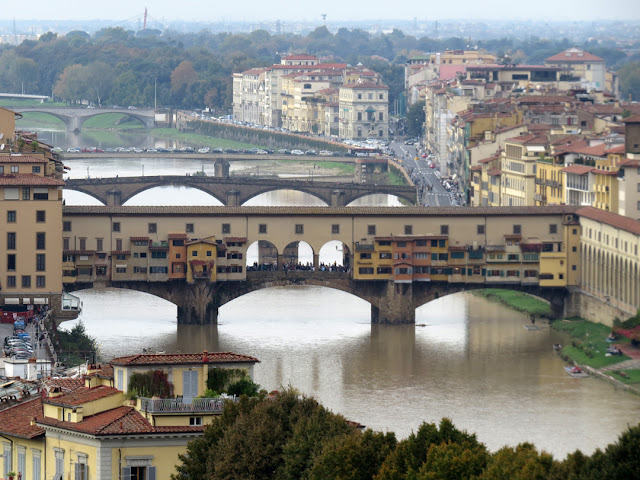
Ponte Vecchio

Ponte Vecchio, Old Bridge, Florence

The Ponte Vecchio (Old Bridge) seen from the Ponte alle Grazie
Above the shops runs the Corridoio Vasariano (Vasari Corridor)
Florence, October 2013

“This charmingly simple bridge was built in 1345 to replace an earlier bridge swept away by flood. Its shops first housed butchers, then grocers, blacksmiths, and other merchants. But in 1593 the Medici grand duke Ferdinand I (1549–1609), whose private corridor linking the Medici palace (Palazzo Pitti) with the Medici offices (the Uffizi) crossed the bridge atop the shops, decided that all this plebeian commerce under his feet was unseemly. So he threw out the butchers and blacksmiths and installed 41 goldsmiths and eight jewelers. The bridge has been devoted solely to these two trades ever since.” (Ponte Vecchio, Fodor's Travel)

Wednesday, April 14, 2010

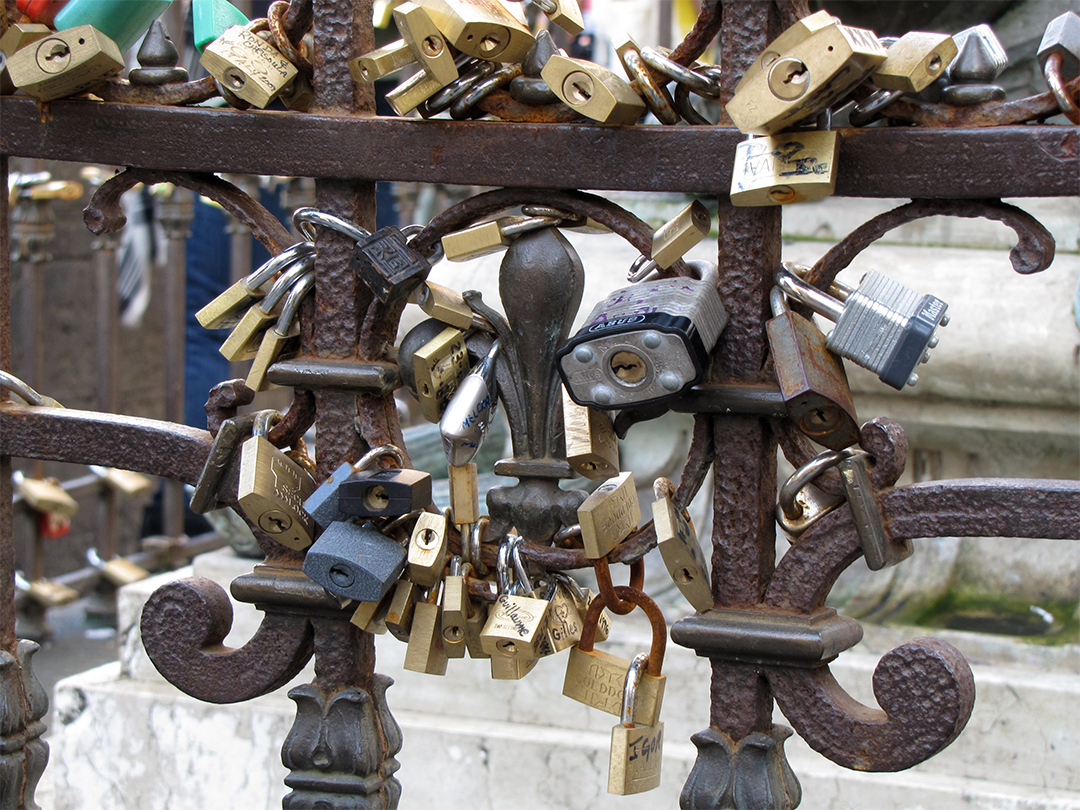
Love Padlocks

Love padlocks at the railing, bust of Benvenuto Cellini by Raffaele Romanelli, Ponte Vecchio, Florence

Love padlocks at the railing
Bust of Benvenuto Cellini by Raffaele Romanelli
Ponte Vecchio
Florence, December 2009

See also: Cadenas d'amour - Ksusha and Kolia - Pont de l'Archevêché - Ponte Milvio - Not Anymore

Wednesday, March 17, 2010

Florentine Sundial

14th century sundial, Ponte Vecchio, Florence

Sundial (14th century)
Ponte Vecchio
Florence, December 2009

Saturday, December 19, 2009

Lungarno

Palazzo Spini Feroni, Santa Trinita Bridge, Lungarno Corsini, Lungarno Acciaiuoli, Florence

Palazzo Spini Feroni and Santa Trinita Bridge
Lungarno Corsini and Lungarno degli Acciaiuoli
Florence, December 2009