Tuesday, May 7, 2019
Handtuchhaus
‘Handtuchhaus’ (Towel building) by Helmut Jahn, 1994
Kurfürstendamm / Lewishamstraße
Berlin, September 2011
“Kudamm 70 – here, you find the widely known ‘Handtuchhaus’ (towel building), i.e. the narrowest office building of Berlin, which was built in 1992-94 by star architect Helmut Jahn on a lot no broader than 2.5 metres. In 2012, Volland Projekte modernised the entire building technology, and optimised the utilization concept of this seven-storey office building. In order to expand the floor area, the building now protrudes up to five metres into the room depth – an exceptional measure which was taken to ideally exploit the narrow lot of 25 x 2.5 metres. The office building, which is “as narrow as a towel”, not least impresses due to its imposing facade of glass and steel. The residential house with its seven office units comprises a floor area of 730 m².” (Kurfürstendamm 70, Volland Group)
Monday, May 6, 2019
Mother of Christ and Saints
Detail of the facade of Santa Maria del Fiore (Saint Mary of the Flower)
Piazza del Duomo
Florence, December 2009
“The competition for a new façade turned into a huge corruption scandal. The wooden model for the façade of Buontalenti is on display in the Museum Opera del Duomo. A few new designs had been proposed in later years, but the models (of Giovanni Antonio Dosio, Giovanni de' Medici with Alessandro Pieroni and Giambologna) were not accepted. The façade was then left bare until the 19th century. In 1864, a competition held to design a new façade was won by Emilio De Fabris (1808–1883) in 1871. Work began in 1876 and was completed in 1887. This neo-gothic façade in white, green and red marble forms a harmonious entity with the cathedral, Giotto's bell tower and the Baptistery, but some think it is excessively decorated. The whole façade is dedicated to the Mother of Christ.” (Florence Cathedral, Wikipedia)
Sunday, May 5, 2019
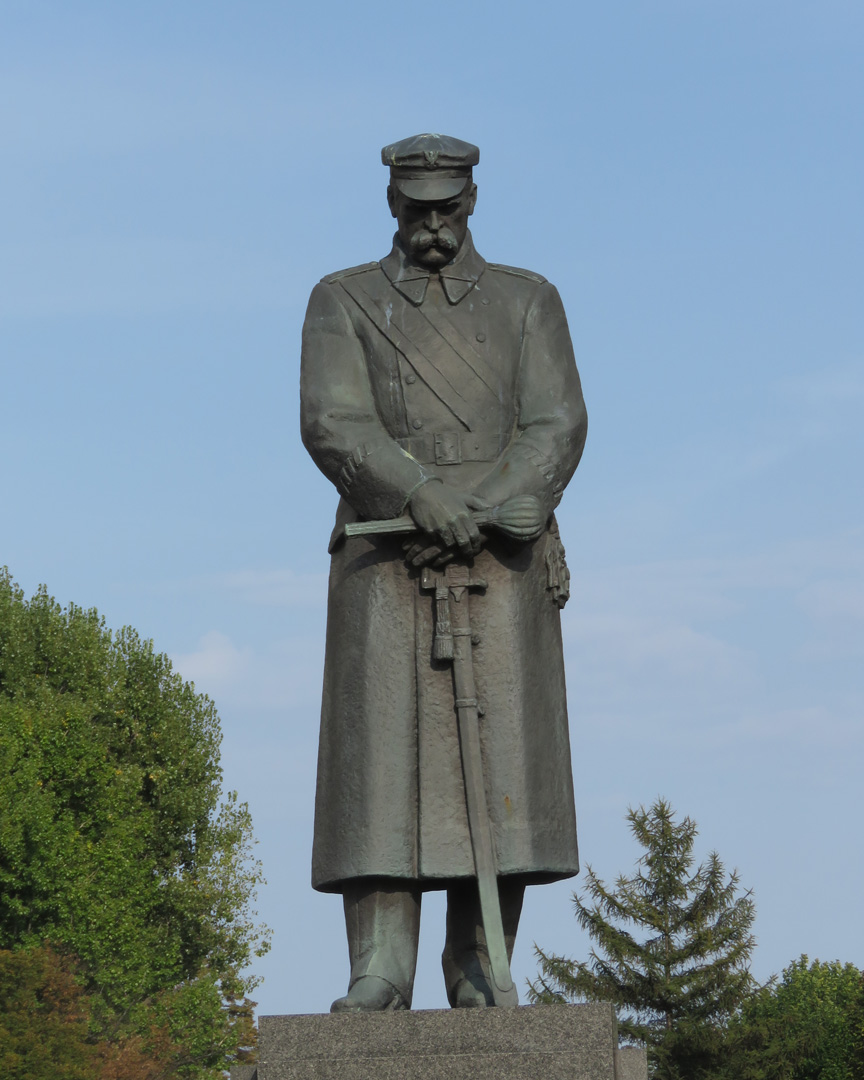
Józef Piłsudski Monument
Józef Piłsudski Monument by Tadeusz Łodziana, 1995
Piłsudski Square
Warsaw, September 2018
“The Józef Piłsudski Monument in Warsaw was erected to honor Józef Piłsudski, a military leader, Marshal of Poland and one of the main figures responsible for Poland's regaining its independence. This 3 metres (9.8 ft) tall, bronze and granite statue is located near Piłsudski's Square and the Hotel Europejski, at Tokarzewski-Karaszewicz Street. It bears the inscriptions ‘Józef Piłsudski’ and ‘Marshal of Poland’. Plans to raise the monument can be traced to 1990, when the president of Warsaw Stanisław Wyganowski endorsed the request of a group campaigning for the creation of a monument to Piłsudski. The monument, cast in the Polish Navy Shipyards, was unveiled on 14 August 1995, on the 75th anniversary of the Battle of Warsaw, which was commanded by Piłsudski. The unveiling was attended by the President of Poland, Lech Wałęsa, and Piłsudski's daughter, Jadwiga Piłsudska. The original plans called for the monument to be raised at Na Rozdrożu Square, but were later modified to site it near the Łazienki. This decision was protested by the supporters of the monument, who declared the new location too minor, and the monument was moved to the current location. The current location has been and still is seen as controversial; for example the statue's designer, Tadeusz Łodziana, expressed his opposition to it in a letter shortly before the monument was unveiled, pointing out that it would cause the monument to be isolated from most ceremonies that take place on the square. Others have specifically criticized the fact that the location of the monument causes Polish soldiers to often face away from it during the guard change ceremony at the nearby Tomb of the Unknown Soldier, Warsaw, and during the observances for Polish Independence Day, which they regard as disrespectful.” (Józef Piłsudski Monument, Wikipedia)
Saturday, May 4, 2019
Alfred de Musset
Grave of Alfred de Musset (1810-1857)
Cimetière du Père-Lachaise, (Père Lachaise Cemetery)
Quartier du Père-Lachaise, 20th arrondissement
Paris, July 2014
“Alfred Louis Charles de Musset-Pathay (11 December 1810 – 2 May 1857) was a French dramatist, poet, and novelist. Along with his poetry, he is known for writing the autobiographical novel La Confession d'un enfant du siècle (The Confession of a Child of the Century). Musset was born in Paris. His family was upper-class but poor and his father worked in various key government positions, but never gave his son any money. His mother came from similar circumstances, and her role as a society hostess – for example her drawing-room parties, luncheons and dinners held in the Musset residence – left a lasting impression on young Alfred. Early indications of Musset's boyhood talents were seen by his fondness for acting impromptu mini-plays based upon episodes from old romance stories he had read. Years later, elder brother Paul de Musset would preserve these, and many other details, for posterity, in a biography on his famous younger brother.” (Alfred de Musset, Wikipedia)
Friday, May 3, 2019
Church of San Sepolcro
Piazza San Sepolcro
Milan, November 2016
“Chiesa di San Sepolcro is a church in Milan, Italy. It was originally built in 1030, but has undergone multiple revisions. The church is located at Piazza San Sepolcro in the historic center of Milan. The latest interior restoration was in 1713–1719, while the present Neo-Romanesque facade was completed in 1894–1897, under the designs of Gaetano Moretti and Cesare Nava. The Bramantino frescoes were moved from the portal to the inside of the church. Other works inside are attributed to Francesco Maria Richini and Carlo Bellosio.” (Church of San Sepolcro, Wikipedia)
Thursday, May 2, 2019
Wednesday, May 1, 2019
Säule in der Brandung
“Säule in der Brandung” (Column in the midst of Waves)
By Brigitte und Martin Matschinski-Denninghoff, 1975
Adenauerplatz, Charlottenburg
Berlin, September 2011
Subscribe to:
Posts (Atom)