Showing posts with label theater. Show all posts
Saturday, December 13, 2025
Teatro Regio
Teatro Regio
Strada Garibaldi
Parma, May 2024
“Teatro Regio di Parma, originally constructed as the Nuovo Teatro Ducale (New Ducal Theatre), is an opera house and opera company in Parma, Italy. Replacing an obsolete house, the new Ducale achieved prominence in the years after 1829, and especially so after the composer Giuseppe Verdi, who was born near Busseto, some thirty kilometres away, had achieved fame. Also well known in Parma was the conductor Arturo Toscanini, born there in 1867. As has been noted by Lee Marshall, ‘while not as well known as La Scala in Milan or La Fenice in Venice, the city’s Teatro Regio... is considered by opera buffs to be one of the true homes of the great Italian tradition, and the well-informed audience is famous for giving voice to its approval or disapproval – not just from the gallery.’ The 1,400-seat auditorium, with four tiers of boxes topped by a gallery, was inaugurated on 16 May 1829 when it presented the premiere of Vincenzo Bellini's ‘Zaira’, a production which was staged another seven times, although it did not prove to be popular with the Parma audiences. Initially Rossini had been invited to compose a work for the inauguration of the house, but he was too busy and so the task fell to Bellini. However, that inaugural season saw three Rossini operas staged, including ‘Moïse et Pharaon’, ‘Semiramide’, and ‘Il barbiere di Siviglia’.” (Teatro Regio, Wikipedia)
Saturday, October 11, 2025
IMAGE Black light Theatre
Národní, Staré Město
Prague, September 2024
“Today the Theatre IMAGE is a theatre company with its own structure and a regular heartbeat. For several years a stable group of creative partners have been the core of the theatre. As a result of their cooperation an ensemble with its own image has grown and established itself in the world of theatre. Performances of special character arise from work of creators co-operating in a friendly atmosphere. The creators started to gather around them a circle of colleagues with the same approach to the idea of theatre. Still, the growing ensemble has retained its own specific image although the structure of the company had to adjust to changing circumstances. This has made the company an unmistakable part of the Prague theatre scene.” (History, IMAGE Black light Theatre)
Thursday, September 11, 2025
Divadlo na Vinohradech
Divadlo na Vinohradech (Vinohrady Theatre)
Náměstí Míru, Vinohrady
Prague, September 2024
“Vinohrady Theatre (Czech: Divadlo na Vinohradech) is a theatre in Vinohrady, Prague. Construction began on February 27, 1905. It served as the Theatre of the Czechoslovak Army from autumn 1950 to January 1966. It contains a curtain painted by Vladimír Županský depicting a naked muse. Playwrights associated with the theatre include Viktor Dyk who was active around 1915. During the Velvet Revolution, where the Czechoslovak Socialist Republic was overthrown, there was a rally outside the theatre on the night of November 19–20; actress Vlasta Chramostová was quoted as asking the crowd: ‘If not now, when? If not us, then who?’” (Vinohrady Theatre, Wikipedia)
Friday, August 22, 2025
Nová scéna Národního divadla
(New Stage of the National Theater) by Karel Prager, 1983
Národní, Nové Město
Prague, September 2024
“The New Stage of the National Theater is a modern postmodern theater building that was built in Prague's Nové Město on Národní třída between 1977 and 1983. Sometimes it is also referred to as brutalist. In 2021, the New Stage building was declared a cultural monument.” (New Stage, Wikipedia)
Wednesday, August 20, 2025
Musical Dome
Musical Dome
Goldgasse
Cologne, September 2024
“The Musical Dome (2012 to 2015: Oper am Dom) is a 1,640-seat theatre in Cologne, North Rhine-Westphalia, Germany. It opened in October 1996. It was originally built as a temporary performance venue for musicals in Cologne's inner borough of Innenstadt. The building has a distinctive fiberglass and steel structure, and is built on a promenade along the river Rhine, in the centre of the old town, adjacent to Cologne Cathedral. During the night, the Dome is illuminated with blue lights that can be observed from afar. The theater officially opened to the public in 1996. The Musical Dome is located between Breslauer Platz and the banks of the river Rhine near Cologne's main train station. A characteristic of the musical dome is the blue dome-shaped roof that is illuminated at night. In addition to the music hall it also houses a glassed-in foyer with bars, a restaurant, as well as administrative offices and a cloakroom. The building is 174 ft (53m) wide and 253 ft (77m) long with a height of 89 ft (27m) at the highest point. As a result, the covered area is 43,056 sq ft (4,000 m2). The structure consists mainly of steel and glass. The roof, which covers the entire building, is made of polyester and suspended from external 30-ton steel arches. Due to the differences in elevation around the dome, the main entrance on the Rhine side is only accessible indirectly via a balcony structure. Underneath this structure is a paid parking garage for 60 vehicles. The auditorium is divided into two levels: orchestra and balcony.” (Musical Dome, Wikipedia)
Tuesday, August 12, 2025
Národní divadlo
Národní divadlo (National Theatre)
Národní, Nové Město
Prague, September 2024
“The National Theatre (Czech: Národní divadlo) is a historic opera house in Prague, Czech Republic. It is known as the alma mater of Czech opera, and as the national monument of Czech history and art. The National Theatre belongs to the most important Czech cultural institutions, with a rich artistic tradition, which helped to preserve and develop the most important features of the nation–the Czech language and a sense for a Czech musical and dramatic way of thinking.” (National Theatre, Wikipedia)
Sunday, July 27, 2025
Alte Oper
Alte Oper (Old Opera)
Opernplatz
Frankfurt, September 2024
“Alte Oper (Old Opera) is a concert hall in Frankfurt am Main, Hesse, Germany. It is located in the inner city, Innenstadt, within the banking district Bankenviertel. Today's Alte Oper was built in 1880 as the city's opera house, which was destroyed by bombs in 1944. It was rebuilt in the 1970s as a concert hall with a large hall and smaller venues, opened in 1981. The square in front of the building is still known as Opernplatz (Opera Square). Many important works were performed for the first time when it was Frankfurt's opera house, including Schreker's ‘Der ferne Klang’ and Carl Orff's ‘Carmina Burana’ in 1937. The Oper Frankfurt now plays in the Opern- und Schauspielhaus Frankfurt, completed in 1951.” (Alte Oper, Wikipedia)
Tuesday, July 22, 2025
Teatro al Parco
Teatro al Parco
Parco Ducale
Parma, May 2024
“The Teatro al Parco is a permanent theatre in Parma, located inside the Ducal Park. The building was constructed between 1939 and 1941 as a venue for trade fairs on the initiative of the Municipality of Parma, which commissioned the project to engineer Ugo Pescatori. The exhibitions, called from the following year Mostre delle Conserve Alimentari, forerunners of today's Cibus, were held annually in the pavilion for about forty years without interruption, with the exception of a parenthesis during the Second World War, until the construction in 1985 of the exhibition centre near Baganzola. In 1987 the Municipality decided to use the now unused building as a public theatre, subsequently entrusting it, by agreement, to the ‘Compagnia delle Briciole’, founded in 1976 in Reggio Emilia and moved to Parma in 1979, where in 1981 it established the Stable Centre in Italy for the Production, Programming and Research of Children's and Youth Theatre, which later became the Stable Theatre of Innovation. In the early 2000s the building was completely renovated, creating a 400-seat hall and a 150-seat hall.” (Teatro al Parco, Wikipedia)
Saturday, July 5, 2025
Oper Leipzig
Oper Leipzig (Leipzig Opera)
Augustusplatz
Leipzig, September 2024
“Construction of the modern opera house began in 1956. The theater was inaugurated on 8 October 1960 with a performance of Wagner's Die Meistersinger von Nürnberg. Ulf Schirmer became Generalmusikdirektor (General Music Director, or GMD) of the company in 2009. He was elected artistic director (Intendant) in 2011 for a five-year term. Schirmer stood down from both posts in 2022. Tobias Wolff became Intendant of the company in 2022. Christoph Gedschold became music director of the company as of the 2022–2023 season. In May 2023, the company announced that Gedschold is to stand down as its music director as of the close of the 2023–2024 season.” (Leipzig Opera, Wikipedia)
Thursday, April 24, 2025
Semperoper
Semperoper by Gottfried Semper, 1841-78
Theaterplatz
Dresden, September 2024
"The Semperoper is the opera house of the Sächsische Staatsoper Dresden (Saxon State Opera) and the concert hall of the Staatskapelle Dresden (Saxon State Orchestra). It is also home to the Semperoper Ballett. The building is located on the Theaterplatz near the Elbe River in the historic centre of Dresden, Germany. The opera house was originally built by the architect Gottfried Semper in 1841. After a devastating fire in 1869, the opera house was rebuilt, partly again by Semper, and completed in 1878. The opera house has a long history of premieres, including major works by Richard Wagner and Richard Strauss." (Semperoper, Wikipedia)
Saturday, March 8, 2025
Romolo Valli Municipal Theatre
Piazza Martiri del 7 Luglio
Reggio Emilia, May 2024
“The Teatro Municipale (also since the 1980s called the Teatro Municipale Valli due to being named after the actor Romolo Valli) is a theatre in Reggio Emilia, Northern Italy. Following the destruction by fire of the 1741 Teatro Cittadella in April 1851, the new theatre was designed by the architect Cesare Costa and constructed in the neoclassical style between 1852 and 1857. Its inauguration took place on 21 April 1857 with the performance of the Vittor Pisani by local composer Achille Peri.” (Teatro Municipale, Wikipedia)
Wednesday, February 26, 2025
Ariosto Theatre
Ariosto Theatre
Piazza della Vittoria
Reggio Emilia, May 2024
“It was rebuilt in 1878 respecting the original project and dedicated to Ludovico Ariosto, the great poet born in Reggio Emilia in 1474. It hosts mainly theatre performances. The reconstruction of 1878 followed the ‘politeama’ concept, that is, a theatre which can be used both for theatrical and equestrian events. According to the London and Paris models borrowed by all the Italian ‘politeama’, the theatre had a cast iron structure; the cavea took on a semi-circular form; the box arrangement, maintained for the second tier, was replaced in the first and third tiers by single galleries. The orchestra pit was added in 1927 and the structures required for the equestrian shows were removed. At the same time the Theatre was completely redecorated by Anselmo Govi with late Art Nouveau style frescoes: the ones on the dome are particularly interesting, depicting the adventures of Orlando Furioso, and surrounded by a band citing the opening verses of the poem. In 1981 the Theatre underwent a series of restoration works: cleaning, demolition of precarious areas, strengthening or rebuilding of the floor structures (the stage first of all), and the laying of new flooring.” (Ariosto Theatre, Reggio Emilia Welcome)
Tuesday, June 4, 2024
Gran Teatro Falla
Gran Teatro Falla
Plaza Fragela
Cádiz, September 2023
“The Gran Teatro Falla is a theater in the city of Cádiz, Andalusia, Spain. It is located in the Plaza Fragela, facing the Casa de las Viudas and adjacent to the Faculty of Medicine of the University of Cádiz. Construction of the theater began in 1884, following plans by architect Adolfo Morales de los Ríos. It was based on the foundation of the previous Gran Teatro de Cádiz, a wooden building designed by García del Álamo and built in 1871, but which had burned in 1881. In 1886 the city government took over direction of the project, which proceeded only intermittently due to lack of funds. The theater was completed in 1905. Municipal architect Juan Cabrera de la Torre made significant modifications to Morales's original plans. The theater was known as the ‘Gran Teatro’ until 1926 when it was renamed for composer and native son Manuel de Falla. Built in the Neo-Mudéjar style, it is made of red brick, and has three grand horseshoe arch entry doorways on its principal façade, with alternating red and white voussoirs. One enters through these doors into a large vestibule, which was redesigned in the 1920s. Stairways ascend to the horseshoe or ‘U’-shaped galleries above. The stage is 18 metres (59 ft) wide and 25.5 metres (84 ft) deep. The ceiling shows an allegory of Paradise, the work of Felipe Abarzuza y Rodríguez de Arias. Every February the Gran Teatro Falla is the site of the artistic competitions of the Carnival of Cádiz. During repairs and restoration from 1987 to 1991, those competitions were held instead at the now-defunct Teatro Andalucía. Through the rest of the year, the theater hosts all manner of shows, such as plays or concerts.” (Gran Teatro Falla, Wikipedia)
Friday, July 14, 2023
Thursday, June 29, 2023
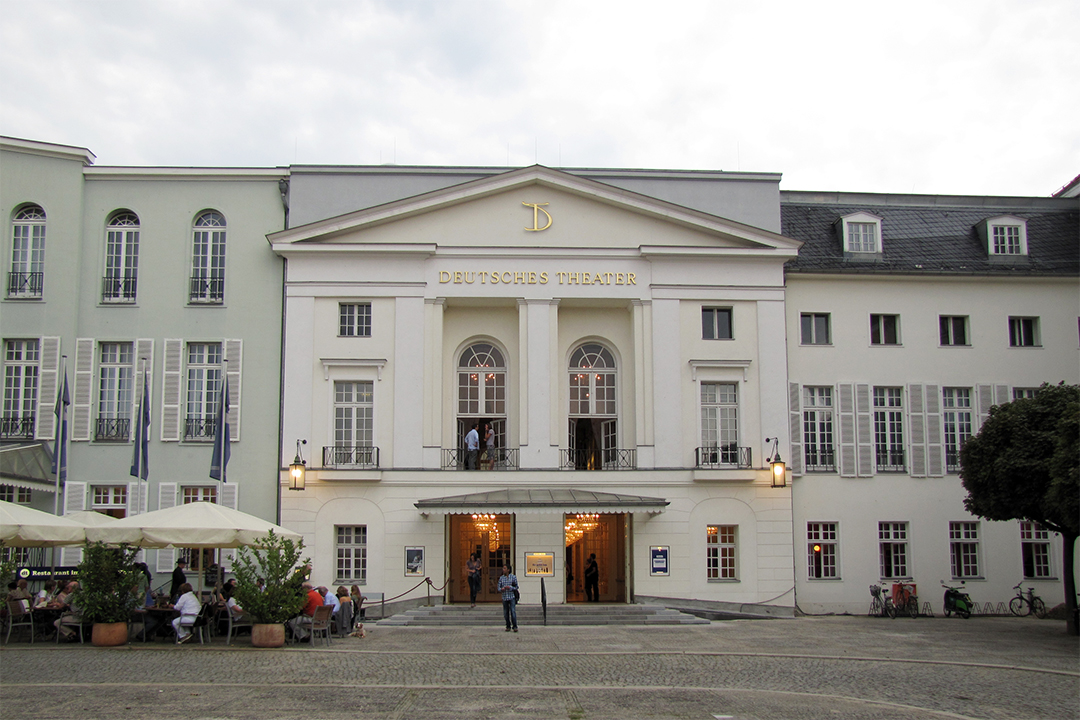
Deutsches Theater
Deutsches Theater
Schumannstraße
Berlin, September 2011
“The Deutsches Theater is a theater in Berlin, Germany. It was built in 1850 as Friedrich-Wilhelm-Städtisches Theater, after Frederick William IV of Prussia. Located on Schumann Street (Schumannstraße), the Deutsches Theater consists of two adjoining stages that share a common, classical facade. The main stage was built in 1850, originally for operettas. Adolf L'Arronge founded the Deutsches Theater in 1883 with the ambition of providing Berliners with a high-quality ensemble-based repertory company on the model of the German court theater, the Meiningen Ensemble, which had been developed by Georg II, Duke of Saxe-Meiningen and his colleagues to become "the most widely admired and imitated company in Europe", thanks to its historically accurate sets and costumes, vividly-realized crowd scenes, and meticulous directorial control. Otto Brahm, the leading exponent of theatrical Naturalism in Germany, took over the direction of the theater in 1894, and applied that approach to a combination of classical productions and stagings of the work of the new realistic playwrights. One of Brahm's ensemble, the legendary theater director Max Reinhardt, took over the directorship in 1904. Under his leadership, it acquired a reputation as one of the most significant theaters in the world. In 1905, he founded a theater school and built a chamber theater. Reinhardt remained the artistic director of the theater until he fled Nazi Germany in 1933. The Deutsches Theater remains one of the most prominent companies in Berlin.” (Deutsches Theater, Wikipedia)
Wednesday, February 22, 2023
Teatro Persio Flacco
Teatro Persio Flacco (Persio Flacco Theater)
Via dei Sarti
Volterra, September 2021
“The Persio Flacco is an active opera and theater stage in Volterra, Italy. Volterra still lacked a proper indoor performance stage in the early nineteenth century. In 1816 a group of citizens, including cavaliere Bartolommeo Falchi, cavaliere Mario Maffei, Luigi Ducci, Francesco Cinci, and Luigi Campani, commissioned the architect Luigi Campani (an architect of the Grand Duke Ferdinand III of Tuscany). The theater was erected on the site of the palazzo belonging to Marchesi Incontri. Work began in 1816 and the theater was inaugurated in 1820. The main curtain (sipario) was painted by Nicola Contestabili, who represented Aulus Persius Flaccus, a Roman satirist and playwright born in Volterra, being led by the muses to the summit of Parnassus, ruled by Apollo. This gave the theater its final name. The ceiling over the seats was painted with Venus in a chariot drawn by swans, and the parapets, with cupids, garlands and vignettes, harmonizing with the curtain. All these beautiful decorations were lost with subsequent restorations. In 1820, a group of 60 prominent citizens formed the Academy of the Riuniti (of the reunited), and purchased the entire theater, assigning to each member property of the individual boxes and seats, and this organization has continuously maintained that theatrical activity. The theater was closed for physical repairs for 15 years, from 1984 to 1999, before the reopening, members donated their ownerships of seats and boxes to the Academy. This availed them of funds to pursue reconstruction.” (Persio Flacco Theater, Wikipedia)
Friday, April 22, 2022
National Stary Theatre
Narodowy Stary Teatr im. Heleny Modrzejewskiej (Helena Modrzejewska National Stary Theater)
Jagiellońska
Stare Miasto (Old Town)
Kraków, September 2018
“The Helena Modrzejewska National Stary Theater in Kraków (Polish: Narodowy Stary Teatr im. Heleny Modrzejewskiej) is one of the oldest public stages in Poland and a national institution of culture, first opened in 1781. It was named after renowned Shakespearean actress Helena Modrzejewska. The theater was created by Feliks Oraczewski, a member of the Polish Parliament (Sejm), and the actor Mateusz Witkowski. On October 17, 1781 the Cracow city authorities gave Witkowski permission to perform comedy under the condition that he pay fifty Polish zloty a month to the municipal treasury. In 1798, Jacek Kluszewski, the starosta of Brzeg, took over the theater and converted two of his own buildings the corner of Szczepański Square and Jagiellonian Street into its permanent home. The theatre is regarded as Poland's leading theatre. In 1997 Krystyna Meissner became the director. Her term here was difficult and the following year she left at the request of the actors. In 2016, the MICET Interactive Museum / Theater Education Center opened in the theater building's 13th century cellars.” (National Stary Theatre, Wikipedia)
Wednesday, August 21, 2019
Sunday, June 16, 2019
Monday, March 11, 2019
Shakespeare's Globe
Shakespeare's Globe
New Globe Walk
Southwark
London, September 2014
“Shakespeare's Globe is a reconstruction of the Globe Theatre, an Elizabethan playhouse for which William Shakespeare wrote his plays, in the London Borough of Southwark, on the south bank of the River Thames. The original theatre was built in 1599, destroyed by the fire in 1613, rebuilt in 1614, and then demolished in 1644. The modern Globe Theatre is an academic approximation based on available evidence of the 1599 and 1614 buildings. It is considered quite realistic, though modern safety requirements mean that it accommodates only 1,400 spectators compared to the original theatre's 3,000. Shakespeare's Globe was founded by the actor and director Sam Wanamaker, built about 230 metres (750 ft) from the site of the original theatre and opened to the public in 1997, with a production of Henry V. The site also includes the Sam Wanamaker Playhouse, an indoor theatre which opened in January 2014. This is a smaller, candle-lit space based on the indoor playhouses of Jacobean London. The Sackler Studios, an educational and rehearsal studio complex, is situated just around the corner from the main site. Michelle Terry currently serves as artistic director. She is the second actor-manager in charge of the organisation, following Mark Rylance, the founding artistic director.” (City of London School, Wikipedia)
Subscribe to:
Posts (Atom)