Showing posts with label Arezzo. Show all posts

Wednesday, May 31, 2023

Logge del Grano

Logge del Grano (Grain Lodges) Market, Piazzetta Logge del Grano, Arezzo

Logge del Grano (Grain Lodges) Market
Piazzetta Logge del Grano
Arezzo, February 2022

“The Badia delle Sante Flora e Lucilla or Abbey of Saints Flora and Lucilla is a Medieval abbey in Arezzo, Tuscany, Italy. Construction of the church began in 1278; and by 1315, the adjacent monastery was built. The cloister (1489) was designed by Giuliano da Maiano. The church was rebuilt starting in 1565 under the designs of Giorgio Vasari. The work was not completed till 1650, when the bell-tower and presbytery were completed. The presbytery has altar (1563) designed by Vasari for his family and once in his parish church of Santa Maria, and moved here in 1865. The church also houses a painted Crucifix (1319) by Segna di Bonaventura and frescoes of the life of St Lawrence (1476) by Bartolomeo della Gatta. The cupola was painted on canvas (1702) by the Baroque painter Andrea Pozzo.” (Badia delle Sante Flora e Lucilla, Wikipedia)

Saturday, May 27, 2023

Badia delle Sante Flora e Lucilla

Badia delle Sante Flora e Lucilla, Piazza della Badia, Arezzo

Badia delle Sante Flora e Lucilla (Abbey of Saints Flora and Lucilla)
Piazza della Badia
Arezzo, February 2022

“The Badia delle Sante Flora e Lucilla or Abbey of Saints Flora and Lucilla is a Medieval abbey in Arezzo, Tuscany, Italy. Construction of the church began in 1278; and by 1315, the adjacent monastery was built. The cloister (1489) was designed by Giuliano da Maiano. The church was rebuilt starting in 1565 under the designs of Giorgio Vasari. The work was not completed till 1650, when the bell-tower and presbytery were completed. The presbytery has altar (1563) designed by Vasari for his family and once in his parish church of Santa Maria, and moved here in 1865. The church also houses a painted Crucifix (1319) by Segna di Bonaventura and frescoes of the life of St Lawrence (1476) by Bartolomeo della Gatta. The cupola was painted on canvas (1702) by the Baroque painter Andrea Pozzo.” (Badia delle Sante Flora e Lucilla, Wikipedia)

Tuesday, May 23, 2023

Vittorio Fossombroni

Vittorio Fossombroni by Pasquale Romanelli, Piazza San Francesco, Arezzo

Vittorio Fossombroni by Pasquale Romanelli, 1864
Piazza San Francesco
Arezzo, February 2022

“Marble statue of Fossombroni with in his right hand a scroll with the hydraulic engineering treaties about the reclamation of the swamps and having his hand on the head of a lion, which in turn has its right leg over a sphere: the allegory of power.” (Vittorio Fossombroni, René & Peter van der Krogt)

Friday, May 19, 2023

Basilica of San Francesco

Basilica of San Francesco, Piazza San Francesco, Arezzo

Basilica of San Francesco
Piazza San Francesco
Arezzo, February 2022

“The Basilica of San Francesco is a late Medieval church in Arezzo, Tuscany, Italy, dedicated to St Francis of Assisi. It is especially renowned for housing in the chancel the fresco cycle Legends of the True Cross by Piero della Francesca. San Francesco is the second church built by the Franciscans in Arezzo, an earlier church being located outside the city walls and destroyed during the Occupation. The building work on San Francesco was begun around 1290. The decoration of its façade was never realised. The interior presents as a large church of simple unadorned design with a wide single nave, flanked on the left side by some chapels and, on the right side, by some niches. The tall groin-vaulted chancel is of square plan. Beneath the church is a smaller Chiesa inferiore or ‘Lower Church’ as at Assisi, with a nave and two aisles, now used as exhibition hall.” (Basilica of San Francesco, Wikipedia)

Monday, May 15, 2023

La Hermana y la Herida

La Hermana y la Herida (The Sister and the Wounded) by Abel Vallmitjana, Giardino del Praticino (Praticino Gardens), Via dell'Orto, Arezzo

“La Hermana y la Herida” (The Sister and the Wounded) by Abel Vallmitjana, 1975
Giardino del Praticino (Praticino Gardens)
Via dell'Orto
Arezzo, February 2022

“Sculpture representing two feminine figures embraced by the anguished and suffering expression. When the Chilean poet Pablo Neruda visited the sculptor in his studio in Tregozzano near Arezzo he saw the plaster model and called it ‘La Hermana y La Herida’, or ‘The Sister and the Wounded’. When Vallmitjana died, the sculpture was still unfinished. His widow had it finished and cast and donated it to the city of Arezzo.” (The Sister and the Wounded, René & Peter van der Krogt)

Thursday, May 11, 2023

Tempietto alla Vittoria del Prato

Tempietto alla Vittoria del Prato, Via dell'Orto, Arezzo

Tempietto alla Vittoria del Prato by Giuseppe Castellucci
Via dell'Orto
Arezzo, February 2022

Sunday, May 7, 2023

Palazzo della Fraternita dei Laici

Palazzo della Fraternita dei Laici (Palace of the Lay Fraternity) by Bernardo Rossellino, Piazza Grande, Arezzo

Palazzo della Fraternita dei Laici (Palace of the Lay Fraternity) by Bernardo Rossellino, 1550
Piazza Grande
Arezzo, February 2022

Wednesday, May 3, 2023

The old well

The old well, Piazza Grande, Arezzo

The old well
Piazza Grande
Arezzo, February 2022

“Twice a year the Saracino Joust fills this place with magic. The banners of the flag-wavers color the sky, drum rolls and claps of light resound in the air. From the well of Piazza Grande the knights of the four districts of Arezzo leave in career launches in remnant to challenge the Buratto King of the Indies.” (Piazza Grande and the Vasari Loggia, Discover Arezzo)

Saturday, April 29, 2023

Fonte Pubblica

Fonte Pubblica (Public Fountain), Piazza Grande, Arezzo

Fonte Pubblica (Public Fountain)
Piazza Grande
Arezzo, February 2022

“In his Nuova Guida per la città di Arezzo, Oreste Brizi states that the Public Fountain is situated on the left of Piazza Grande and supplied by waters which travel for more than a mile from the aqueduct and the Fortress Hill tunnel. The adductor aqueduct and tunnel were realised in 1600 on a plan and under the direction of engineer Santi di Pagni. The fountain in Piazza Grande supplied the Public Fountain and the horse trough in via Sant’Agostino and «the water reached there after serving various wheat mills situated between one fountain and the other», as well as a wash-house on the same street, ‘the water of which then gave motion to the millstones of other mills in the city’.” (Public Fountain of Arezzo, IMSS)

Tuesday, April 25, 2023

Apse of Santa Maria della Pieve

Apse of Santa Maria della Pieve, Piazza Grande, Arezzo

Apse of Santa Maria della Pieve
Piazza Grande
Arezzo, February 2022

“The 13th century apse has also two rows of loggia which recall the façade's structure, repeating the use of different style capitals. The sides have mullioned windows.” (Santa Maria della Pieve, Wikipedia)

Friday, April 21, 2023

One hundred holes

Bell tower, Santa Maria della Pieve, Corso Italia, Arezzo

“One hundred holes” bell tower
Santa Maria della Pieve
Corso Italia
Arezzo, February 2022

“The bell tower has a sturdy appearance with five rows of mullioned windows. Internally, the base houses the baptistery. The baptismal font dates to the 14th century, and has panels with Stories of St. John the Baptist by Giovanni d'Agostino (1332–1333).” (Santa Maria della Pieve, Wikipedia)

Monday, April 17, 2023

Santa Maria della Pieve

Facade, Santa Maria della Pieve, Corso Italia, Arezzo

Santa Maria della Pieve
Corso Italia
Arezzo, February 2022

“The church's most striking feature is its façade, with a five-arch lower floor surmounted by three loggias, with the number of columns increasing with the elevation. The columns, and its capitals, are each different from the other (one is a statue). The original façade had no particular features, the current decoration having been added in the 12th century.” (Santa Maria della Pieve, Wikipedia)

Thursday, April 13, 2023

Church of San Michele

Church of San Michele, Piazza San Michele, Arezzo

Church of San Michele
Piazza San Michele
Arezzo, February 2022

“This church has a modern façade. Traces of the original Romanesque edifice and the Gothic restoration can be seen in the interior.” (Arezzo, Wikipedia)

Sunday, April 9, 2023

Church of St. Augustine

Church of St. Augustine, Piazza di Sant'Agostino, Arezzo

Church of St. Augustine, 1766
Piazza di Sant'Agostino
Arezzo, February 2022

“Church of St. Augustine, founded in 1257, modified in the late 15th and the late 18h centuries. The façade and the interior decoration are largely from Baroque times. The square plan bell tower is from the 15th century.” (Arezzo, Wikipedia)

Wednesday, April 5, 2023

Monument to Mecenate

Monument to Mecenate, Via Margaritone, Arezzo

Monument to Mecenate, early 19th Century
Via Margaritone
Arezzo, February 2022

“Nineteenth century marble copy of a bust, preserved in the Capitoline Museums in Rome, that at the time was believed an ancient portrait of Mecenate, then recognized as a modern work. The portrait bust, made in Rome, was donated to the Municipality of Arezzo in 1834 and exhibited in the Town Hall on top a granite column. In 1937 the monument was relocated to the area of the Roman Amphiteater, as ornament at the entranmce of the Archeological Museum ‘Gaio Cilnio Mecenate’. Mecenate (68-8 BC?), born in Aretium from a noble Etruscan family, was trusted advisor to Octavianus Augustus, first Emperor of Rome, and patron of the greatest poets and artists of the time.” (Monumento a Mecenate, Polo Museale della Toscana)

Saturday, April 1, 2023

Roman amphitheatre

Roman amphitheatre, Via Margaritone, Arezzo

Roman amphitheatre
Via Margaritone

Arezzo, February 2022

“The Roman Amphitheater is the largest archaeological site in Arezzo. It sits in the southern area of the walled city. Over the centuries, it has been left in disarray and been looted of its treasures. Churches and buildings have been built over it as well. Today what is left of the Amphitheater are pathways made of brick and sandstone as well as arches and the two main entrances. Despite the fact that few features remain of the Amphitheater, it hasn’t lost its grandeur. It was founded in the Hadrian age, between 117 and 138 AD, is little slightly than the Coliseum with a greater axis 121 meters long and a lesser axis 68 meters long. The Roman Amphitheater was built for events and celebrations in Arezzo. It could hold up to eight thousand people. Today it hosts events, shows and outdoor concerts in the summer. Its history and the numerous artifacts of the Roman era of Arezzo are displayed at the Archaeological Museum Giao Cilnio Mecenate which is adjacent to the amphitheater.” (The Roman Amphitheatre, Discover Arezzo)

Friday, December 3, 2021

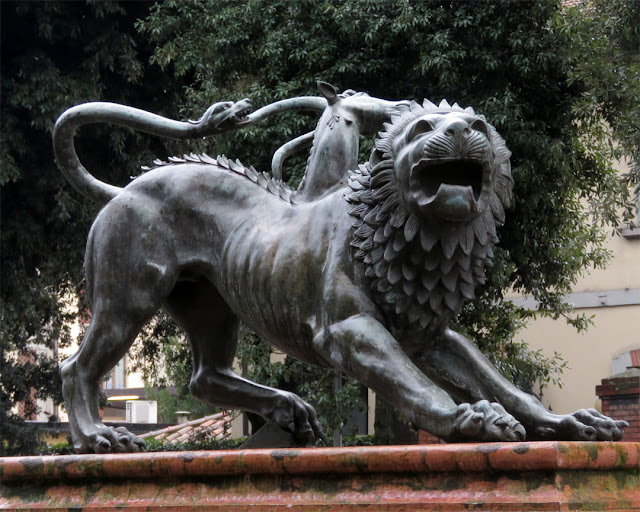
Chimera of Arezzo

Chimera of Arezzo (copy), Giardini del Porcinai, Viale Michelangelo, Arezzo

Chimera of Arezzo (copy)
Giardini del Porcinai
Viale Michelangelo
Arezzo, February 2021

“The Chimera of Arezzo is regarded as the best example of ancient Etruscan artwork. British art historian, David Ekserdjian, described the sculpture as "one of the most arresting of all animal sculptures and the supreme masterpiece of Etruscan bronze-casting." Made entirely of bronze and measuring 78.5 cm high with a length of 129 cm, it was found alongside a small collection of other bronze statues in Arezzo, an ancient Etruscan and Roman city in Tuscany. The statue was originally part of a larger sculptural group representing a fight between a Chimera and the Greek hero Bellerophon. This sculpture was likely created as a votive offering to the Etruscan god Tinia.” (Chimera of Arezzo, Wikipedia)

Saturday, November 27, 2021

Piazza Grande

Apse of Santa Maria della Pieve, the old Tribunal Palace, and the Lay Fraternity, Piazza Grande, Arezzo

Apse of Santa Maria della Pieve, the old Tribunal Palace, and the Lay Fraternity
Piazza Grande
Arezzo, February 2021

“The Piazza Grande is the most noteworthy medieval square in the city, opening behind the 13th century Romanesque apse of Santa Maria della Pieve. Once the main marketplace of the city, it is currently the site of the Giostra del Saracino (Joust of the Saracen). It has a sloping pavement in red brick with limestone geometrical lines. Aside from the apse of the church, other landmarks of the square include the Palace of the Lay Fraternity, a 14th–15th century palazzo, with a Gothic ground floor and a quattrocento second floor by Bernardo Rossellino.” (Arezzo, Wikipedia)

Sunday, November 21, 2021

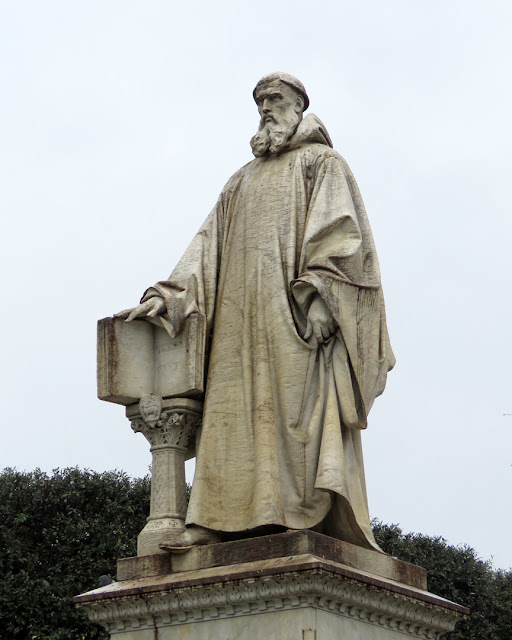
Guido of Arezzo

Guido of Arezzo (Guido Monaco) by Salvino Salvini, Piazza Guido Monaco, Arezzo

Guido of Arezzo (Guido Monaco) by Salvino Salvini, 1882
Piazza Guido Monaco
Arezzo, February 2021

“Guido of Arezzo (c. 991 – after 1033) was an Italian music theorist and pedagogue of the medieval era. He is regarded as the inventor of modern staff notation that replaced neumatic notation. His text, the Micrologus, was the second most widely distributed treatise on music in the Middle Ages (after the writings of Boethius). Guido was a Benedictine monk from the Italian city-state of Arezzo. Recent research has dated his Micrologus to 1025 or 1026; since Guido stated in a letter that he was thirty-four when he wrote it, his birthdate is presumed to be around 991 or 992. His early career was spent at the monastery of Pomposa, on the Adriatic coast near Ferrara. While there, he noted the difficulty that singers had in remembering Gregorian chants. He came up with a method for teaching the singers to learn chants in a short time, and quickly became famous throughout north Italy. However, around 1025 he attracted the hostility of the other monks at the abbey who resisted his musical innovations, prompting him to move to Arezzo, a town which had no abbey, but which did have a large group of cathedral singers, whose training Bishop Tedald invited him to conduct.” (Guido of Arezzo, Wikipedia)

Monday, November 15, 2021

Duomo di Arezzo

Duomo di Arezzo (Arezzo Cathedral), Piazza del Duomo, Arezzo

Duomo di Arezzo (Arezzo Cathedral)
Piazza del Duomo
Arezzo, February 2021

“Arezzo Cathedral (Duomo di Arezzo, Cattedrale di Ss. Donato e Pietro) is a Roman Catholic cathedral in the city of Arezzo in Tuscany, Italy. It is located on the site of a pre-existing Palaeo-Christian church and, perhaps, of the ancient city's acropolis. The first cathedral of Arezzo was built on the nearby Pionta Hill, over the burial place of Donatus of Arezzo, martyred in 363. In 1203 Pope Innocent III had the cathedral moved within the city's walls, to the current site. The cathedral however lost the relics of Donatus, which were transferred to the church of San Donato in Castiglione Messer Raimondo (in what is now the province of Teramo). In spite of this, the cathedral is still dedicated to Saint Donatus and at the high altar houses a 14th-century arch named after him.” (Arezzo Cathedral, Wikipedia)