Showing posts with label Florence+2014. Show all posts

Saturday, June 16, 2018

Quick Dining

Cooks and waiters dining, Mercato Centrale, Central Market or Mercato di San Lorenzo, Piazza del Mercato Centrale, Florence

Cooks and waiters dining
Mercato Centrale (Central Market)
or Mercato di San Lorenzo
Piazza del Mercato Centrale
Florence, April 2014

“At the Mercato Centrale, in the San Lorenzo area, you'll find a diverse selection of shops offering visitors quality food from all over Italy, most of which are managed by the 3rd or 4th generation owners. Here, hospitality is a defining characteristic and shoppers can taste exhibited products. From April 23, the first floor of Florence's Central Market is open again. The market's renewed space of 3000 mq now offers 500 seatings and hosts 12 workshops, a restaurant, a pizzeria, a brewery, the Chianti Classico shop, a bookshop and a cooking school. Among the first floor new workshops you'll find cheese, bread, gelato, chocolate, pasta and cold cuts shops exhibiting the best food products from Italy.” (Around Florence: 5 food markets, Turismo in Toscana)

Tuesday, October 13, 2015

Rotonda degli Scolari

Rotunda, church of St. Mary of the Angels, Florence
,
Rotonda degli Scolari (Scholars' Rotunda), originally by Filippo Brunelleschi
Chiesa di Santa Maria degli Angeli (Church of St. Mary of the Angels)
Via degli Alfani / Via del Castellaccio
Florence, April 2014

“In 1434, Filippo Brunelleschi was commissioned by the Medici family to design an oratory for the monastery. It was located at the corner of the property, along the outer wall. Though construction was rapid, it was halted due to funding problems in 1437. In 1503, the shell was given a simple wooden roof, but the structure deteriorated rapidly. The building, which was used for various purposes, was patched up and given its modern appearance in the 1930s. It was given to the university and thus its more modern name Rotonda degli Scolari (‘Scholars' Rotunda’).” (Church of St. Mary of the Angels, Florence, Wikipedia)

Tuesday, March 3, 2015

Zodiac Wheel

Opus sectile zodiac, basilica of San Miniato al Monte, St. Minias on the Mountain, viale dei Colli, Florence

The wheel of the zodiac from the opus sectile pavement
San Miniato al Monte (St. Minias on the Mountain)
Viale dei Colli
Florence, April 2014

“Opus sectile is an art technique popularized in the ancient and medieval Roman world where materials were cut and inlaid into walls and floors to make a picture or pattern. Common materials were marble, mother of pearl, and glass. The materials were cut in thin pieces, polished, then trimmed further according to a chosen pattern. Unlike tessellated mosaic techniques, where the placement of very small uniformly sized pieces forms a picture, opus sectile pieces are much larger and can be shaped to define large parts of the design.” (Opus sectile, Wikipedia)

See also: San Miniato al Monte - Inside San Miniato

Monday, February 23, 2015

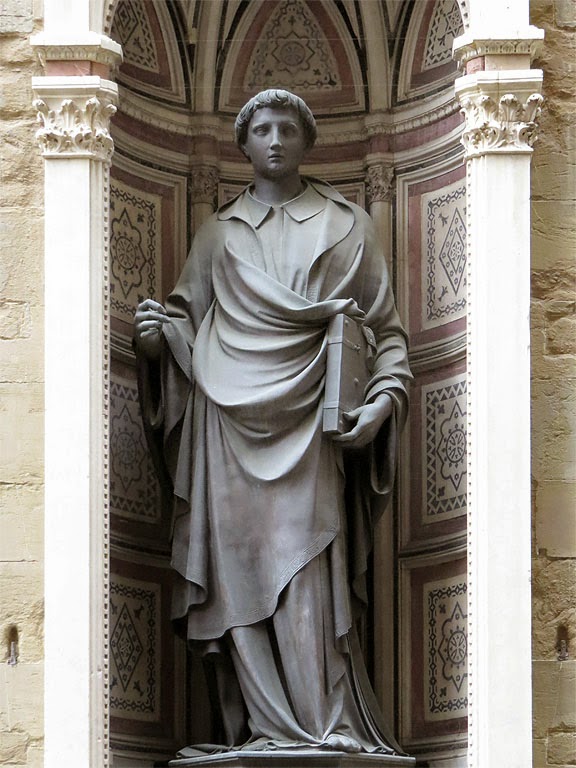
Saint Eligius


Sant'Eligio, Saint Eligius by Nanni di Banco, Orsanmichele Museum, Florence

“Sant'Eligio” (Saint Eligius) by Nanni di Banco, 1415
Orsanmichele Museum
Via dell'Arte della Lana
Florence, April 2014

See also: Christ and St. Thomas - San Luca - Madonna delle Grazie Altar - San Matteo - Santo Stefano - St. Matthew & St. Stephen

Sunday, February 15, 2015

Four Crowned Martyrs

Santi Quattro Coronati, Four Crowned Martyrs by Nanni di Banco, Orsanmichele Museum, Florence

“Santi Quattro Coronati” (Four Crowned Martyrs) by Nanni di Banco, 1415
Orsanmichele Museum
Via dell'Arte della Lana
Florence, April 2014

See also: Christ and St. Thomas - San Luca - Madonna delle Grazie Altar - San Matteo - Santo Stefano - St. Matthew & St. Stephen

Saturday, February 7, 2015

Giovanni Villani

Statue of Giovanni Villani by Gaetano Trentanove, Loggia del Mercato Nuovo, Florence

Statue of Giovanni Villani by Gaetano Trentanove, 1890
Loggia del Mercato Nuovo
Piazza del Mercato Nuovo
Florence, April 2014

See also: Loggia del Mercato Nuovo

Friday, January 30, 2015

Mercato di San Lorenzo

Mercato Centrale, Central Market, Piazza del Mercato Centrale, Florence

First floor, Mercato Centrale (Central Market)
Piazza del Mercato Centrale
Florence, April 2014

“At the Mercato Centrale, in the San Lorenzo area, you'll find a diverse selection of shops offering visitors quality food from all over Italy, most of which are managed by the 3rd or 4th generation owners. Here, hospitality is a defining characteristic and shoppers can taste exhibited products. From April 23, the first floor of Florence's Central Market is open again. The market's renewed space of 3000 mq now offers 500 seatings and hosts 12 workshops, a restaurant, a pizzeria, a brewery, the Chianti Classico shop, a bookshop and a cooking school. Among the first floor new workshops you'll find cheese, bread, gelato, chocolate, pasta and cold cuts shops exhibiting the best food products from Italy.” (Around Florence: 5 food markets, Turismo in Toscana)

Thursday, January 22, 2015

Loggia del Mercato Nuovo

Statue of Bernardo Cennini by Emilio Mancini, Michele di Lando by Antonio Bortone, Loggia del Mercato Nuovo, Florence

Statues of Bernardo Cennini by Emilio Mancini, 1889
and Michele di Lando by Antonio Bortone, 1895
Loggia del Mercato Nuovo
Piazza del Mercato Nuovo
Florence, April 2014

See also: Giovanni Villani

Wednesday, January 14, 2015

Eighteen Colors

35 Euro shoes in 18 colors, Via de' Gori, Florence

35 Euro shoes in 18 colors
Via de' Gori
Florence, April 2014

Tuesday, January 6, 2015

Mercato Centrale

Mercato Centrale, Central Market, Piazza del Mercato Centrale, Florence

Ground floor, Mercato Centrale (Central Market)
Piazza del Mercato Centrale
Florence, April 2014

“Inside the market are myriad vendors dedicated to the primary ingredients of Tuscan cuisine. On the ground floor you will find butchers of all types, with everything from pig's feet to whole chickens with their heads and feet still on, to giant, milky-white sheets of tripe, rabbits, wild boar, steaks, sausages, etc. You will also find gastronomie offering cheeses, cured meats, olives and other delicatessen fare, as well as stalls selling bread, pasta, wine and other grocery items.” (Central Market, Florence Online)

Sunday, December 21, 2014

Via dell'Amorino

Door handle, via dell'Amorino, Florence

Door handle
Via dell'Amorino
Florence, April 2014

Saturday, December 13, 2014

St. Matthew & St. Stephen

St. Matthew and St. Stephen, by Lorenzo Ghiberti, Orsanmichele Museum, Florence

“San Matteo” (Matthew the Apostle) by Lorenzo Ghiberti, 1420
“Santo Stefano” (Saint Stephen) by Lorenzo Ghiberti, 1428
Orsanmichele Museum
Florence, April 2014

See also: Christ and St. Thomas - San Luca - Madonna delle Grazie Altar - San Matteo - Santo Stefano

Friday, December 5, 2014

Boar's Head

Mounted boar's head, La Norcineria, Pork butcher, Via Sant'Antonino, Florence

“La Norcineria”, “Specialità toscane”
(Pork butcher, Tuscan specialties)
Via Sant'Antonino
Florence, April 2014

“Why are boar hunted? Apart from the fact that they taste good (think Cinghiali al umido) [or any other recipe you can link to] but they cause a lot of damage to gardens and trees. This sounds harsh (you can only really appreciate the murderous qualities needed to shoot the creatures after your lovingly planted vegetable garden has been entirely rooted up) but these animals also breed terribly fast. Originally the Wild Boar had one or two young every year, thus sustaining a balanced population. Unfortunately the domestic (and prolific) pig came into the genetic mix and created a hybrid Boar which produces between 4 – 10 offspring each pregnancy. Thus the countryside is overpopulated and hunting is a sensible solution.” (The Wild Boar Survival Guide, Under the Tuscan Gun)

Thursday, November 27, 2014

Cosimo I de' Medici

Equestrian statue of Cosimo I de' Medici by Giambologna, piazza della Signoria, Florence

Equestrian statue of Cosimo I de' Medici by Giambologna, 1594
Piazza della Signoria
Florence, April 2014

Wednesday, November 19, 2014

Paolo Uccello's Clock

Clock by Angelo Niccolai, fresco by Paolo Uccello, Santa Maria del Fiore, Florence

Clock by Angelo Niccolai, fresco by Paolo Uccello, 1443
Santa Maria del Fiore (Saint Mary of the Flower)
Piazza del Duomo
Florence, April 2014

“The first public clock in the city of Florence was installed on the tower of Palazzo Vecchio on March 25, 1353, the work of Niccolò di Bernardo. A little less than a century later, a grandson of his, Angelo Niccolai degli Orologi, was commissioned to construct the mechanical clock of Santa Maria del Fiore, installed on the cathedral's inner façade in 1443. The dial was painted in fresco by Paolo Uccello (1397-1475), inscribing in a square a circle divided into 24 hours running counter-clockwise, according to a conventional representation of the time, emulating the movement of the gnomon's shadow on a vertical sundial. The hours are given in the so-called ‘Italian style’, which marked the duration of the day starting from sunset. They are indicated by an elliptical star with one ray longer than the others, an element recurrently used by the artist in his paintings to depict the comet of the Nativity. This is probably an allusion to Christ, ‘light of the world’, as is further confirmed by the presence of the four Evangelists portrayed in the false oculi at the corners of the great square.” (Ancient mechanical ‘oriuoli’, Museo Galileo)

Tuesday, November 11, 2014

Santo Stefano

Copy of Santo Stefano, Saint Stephen by Lorenzo Ghiberti, Orsanmichele, Via dell'Arte della Lana side, Florence

“Santo Stefano” (Saint Stephen) by Lorenzo Ghiberti, 1428 (copy)
Orsanmichele, Via dell'Arte della Lana side
Florence, April 2014

“Lamberti's marble St. Luke, which was once in the spot now occupied by Giambologna's St. Luke, is now in the Bargello. Likewise a marble St. John The Evangelist by the school of Orcagna was replaced with a bronze by Anrea Pisano (the guilds showed their importance and wealth by using bronze instead of gold, which was much more expensive) and is now in the Spedale Innocenti. And lastly, the original marble St. Stephen, again by Pisano, was replaced with a bronze version by Ghiberti. Pisano's St. Stephen can be seen at the Opera Duomo. ” (Sculptures of Orsanmichele, Orsanmichele)

See also: Christ and St. Thomas - San Luca - Madonna delle Grazie Altar - San Matteo

Monday, November 3, 2014

Pellegrino Artusi

Bust on the grave of Pellegrino Artusi by Italo Vagnetti, Porte Sante Cemetery, San Miniato al Monte, Florence,

Bust on the grave of Pellegrino Artusi by Italo Vagnetti
Porte Sante Cemetery, San Miniato al Monte
Florence, April 2014

“The whole complex is surrounded by defensive walls, originally built hastily by Michelangelo during the siege and in 1553 expanded into a true fortress (fortezza) by Cosimo I de' Medici. The walls now enclose a large cemetery, the Porte Sante, laid out in 1854.” (San Miniato al Monte, Wikipedia)

Tuesday, September 23, 2014

Nero al Tondo

Wine crate used as a flower box outside a restaurant, via Orsanmichele, Florence

Wine crate used as a flower box outside a restaurant
Via Orsanmichele
Florence, April 2014

Monday, September 15, 2014

Dante Alighieri

Statue of Dante Alighieri by Paolo Emilio Demi, Piazzale degli Uffizi, Florence

Statue of Dante Alighieri by Paolo Emilio Demi
Niche of the Uffizi colonnade
Piazzale degli Uffizi
Florence, April 2014

“Vincenzo Batelli, for that was the name of this clever Florentine printer, found it impossible to conceive of a niche as a purely architectural feature. Like so many others of his time, a niche, for him, was nothing other than an architectural backdrop to set off the fame and glory of some illustrious person, and thus a sort of vacant lot, just waiting for its guest of honour. The city of Florence and indeed the entire region of Tuscany was unrivalled for its lavish supply of geniuses, heroes, artists, poets and men of science. It would therefore be quite simple to fill each one of Vasari’s niches and still have plenty of the great and the good left over. Why not seize this golden opportunity to wed all these lonely widowed niches with their perfect spouse?” (The strange story of the 28 statues, The Museums of Florence)

Thursday, September 11, 2014

Palazzo delle Assicurazioni Generali

Florence

Palazzo delle Assicurazioni Generali
Piazza della Signoria
Florence, April 2014