Showing posts with label Lisbon. Show all posts
Tuesday, July 16, 2024
Capela de São João Baptista
Capela de São João Baptista (Chapel of St. John the Baptist)
Igreja de São Roque (Church of Saint Roch)
Largo Trindade Coelho
Lisbon, April 2019
“This chapel (Capela de São João Baptista) was commissioned in 1740 by King John V. Upon completion, it was said to be the most expensive chapel in Europe, funded with the gold and other wealth that flowed to Portugal from Brazil. The designs and material were assembled under the direction of the architects Luigi Vanvitelli (1700–1773) and Niccolo Salvi (1697–1751). Vanvitelli modified his original design according to drawings sent to Italy by architect João Frederico Ludovice (1673–1752). Hundreds of different artists and craftsmen worked on its construction. It was assembled in the Church of St. Anthony of the Portuguese (Sant'Antonio dei Portoghesi) in Rome beginning in 1742. Consecrated by Pope Benedict XIV on 15 December 1744, it was sufficiently finished that the pontiff could say Mass in it on 6 May 1747. In September of that year, Manuel Pereira de Sampaio, Portuguese ambassador to the Holy See, saw to the dismantling of the chapel and its transport by three ships to Lisbon, where it was reassembled in São Roque in what was formerly the 17th-century Chapel of the Holy Ghost. Reassembly was overseen by Francesco Feliziani and Paolo Niccoli (or Riccoli), along with the Italian sculptor Alessandro Giusti (1715–1799). The assembly of the mosaic panels depicting the Baptism of Christ and Pentecost were not completed until August 1752, two years after the death of John V.” (Igreja de São Roque, Wikipedia)
Monday, January 1, 2024
Vitral
Vitral (Stained glass)
Church of Santa Maria de Belém
Mosteiro dos Jerónimos (Jerónimos Monastery)
Praça do Império, Belém
Lisbon, April 2019
“Further remodelling of the monastery was begun in 1898 subsequent to the work done by Parente da Silva in 1895 on the central annex, now simplified, as well as restoration of the cadeirals (the chairs used by the clergy in religious services), which were completed in 1924 by sculptor Costa Mota. In 1938 the organ in the high choir was dismantled at the same time that a series of stained-glass windows, designed by Abel Manta and executed by Ricardo Leone, were replaced in the southern façade.” (Jerónimos Monastery, Wikipedia)
Sunday, December 10, 2023
Naked woman
Naked woman by Ruy Roque Gameiro, 1933
Calouste Gulbenkian Garden
Avenida de Berna
Lisbon, April 2019
“Ruy Roque Gameiro (27 February 1906 – 18 August 1935) was a Portuguese sculptor. Although he died relatively young, he won the admiration of critics, particularly José de Figueiredo. Son of the watercolour master Alfredo Roque Gameiro and disciple of José Simões de Almeida (nephew), he attended the auto mechanic course at the Marqués de Pombal Industrial School in Lisbon, at that time directed by Sanches de Castro. In 1928, he finished the course of the School of Fine Arts of Lisbon, with a proven proof of sculpture under the title Abel and Cain. The following year, he exhibited for the first time in the National Society of Fine Arts – Sociedade Nacional de Belas Artes, with two sculptures, Salomé and the head of the painter José Tagarro, the latter soon acquired for the National Museum of Contemporary Art.” (Ruy Roque Gameiro, Wikipedia)
Thursday, November 16, 2023
Monday, October 23, 2023
Satyricon I
“Satyricon I” by Reuben Nakian, 1981
Calouste Gulbenkian Garden
Avenida de Berna
Lisbon, April 2019
“Reuben Nakian (August 10, 1897, College Point, New York – December 4, 1986, Stamford, Connecticut) was an American sculptor and teacher of Armenian extraction. His works' recurring themes are from Greek and Roman mythology. Noted works include Leda and the Swan, The Rape of Lucrece, Hecuba, and The Birth of Venus. He was also commissioned to create portraits of Roosevelt's cabinet in the 1930s.” (Reuben Nakian, Wikipedia)
Friday, September 29, 2023
Wednesday, September 13, 2023
Igreja de São Paulo
Igreja de São Paulo (Saint Paul church)
Praça de São Paulo
Lisbon, April 2019
“The lovely São Paulo Church is situated in the historical centre of cosmopolitan Lisboa, next to the much frequented Cais do Sodré area, since early times a place of trading and commerce. The present temple was rebuilt over a previous church, after it got destroyed with the big Earthquake of 1755 that changed forever the face of Lisboa. In 1768 the restoration works began, according to the Architect Remígio Francisco de Abreu project, inverting the Church’s original orientation and following the typical style of the majestic Mafra Convent. The Church is characterized by its one only nave, two square towers, a rectangular main chapel and eight lateral chapels. The paintings in the Church’s interior are attributed to João Grossi and Pedro Alexandrino de Carvalho, and the ones in the ceiling to Jerónimo de Andrade. The façade shows proudly the image of the ‘Saint Paul’s Conversion’ and the images of Saint Paul and Saint Peter.” (São Paulo Church, Guia da Cidade)
Friday, September 1, 2023
Chafariz do Carmo
Chafariz do Carmo (Carmo Fountain)
Largo do Carmo
Lisbon, April 2019
“One of the several – and most remarkable – public fountains built in Lisbon through the 15th-18th centuries, the Chafariz do Carmo sits in the Largo do Carmo plaza, beside the convent of the same name. Of late Baroque architecture, the fountain is enclosed within a porch supported by four majestic pillars and was raised on an aqueduct that once carried water to the city. Purely decorative today, it certainly adds to the place's atmosphere and is worth having a quick look-see” (Chafariz do Carmo, GPSmyCity)
Wednesday, August 16, 2023
Friday, August 4, 2023
Praça do Comércio
Arco da Rua Augusta (Augusta Street Arch)
Praça do Comércio
Lisbon, April 2019
“The Praça do Comércio (Commerce Plaza) is a large, harbour-facing plaza in Portugal's capital, Lisbon, and is one of the largest in Portugal, with an area of 175 by 175 m (574 by 574 ft), that is, 30,600 m2 (329,000 ft2). Facing the Tagus (Tejo) to the South, the plaza is still commonly known in Portuguese as Terreiro do Paço (Palace Yard), as it hosted the Paço da Ribeira (Royal Palace of Ribeira) until the latter was destroyed by the great 1755 Lisbon earthquake (the subway station located there is still named after the old name of the plaza). After the earthquake, the plaza was completely remodeled as part of the rebuilding of the Pombaline Downtown (Baixa), ordered by Sebastião José de Carvalho e Melo, 1st Marquis of Pombal, who was (chief) Minister of Portugal from 1750 to 1777, during the reign of the Portuguese King José I.” (Praça do Comércio, Wikipedia)
Monday, July 31, 2023
Saturday, July 15, 2023
Village Underground Lisboa
Avenida da Índia
Lisbon, April 2019
“Village Underground Lisboa is an international platform for creativity, art, and culture. It has an original architectural structure built with two buses and 14 shipping containers converted into multidisciplinary creative spaces where an artistic community resides. It has a restaurant and a sound recording studio. It hosts music, theater, cinema, and dance events with a focus on street culture.” (Village Underground Lisboa, Tripadvisor)
Monday, July 3, 2023
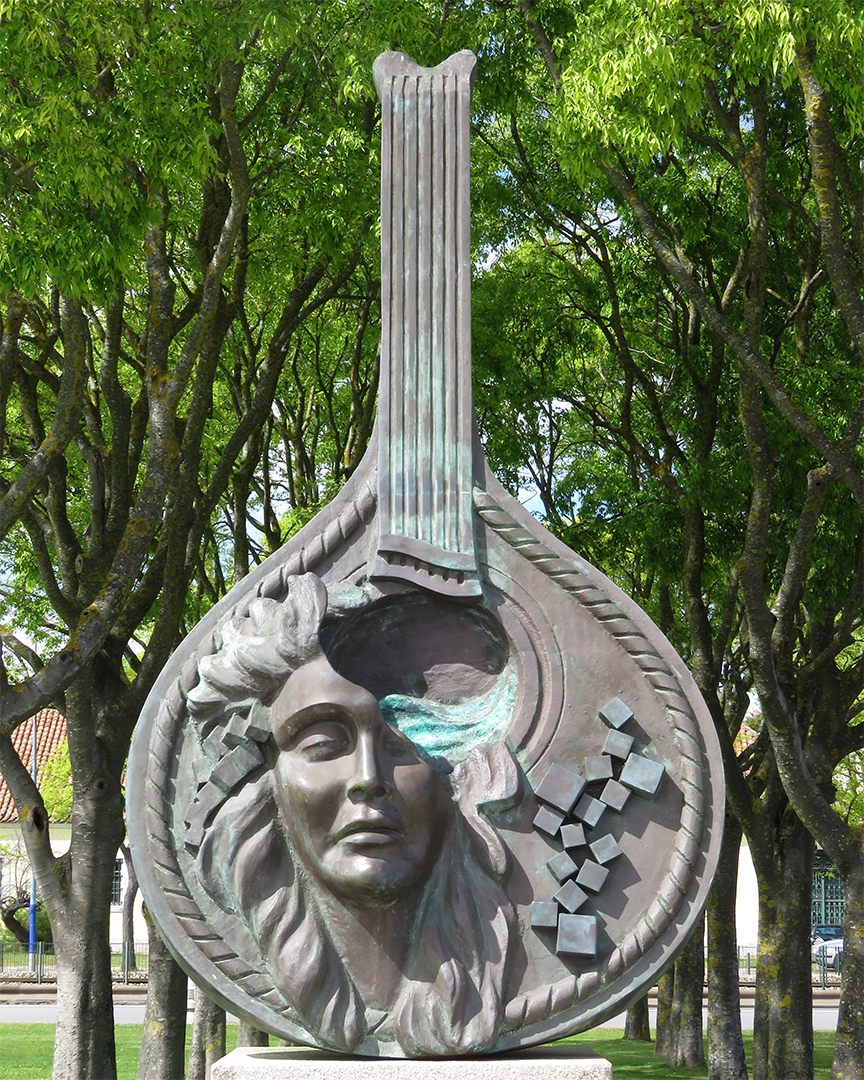
Guitarra na Proa
Guitarra na Proa by Domingos de Oliveira, 2000
“Homenagem a Amália, o Fado e a Lisboa”
Avenida Brasília, Belém
Lisbon, April 2019
“Amália da Piedade Rebordão Rodrigues (23 July 1920 – 6 October 1999), better known as Amália Rodrigues or popularly as Amália, was a Portuguese fadista (fado singer). Known as the ‘Rainha do Fado’ (Queen of Fado), Rodrigues was instrumental in popularising fado worldwide and travelled internationally throughout her career. Amália remains the best-selling Portuguese artist in history.” (Amália Rodrigues, Wikipedia)
Friday, June 23, 2023
MAAT
MAAT - Museu de Arte, Arquitetura e Tecnologia
(Museum of Art, Architecture and Technology) by Amanda Levete, 2018
Avenida Brasília, Belém
Lisbon, April 2019
“The Museum of Art, Architecture and Technology (Museu de Arte, Arquitetura e Tecnologia) is a museum in Lisbon, Portugal. MAAT is a cultural project for the city Lisbon that is focused on three areas - Art, Architecture, and Technology. The €20m museum sits on the River Tagus (Rio Tejo) to the west of the city centre. and ‘one of Europe's most lyrical new museums’. It establishes a connection between the new building and the Tejo Power Station, one of Portugal's most prominent examples of industrial architecture from the first half of the 20th century, and one of the most visited museums in the country. The museum is designed by Amanda Levete Architects. MAAT's ambition is to present national and international exhibitions by contemporary artists, architects, and thinkers. The programme also includes various curatorial perspectives on EDP Foundation's Art Collection, reflecting current subject matters and trends.” (Museum of Art, Architecture and Technology, Wikipedia)
Thursday, June 15, 2023
Central Tejo
“Central Tejo” by Pedro Cabrita Reis, 2018
Museu de Arte, Arquitetura e Tecnologia
Avenida Brasília, Belém
Lisbon, April 2019
“The EDP Foundation commissioned the artist Pedro Cabrita Reis to produce the sculpture Central Tejo, which was completed in June 2018. A couple of possible locations were presented to him, but Cabrita Reis already knew exactly where he wanted to install the piece: at a pier on the Tejo in front of the old power station, where the barges which supplied coal to the energy factory would moor before the latter was turned into a museum. ‘It’s a historical place. Any artwork created there would immediately become part of the city’s history.’ To achieve the delicate balance between monumentality and lightness, Cabrita Reis used two of his favourite materials — aluminum tubes and fluorescent lights. A common denominator of most of his work since the mid 2000s, aluminium and neon lights are the basis of some of his most well-known pieces, such as the installation A Remote Whisper, presented at the Venice Biennale in 2013. ‘I work with everyday materials, which are easily recognisable’, he explains. ‘People see simple aluminum tubes and fluorescent lights which are identical to the ones they have at home and are disarmed.’ The configuration of the piece also had to be simple. ‘Simplicity,’ the artist stresses, ‘is always the objective’.” (Pedro Cabrita Reis — Central Tejo, 2018, MAAT)
Wednesday, June 7, 2023
Tomb of Fernando Pessoa
Tomb of the poet Fernando Pessoa (1888-1935)
Mosteiro dos Jerónimos (Jerónimos Monastery)
Praça do Império, Belém
Lisbon, April 2019
“The inside walls of the cloister have a wealth of Manueline motives with nautical elements, in addition to European, Moorish and Eastern motifs. The round arches and the horizontal structure are clearly in line with the Renaissance architectural style, while at the same time there is also a relationship with Spanish architecture. The decorations on the outer walls of the inner courtyard were made in Plateresco style by Castilho: the arcades include traceried arches that give the construction a filigree aspect. In one of these arcades is the sober tomb of the poet Fernando Pessoa, while several other tombs in the chapterhouse contain the remains of the poet and playwright Almeida Garrett (1799–1854), the writer-historian Alexandre Herculano (1810–1877), former presidents Teófilo Braga (1843–1924) and Óscar Carmona (1869–1951).” (Jerónimos Monastery, Wikipedia)
Tuesday, May 30, 2023
Santa Maria de Belém
Church of Santa Maria de Belém
Mosteiro dos Jerónimos (Jerónimos Monastery)
Praça do Império, Belém
Lisbon, April 2019
“Diogo Boitac laid the foundations for this three-aisled church with five bays under a single vault, a clearly marked but only slightly projecting transept and a raised choir. The hall church layout is composed of aisles and nave that are of equal height. Boitac built the walls of the church as far as the cornices and then started with the construction of the adjoining monastery. Juan de Castillo, a Spanish architect and sculptor, continued the construction in 1517. He completed the retaining walls and the unique single-span ribbed vault, a combination of stellar vaulting and tracery vaults spanning the 19-metre (62-ft) wide church.[11] Each set of ribs in the vaulting is secured by bosses. The bold design (1522) of the transversal vault of the transept lacks any piers or columns, while Boitac had originally planned three bays in the transept. The transept's unsupported vault gives the visitor the impression that it floats in the air. Castilho also decorated the six 25-metre-high, slender, articulated, octagonal columns with refined grotesque or floral elements typical of the Renaissance style. The construction of this late-Gothic hall is aesthetically and architecturally a masterwork: it augments the spatial effect of this vast building. The northern column closest to the transept there is a medallion that may have been intentionally included as a portrait of Boitac or Juan de Castilho.” (Jerónimos Monastery, Wikipedia)
Monday, May 22, 2023
Two-storey cloisters
Mosteiro dos Jerónimos (Jerónimos Monastery)
Praça do Império, Belém
Lisbon, April 2019
“Work on the vast square cloister (55 × 55 m) of the monastery was begun by Boitac. He built the groin vaults with wide arches and windows with tracery resting on delicate mullions. Juan de Castilho finished the construction by giving the lower storey a classical overlay and building a more recessed upper storey. The construction of such a cloister was a novelty at the time. Castilho changed the original round columns of Boitac into rectangular ones, and embellished it with Plateresque-style ornamentation. Each wing consists of six bays with tracery vaults. The four inner bays rest on massive buttresses, forming broad arcades. The corner bays are linked by a diagonal arched construction and show the richly decorated corner pillars. The cloister had a religious function as well as a representative function by its decorative ornamentation and the dynastic symbolic motives, such as the armillarium, coat-of-arms, and the cross from the Order of Christ, showing the growing world power of Portugal. The inside walls of the cloister have a wealth of Manueline motives with nautical elements, in addition to European, Moorish and Eastern motifs. The round arches and the horizontal structure are clearly in line with the Renaissance architectural style, while at the same time there is also a relationship with Spanish architecture. The decorations on the outer walls of the inner courtyard were made in Plateresco style by Castilho: the arcades include traceried arches that give the construction a filigree aspect.” (Jerónimos Monastery, Wikipedia)
Sunday, May 14, 2023
Vasco da Gama
Neomanueline tomb of Vasco da Gama
Mosteiro dos Jerónimos (Jerónimos Monastery)
Praça do Império, Belém
Lisbon, April 2019
“To celebrate the 1898 fourth centenary of the arrival of Vasco da Gama in India, it was decided to restore the tomb of the explorer in 1894. The tombs of Vasco da Gama and Luís de Camões, carved by the sculptor Costa Mota, were placed in the southern lateral chapel. A year later the monastery received the remains of the poet João de Deus, later joined by the tombs of Almeida Garret (1902), Sidónio Pais (1918), Guerra Junqueiro (1923) and Teófilo Braga (1924).” (Jerónimos Monastery, Wikipedia)
Saturday, May 6, 2023
Mosteiro dos Jerónimos
Mosteiro dos Jerónimos (Jerónimos Monastery)
View from the top of Padrão dos Descobrimentos
Praça do Império, Belém
Lisbon, April 2019
“The Jerónimos Monastery or Hieronymites Monastery (Portuguese: Mosteiro dos Jerónimos) is a former monastery of the Order of Saint Jerome near the Tagus river in the parish of Belém, in the Lisbon Municipality, Portugal. It became the necropolis of the Portuguese royal dynasty of Aviz in the 16th century but was secularized on 28 December 1833 by state decree and its ownership transferred to the charitable institution, Real Casa Pia de Lisboa. The Jerónimos Monastery is one of the most prominent examples of the late Portuguese Gothic Manueline style of architecture in Lisbon. It was erected in the early 1500s near the launch point of Vasco da Gama's first journey, and its construction funded by a tax on the profits of the yearly Portuguese India Armadas. In 1880, da Gama's remains and those of the poet Luís de Camões (who celebrated da Gama's first voyage in his 1572 epic poem, The Lusiad), were moved to new carved tombs in the nave of the monastery's church, only a few meters away from the tombs of the kings Manuel I and John III, whom da Gama had served. In 1983, the Jerónimos Monastery was classified as a UNESCO World Heritage Site, along with the nearby Tower of Belém.” (Jerónimos Monastery, Wikipedia)
Subscribe to:
Posts (Atom)