Friday, December 31, 2010
Le Zouave
The “Zouave” by Georges Diebolt
Pont de l'Alma
Paris, July 2010
“The ‘Zouave’ is an 1856 stone statue by French artist Georges Diebolt, which has been sited on the Pont de l'Alma in Paris since the 1850s. The statue is used as an informal flood marker for the level of the River Seine in Paris. An arch bridge over the Seine was first constructed at this location in Paris in the 1850s, connecting the Avenue George V (formerly the Avenue d'Alma) to the Quai d'Orsay and Quai Branly. The new bridge was named after the 1854 Battle of Alma in the Crimean War. The two supporting piers of the bridge in the river were decorated with military sculptures, one on each side of each pier. Each of the four sculptures depicts a French soldier from the Crimean War: a Zouave and a grenadier by Georges Diebolt, and a chasseur and an artilleryman by Auguste Arnaud. Three of the four statues on the Pont de l'Alma were removed and relocated when the bridge was reconstructed as a wider girder bridge in the 1970s, but the ‘Zouave’ was reinstalled on the new bridge, although in a somewhat lower position.” (Zouave, Wikipedia)
Thursday, December 30, 2010
Lamps
Lamps
Stables Market
Camden Town, Camden
London, October 2009
“Camden Market Stables is a labyrinth of cultures and subcultures, overground and underground, home to brands both global and local. Once a network of saddlers workshops, tack rooms and a horse hospital and stables, it’s now home to our listed cobbled yards, umbrella alley, incredible experiences and so much more.” (Stables Market, Camden Market)
Wednesday, December 29, 2010
Fontana delle Arti
Fontana delle Arti (Fountain of the Arts) by Pietro Lombardi
Via Margutta, Rione Campo Marzio
Rome, September 2010
See also: Fontana dei Monti (Fountain of the Mountains) - Fontana della Pigna (Fountain of the Pinecone) - Fontana del Timone (Fountain of the Helm) - Fontana dei Libri (Fountain of the Books) - Fontana delle Anfore (Fountain of the Amphorae) - Fontana delle Palle di Cannone (Fountain of the Cannonballs) - Fontana della Botte (Fountain of the Cask) - Fontana delle Tiare (Fountain of the Tiaras)
Tuesday, December 28, 2010
Ralp Kramden
Jackie Gleason as Ralph Kramden by Lawrence J. Nowlan Jr.
Port Authority Bus Terminal
Eighth Avenue
New York, September 2007
“Then as the century drew to a close TV Land began airing ‘The Honeymooner’ reruns on cable television—introducing Ralph and Alice, Trixie and Norton to an entirely new generation. In 1999 the TV cable channel came up with the idea to erect a statue to Ralph; a common guy who represented millions of Americans and who had become an icon of 1950s television. With the cooperation of Jackie Gleason’s estate the plan went ahead. New Jersey sculptor Lawrence J. Nowlan, Jr. was given the commission to design the statue. The Philadelphia-born artist was known for his ability to capture moments in time—camera-like—in his stirring monuments. The site chosen for the 4,000-pound bronze was inspired. Ralph Kramden did not belong in Central Park with Giuseppe Mazzini or in Union Square with Abraham Lincoln. He belonged at the Port Authority Bus Terminal. The Port Authority of New York and New Jersey accepted the gift gladly. Ken Philmus, director of tunnels, bridges, and terminals said ‘Who better Than Ralph Kramden to greet commuters and bus drivers in front of the place where more than 200,000 commuters and 7,000 buses pass through every day?’ On August 29, 2000 The Honeymooners theme drowned out the roar of taxicabs and buses as Joyce Randolph, who played Trixie, unveiled the statue. Nowlan had captured Ralph happily strolling to work, his leather jacket zipped up nearly to the neck. In his hand is his lunchbox which undoubtedly holds sandwiches wrapped in wax paper by Alice and a thermos of coffee. The 8-foot statue did what it was intended to do: it connected with the common Joe. According to The Los Angeles Times, construction worker Tino Riveria commented ‘I like that guy Kramden. He was a big mouth, but there are millions of big mouths in New York. So naturally, people here are going to identify with him.’ Below the statue a plaque reads ‘Jackie Gleason as Ralph Kramden: Bus Driver—Raccoon Lodge Treasure—Dreamer. Presented by the People of TV Land.’ The statue stands not only as a memory to an iconic television character; it is a tribute to the hard-working, uncelebrated American workforce—the millions of Ralph Kramdens nationwide.” (The Ralph Kramden Statue, Daytonian in Manhattan)
Monday, December 27, 2010
Temple Bookstore
La librairie du Temple
Rue des Hospitalières-Saint-Gervais, Le Marais
Quartier Saint-Gervais, 4th arrondissement
Paris, July 2010
“Today, even though it houses many luxury boutiques, the Rue des Rosiers, with its bookstores, particularly the Librairie du Temple , a landmark in the neighborhood, along with the bookstore of the Musée d’art et d’histoire du Judaïsme, for books on Jewish themes, as well as its restaurants and other typical shops, contribute to the life of the Marais as an important center of Parisian Jewish life.” (Le Marais, Le Guide Culturel des Juifs d’Europe)
Sunday, December 26, 2010
Beyond Tomorrow
“Beyond Tomorrow” by Karin Jonzen
Guildhall Piazza, City of London
London, October 2009
“A seated male figure and a reclining female figure, whose clasped hands rest on her knee. The female figure looks expectantly in the direction of the Guildhall.” (Beyond Tomorrow, Art UK)
Saturday, December 25, 2010
Sant'Antonio dei Portoghesi
Sant'Antonio dei Portoghesi (Saint Anthony of the Portuguese)
Via dei Portoghesi
Rome, September 2010
“The church of Saint Anthony in Campo Marzio, known as Saint Anthony of the Portuguese (Italian: Sant'Antonio dei Portoghesi, Portuguese: Santo António dos Portugueses), is a Baroque Roman Catholic titular church in Rome, dedicated to Saint Anthony of Lisbon. The church functions as a national church of the Portuguese community residing in that city and pilgrims visiting Rome and the Vatican. It also serves the Brazilian community. Established as titulus S. Antonii in Campo Martio in 2001, it is currently assigned to Cardinal Manuel José Macário do Nascimento Clemente. The national church of the Portuguese people was originally founded in 1445 at the behest of Cardinal Antonio Martinez de Chaves adjacent to a hospice for Portuguese pilgrims. The hospice, with a small chapel dedicated to Our Lady of Bethlehem, had been founded in the fourteenth century by the noblewoman Guiomar of Lisbon. It was rebuilt in 1638 to a design by Martino Longhi the Younger. The ribbed dome was designed by Carlo Rainaldi in 1674. Work on the façade continued under Cristoforo Schor in 1695. The stained glass window above the door depicts St Anthony with the Child Jesus.” (Sant'Antonio dei Portoghesi, Wikipedia)
Friday, December 24, 2010
Thursday, December 23, 2010
Wednesday, December 22, 2010
Tuesday, December 21, 2010
Fontana della Botte
Fontana della Botte (Fountain of the Cask) by Pietro Lombardi
Via della Cisterna, Rione Trastevere
Rome, September 2010
See also: Fontana dei Monti (Fountain of the Mountains) - Fontana della Pigna (Fountain of the Pinecone) - Fontana del Timone (Fountain of the Helm) - Fontana dei Libri (Fountain of the Books) - Fontana delle Anfore (Fountain of the Amphorae) - Fontana delle Palle di Cannone (Fountain of the Cannonballs) - Fontana delle Arti (Fountain of the Arts) - Fontana delle Tiare (Fountain of the Tiaras)
Monday, December 20, 2010
St Christopher's House
Saint Christopher's House
Church of The Holy Trinity
East 88th Street
New York, September 2007
“St. Christopher's House looks like an elegant French Renaissance chateau. It both complements the French Gothic church and is an effective terminal feature on the west end of the complex. Three large arches grace a recessed ground-floor porch. The porch is repeated on the second story, while steep roofs intersected by pinnacled dormers rise above the third-floor facade. An interesting decoration on St. Christopher’s House is the sculptured figure of the saint for whom it is named, placed high up on the outside of the circular stairwell. He is represented in the traditional way, carrying the child Christ on his shoulder and leaning upon his palm-tree staff. The cockleshell ornamentation on the facade symbolizes St. James in honor of the original connection with St. James Church. In 1958 an addition was built extending St. Christopher’s House northward to provide 3 new floors of offices and a modern kitchen in the basement. The alteration was designed by Frank and Walter Eberhart and is a remarkable contextual work, with carefully chosen brick laid in criss-cross patterns, custom-molded terra cotta and a soaring chimney stack.” (St. Christopher's Mission House, The Church of The Holy Trinity)
Sunday, December 19, 2010
Saturday, December 18, 2010
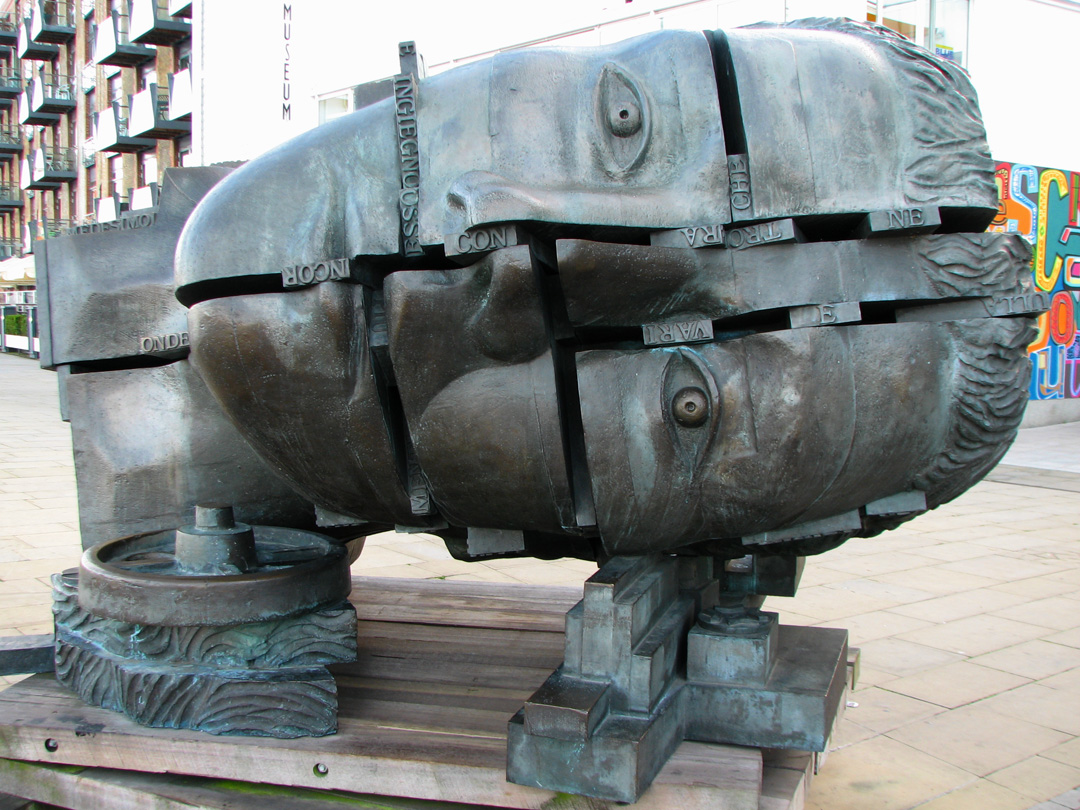
Head of Invention
“Head of Invention” by Eduardo Paolozzi, 1989
Butler's Wharf
London, October 2009
“For more than twenty-five years, the Head of Invention sculpture has been a familiar sight for our visitors. It was first installed outside the museum’s Shad Thames building in 1990 and was transferred to Kensington in 2016 when the museum reopened in the old Commonwealth Institute building. The sculpture was created by Eduardo Paolozzi, one of the most important artists to emerge out of Britain during the post-war era. It was commissioned by the Design Museum’s founder, Sir Terence Conran, to commemorate the opening of the museum in 1989. But this was more than just a straightforward commission, nor was it a bland commercial transaction. Rather, the commissioning of the Head of Invention was one part of a lifelong collaboration and friendship between Paolozzi and Conran. Their careers had different paths, but it’s nonetheless fascinating to trace the ways in which their lives overlapped and to see how they worked together.” (Head of Invention, The Design Museum)
Friday, December 17, 2010
Thursday, December 16, 2010
Wednesday, December 15, 2010
Tuesday, December 14, 2010
Monday, December 13, 2010
Sunday, December 12, 2010
Saturday, December 11, 2010
Friday, December 10, 2010
Thursday, December 9, 2010
Oval Staircase
Helicoidal staircase by Francesco Borromini
Palazzo Barberini
Via delle Quattro Fontane
Rome, September 2010
“Maderno envisioned a floor plan in the shape of an ‘H’, with the Sforza wing facing the piazza. A second parallel wing is connected by a central hall. Flanking the hall, two sets of stairs lead to the piano nobile, a large squared staircase by Bernini to the left and a smaller oval staircase by Borromini to the right. The main block presents three tiers of great arch-headed windows, like glazed arcades, a formula that was more Venetian than Roman. On the uppermost floor, Borromini's windows are set in a false perspective that suggests extra depth, a feature that has been copied into the 20th century.” (Palazzo Barberini, Wikipedia)
Wednesday, December 8, 2010
Coins
“Life Underground” by Tom Otterness, 2001
14th Street/Eighth Avenue station
Eighth Avenue at 14th Street
New York, September 2008
“Life Underground (2001) is a permanent public artwork created by American sculptor Tom Otterness for the New York City Subway's 14th Street/Eighth Avenue station, which serves the A, C, E, and L trains. It was commissioned by the Metropolitan Transportation Authority's Arts for Transit program for US$200,000, one percent of the station's renovation budget. This program has commissioned permanent works of art for public transportation facilities the MTA owns and operates. This work is one of the most popular artworks in the subway system.” (Life Underground, Wikipedia)
Tuesday, December 7, 2010
Pompidou’s Huts
Architectural haikus by Tadashi Kawamata, 2010
Centre Georges Pompidou
Place Georges-Pompidou
Quartier Saint-Merri, 4th arrondissement
Paris, July 2010
“Tadashi Kawamata, a Japanese sculptor and installer, is known for creating urban spaces that utilize simple materials. Often times, Kawamata selects an single item, whether it is a material or an object, that becomes the basic module of a huge construction. His latest spaces are occupying the external façade of the Centre Pompidou in Paris. These timbers huts, which are lined with cardboard, attach on to the existing structural framework, like a parasite, and morph into something entirely new. These precariously hanging wooden huts strongly contrast the highly technical aesthetic of Piano’s and Rogers’ facade. ‘From his reflections on the architecture of the Pompidou Center, its location in the urban fabric, its intimate memory, the Japanese artist invests more locations within the Centre: the Children’s gallery, Forum and exterior facades’, explained the museum.” (Pompidou’s Huts, ArchDaily)
Monday, December 6, 2010
The Bard
William Shakespeare by Giovanni Fontana, 1874
Leicester Square Gardens
London, October 2009
“A statue of William Shakespeare, by the sculptor Giovanni Fontana after an original by Peter Scheemakers, has formed the centrepiece of Leicester Square Gardens in London since 1874. The marble figure, copied from Scheemakers's 18th-century monument to Shakespeare in Poets' Corner, Westminster Abbey, stands on a pedestal flanked by dolphins at the centre of a fountain. It is the result of improvements to the gardens made by the financier Albert Grant, who bought the Square in 1874 and had it refurbished to a design by James Knowles. The scroll held by Shakespeare is inscribed with a quotation from Twelfth Night (Act IV, Scene II), ‘There is no darkness but ignorance’, where the original in Poets' Corner has a misquoted passage from The Tempest. The Leicester Square statue also differs from its model in omitting portrait reliefs of Henry V, Richard III and Elizabeth I from the plinth on which Shakespeare rests.” (Statue of William Shakespeare, Wikipedia)
Sunday, December 5, 2010
Laocoön and His Sons
“Laocoonte ed i suoi figli” (Laocoön and His Sons)
Vatican Museums, Vatican City
Rome, September 2010
“The statue of ‘Laocoön and His Sons’, also called the Laocoön Group (Italian: Gruppo del Laocoonte), has been one of the most famous ancient sculptures since it was excavated in Rome in 1506 and put on public display in the Vatican Museums, where it remains today. The statue is very likely the same one praised in the highest terms by Pliny the Elder, the main Roman writer on art, who attributed it to Greek sculptors but did not say when it was created. The figures are nearly life-sized, with the entire group measuring just over 2 m (6 ft 7 in) in height. The sculpture depicts the Trojan priest Laocoön and his sons Antiphantes and Thymbraeus being attacked by sea serpents. The Laocoön Group has been called "the prototypical icon of human agony" in Western art. Unlike the agony often portrayed in Christian art depicting the Passion of Jesus and martyrs, the suffering here suggests neither redemption nor reward. The agony is conveyed through the contorted facial expressions, particularly Laocoön's bulging eyebrows, which were noted by Guillaume Duchenne de Boulogne as physiologically impossible. These expressions are mirrored in the struggling bodies, especially Laocoön's, with every part of his body shown straining. Pliny attributed the work, then in the palace of Emperor Titus, to three Greek sculptors from the island of Rhodes: Agesander, Athenodoros, and Polydorus, but he did not mention the date or patron. In style it is considered "one of the finest examples of the Hellenistic baroque" and certainly in the Greek tradition. However, its origin is uncertain, as it is not known if it is an original work or a copy of an earlier bronze sculpture. Some believe it to be a copy of a work from the early Imperial period, while others think it to be an original work from the later period, continuing the Pergamene style of some two centuries earlier. Regardless, it was probably commissioned for a wealthy Roman's home, possibly from the Imperial family. The dates suggested for the statue range from 200 BC to the 70s AD, with a Julio-Claudian date (27 BC to 68 AD) now being the preferred option. Despite being in mostly excellent condition for an excavated sculpture, the group is missing several parts and underwent several ancient modifications, as well as restorations since its excavation. The statue is currently on display in the Museo Pio-Clementino, which is part of the Vatican Museums.” (Laocoön and His Sons, Wikipedia)
See also: Museums Staircase - Musei Vaticani
Saturday, December 4, 2010
Friday, December 3, 2010
Thursday, December 2, 2010
Orme Court
Orme Court
Bayswater
London, October 2009
“Orme Court is a low-rise period building that's been converted into a collection of apartments and offices. Its location is highly sought-after, with Hyde Park, Notting Hill and Paddington all within walking distance. The apartment block is also just moments away from both Queensway and Bayswater tube stations for the Central, District and Circle lines.” (Orme Court, HomeViews)
Wednesday, December 1, 2010
Subscribe to:
Comments (Atom)