Monday, March 31, 2003
Saint-Étienne-du-Mont
The church of Saint-Étienne-du-Mont
Place Sainte-Geneviève
Quartier de la Sorbonne, 5th arrondissement
Paris, July 2002
“Saint-Étienne-du-Mont is a Catholic church in Paris, France, on the Montagne Sainte-Geneviève in the 5th arrondissement, near the Panthéon. It contains the shrine of St. Geneviève, the patron saint of Paris. The church also contains the tombs of Blaise Pascal and Jean Racine. Jean-Paul Marat is buried in the church's cemetery. The sculpted tympanum, The Stoning of Saint Stephen, is the work of French sculptor Gabriel-Jules Thomas. Renowned organist, composer, and improviser Maurice Duruflé held the post of Titular Organist at Saint-Étienne-du-Mont from 1929 until his death in 1986.” (Saint-Étienne-du-Mont, Wikipedia)
Sunday, March 30, 2003
Aux grands hommes
“Aux grands hommes la patrie reconnaissante”
Panthéon
Place du Panthéon
Quartier de la Sorbonne, 5th arrondissement
Paris, July 2002
“The Panthéon (from Ancient Greek πάνθειον (pántheion) ‘[temple] to all the gods’) is a monument in the 5th arrondissement of Paris, France. It stands in the Latin Quarter (Quartier Latin), on the Montagne Sainte-Geneviève, in the centre of the Place du Panthéon, which was named after it. The edifice was built between 1758 and 1790, from designs by Jacques-Germain Soufflot, at the behest of King Louis XV; the king intended it as a church dedicated to Saint Genevieve, Paris's patron saint, whose relics were to be housed in the church. Neither Soufflot nor Louis XV lived to see the church completed.” (Panthéon, Wikipedia)
Saturday, March 29, 2003
Langue des Signes
École française de langue des signes
French school of sign languages
Rue Saint-Jacques / rue de l'Abbé-de-L'Épée
Quartier du Val-de-Grâce, 5th arrondissement
Paris, July 2002
Friday, March 28, 2003
Thursday, March 27, 2003
Notre-Dame du Val-de-Grâce
Place Alphonse-Laveran
Quartier du Val-de-Grâce, 5th arrondissement
Paris, July 2002
“The Church of the Val-de-Grâce is a Roman Catholic church in the 5th arrondissement of Paris, in what is now the Val-de-Grâce Hospital. The edifice was formerly a royal abbey, and its dome is a principal landmark of the skyline of Paris. The church was initially designed by François Mansart, succeeded by Jacques Lemercier who designed the Saint-Sacrament chapel's spiral-coffered dome after Philibert de L'Orme's chapel at the Château d'Anet.” (Val-de-Grâce, Wikipedia)
Wednesday, March 26, 2003
Tuesday, March 25, 2003
Monday, March 24, 2003
Sunday, March 23, 2003
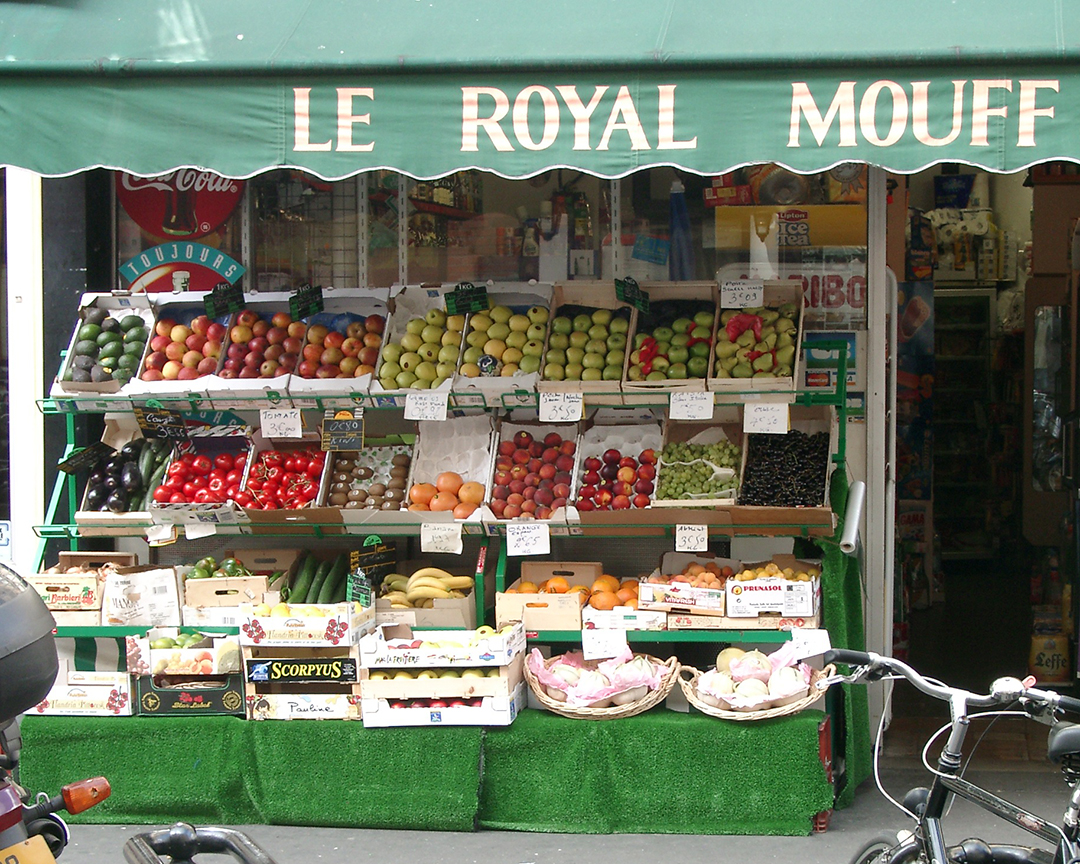
Bunches of grapes
Fruit and vegetable stall
Rue Mouffetard
Quartier du Val-de-Grâce, 5th arrondissement
Paris, July 2002
Saturday, March 22, 2003
Friday, March 21, 2003
Street clock
Street clock
Place de la Contrescarpe
Quartier du Val-de-Grâce?, 5th arrondissement
Paris, July 2002
Thursday, March 20, 2003
Interior of the Sacré-Cœur
Basilique du Sacré-Cœur (Basilica of the Sacred Heart)
Rue du Chevalier de la Barre
Quartier de Clignancourt, 18th arrondissement
Paris, July 2002
Wednesday, March 19, 2003
Filming at the Sacré-Cœur
Rue du Cardinal-Dubois, Montmartre
Quartier de Clignancourt, 18th arrondissement
Paris, July 2002
Tuesday, March 18, 2003
Cathédrale Notre-Dame de Paris
Cathédrale Notre-Dame de Paris (Cathedral of Our Lady of Paris)
Île de la Cité
Quartier Notre-Dame, 4th arrondissement
Paris, July 2002
Monday, March 17, 2003
Shakespeare and Company
Rue de la Bûcherie
Quartier de la Sorbonne, 5th arrondissement
Paris, July 2002
“Shakespeare and Company is an English-language bookstore opened in 1951 by George Whitman, located on Paris's Left Bank. The store was named after Sylvia Beach's bookstore of the same name founded in 1919 on the Left Bank, which closed in 1941. Whitman adopted the ‘Shakespeare and Company’ name for his store in 1964. The bookstore is situated at 37 rue de la Bûcherie, in the 5th arrondissement. Opened in 1951 by American George Whitman, it was originally called "Le Mistral", but was renamed to "Shakespeare and Company" in 1964 in tribute to Sylvia Beach's store and on the 400th anniversary of William Shakespeare's birth. Today, it continues to serve as a purveyor of new and second-hand books, as an antiquarian bookseller, and as a free reading library open to the public. Additionally, the shop houses aspiring writers and artists in exchange for helping out around the bookstore. Since the shop opened in 1951, more than 30,000 people have slept in the beds found tucked between bookshelves. The shop's motto, ‘Be Not Inhospitable to Strangers Lest They Be Angels in Disguise’, is written above the entrance to the reading library.” (Shakespeare and Company, Wikipedia)
Sunday, March 16, 2003
Fontaine Wallace
Fontaine Wallace (Wallace fountain)
Shakespeare and Company
Rue de la Bûcherie
Quartier de la Sorbonne, 5th arrondissement
Paris, July 2002
“Wallace fountains are public drinking fountains named after, financed by and roughly designed by Sir Richard Wallace and sculpted by Charles-Auguste Lebourg. They are large cast-iron sculptures scattered throughout the city of Paris, France, mainly along the most-frequented sidewalks. A great aesthetic success, they are recognized worldwide as one of the symbols of Paris. A Wallace fountain can be seen outside the Wallace Collection in London, the gallery that houses the works of art collected by Sir Richard Wallace and the first four Marquesses of Hertford.” (Wallace fountain, Wikipedia)
Saturday, March 15, 2003
Balloon reflected
Balloon reflected
Parc André Citroën
Rue de la Montagne-de-la-Fage
Quartier de Javel, 15th arrondissement
Paris, July 2002
Friday, March 14, 2003
Ballon de Paris
Ballon de Paris
Parc André Citroën
Rue de la Montagne-de-la-Fage
Quartier de Javel, 15th arrondissement
Paris, July 2002
“The Ballon Generali is a tethered helium balloon, used as tourist attraction and as an air quality awareness tool. Installed in Paris since 1999 in the Parc André-Citroën, it was created and developed by the French company Aerophile SAS for the celebration of the year 2000. The balloon has lofted more than 500,000 passengers into the sky since its opening.” (Ballon Generali, Wikipedia)
Thursday, March 13, 2003
Greenhouse and fountains
Greenhouse and dancing fountains
Parc André Citroën
Rue de la Montagne-de-la-Fage
Quartier de Javel, 15th arrondissement
Paris, July 2002
“Parc André-Citroën is a 14 hectares (35 acres) public park located on the left bank of the river Seine in the 15th arrondissement of Paris. Built on the site of a former Citroën automobile manufacturing plant, the park is named after company founder André Citroën. When it opened in 1992, it was the largest park to open in Paris in more than a century. In 1915, Citroën built its factory on the banks of the Seine where it operated until the 1970s. At that time, 24 hectares (59 acres) were vacated and subsequently addressed in Paris' urban plan, ultimately giving rise to the Parc André Citroën. The park was designed beginning of the 1990s by the French landscape designers Gilles Clément and Alain Provost and the architects Patrick Berger, Jean-François Jodry and Jean-Paul Viguier.” (Parc André-Citroën, Wikipedia)
Wednesday, March 12, 2003
Inside the greenhouse
Inside one of the greenhouses
Parc André Citroën
Rue de la Montagne-de-la-Fage
Quartier de Javel, 15th arrondissement
Paris, July 2002
“The park is built around a central, rectangular lawn of roughly 273 by 85 metres (895' x 279') in size. It is embellished with two greenhouse pavilions (hosting exotic plants and Mediterranean vegetation) at the eastern, urban end which are separated by a paved area featuring dancing fountains. The south edge of the lawn is bounded by a monumental canal — the ‘Jardin des Métamorphoses’ — composed of an elevated reflecting pool that reaches through granite guard houses, lined by a suspended walkway. On the north side are two sets of small gardens: the six ‘Serial Gardens’, each with a distinct landscape and architectural design and a ‘Garden in Movement’ that presents wild grasses selected to respond at different rates to wind velocity. A 630-meter (690 yard) diagonal path cuts through the park.” (Parc André-Citroën, Wikipedia)
Tuesday, March 11, 2003
Aerophile 5500 C/N 6
Aerophile 5500 C/N 6 stationary balloon for panoramic views
Parc André Citroën
Rue de la Montagne-de-la-Fage
Quartier de Javel, 15th arrondissement
Paris, July 2002
“The balloon, filled with 6,000 m3 (210,000 cu ft) of helium, is attached to the ground with a cable, controlled by an hydroelectric winch. This tourist attraction can board up to 30 passengers (this amounts to around 2,500 kg (5,500 lb)) at 150 m (490 ft) above Paris. It is 32 m (105 ft) high, and has a diameter of 22 m (72 ft). It has been used as advertising billboard for Fortis, then from 2002 for Eutelsat.” (Ballon Generali, Wikipedia)
Monday, March 10, 2003
Viaduc de Passy
Pont de Bir-Hakeim
Originally named Viaduc de Passy
Quartier de la Muette, 16th arrondissements
Paris, July 2012
“The Pont de Bir-Hakeim (Bridge of Bir Hakeim), named after the 1942 battle in Libya, until 1948 the Pont de Passy (Bridge of Passy), is a steel open spandrel deck arch bridge on stone masonry starlings, which crosses the River Seine in Paris. It connects the 15th and 16th arrondissements, passing over the northeast end of the Île aux Cygnes (the Isle of the Swans). The bridge, made of steel, was constructed between 1903 and 1905, in replacement of a footbridge that had been erected in 1878. The bridge has two levels: one for motor vehicles and pedestrians, the other being a rail viaduct (the Viaduc de Passy) built above the first one, through which passes Line 6 of the Paris Métro. The bridge is 237 metres (778 ft) long and 24.7 metres (81 ft) wide. The part crossing the Grand Bras (great anabranch) of the Seine (west from the island) is slightly longer than the one crossing the Petit Bras (small anabranch).” (Pont de Bir-Hakeim, Wikipedia)
Sunday, March 9, 2003
Les forgerons-riveteurs
“Les forgerons-riveteurs” (The Ironsmith-Riveters) by Gustave Michel
Pont de Bir-Hakeim (Bir-Hakeim Bridge)
15th arrondissement of Paris
Paris, July 2002
Saturday, March 8, 2003
Friday, March 7, 2003
Benjamin Franklin
Monument to Benjamin Franklin by John J. Boyle & Frédéric Brou, 1906
Square de Yorktown, Rue Benjamin-Franklin
Quartier de la Muette, 16th arrondissement
Paris, July 2002
“Rue Benjamin-Franklin is located in the 16th arrondissement of Paris. At one end of the street is a monument in honor of Franklin, who in addition to being one of the founding fathers of the United States was also a resident of Paris for a period of time. The street took on the name ‘rue Franklin’ in 1791. The bronze statue sits on a stone pedestal inlaid with bronze tablets. The statue was a given to Paris from John H. Harjes, an American banker, in honor of the 200th birthday of Franklin who lived near this spot from 1777 to 1785. He lived at the Valentois Mansion at what is now 66 Rue Raynouard.” (Rue Benjamin-Franklin, French-American Cultural Foundation)
Thursday, March 6, 2003
Carré des Feuillants
Carré des Feuillants restaurant
Rue de Castiglione
Quartier de la Place-Vendôme, 1st arrondissement
Paris, July 2002
“Located on the site of a 17th-century convent, next to the prestigious Place Vendôme, chef Alain Dutournier’s Carré des Feuillants opened in 1986 to much fanfare. It remains a stalwart of the Paris dining scene to this day. Boasting a minimalist, Alberto Bali-designed interior – four lounges arranged around an internal courtyard – menus reflect Dutournier’s respect for native products and flavours in streamlined, contemporary dishes. The likes of roasted sweetbreads of veal in an oyster sauce and grilled monkfish with French caviar and crisped potatoes arrive paired with remarkable labels and rare vintages amid a hushed, yet unstuffy atmosphere.” (Carré des Feuillants, 50 Best)
Wednesday, March 5, 2003
Sfera di San Leo
Sfera di San Leo (Sphere of San Leo) by Arnaldo Pomodoro, 1996-2000
Palais-Royal
Place Colette
Quartier du Palais-Royal, 1st arrondissement
Paris, July 2002
“The Sphere of San Leo is very different from Pomodoro’s previous spheres. After so many attempts at this form, the artist wanted to return in his memory to the places of his childhood and, thinking of the medieval fortress of San Leo, he covered the surface of the sphere with arrows, teeth, stays, as a reminder of an ancient weapon of war. There is no longer the contrast between the bright and smooth surface and its interior devoured by marks and signs: it seems that the erosion has reached even the outside, with a menacing but dynamic presence, because, as Jacqueline Risset wrote, ‘inside there is another smaller sphere, clean and intact, which is trying to emerge, communicating to the whole an idea of birth and renewal that seems to contradict the catastrophe.’” (Works around the World, Arnaldo Pomodoro)
Tuesday, March 4, 2003
Desert rose
Disco in forma di rosa del deserto n. 1 by Arnaldo Pomodoro, 1993-1994
Place Colette
Quartier du Palais-Royal, 1st arrondissement
Paris, July 2002
Monday, March 3, 2003
Blue, red, and white
Millennium Dome by Richard Rogers, 1999
Millennium Way
North Greenwich
London, January 2002
Sunday, March 2, 2003
Saturday, March 1, 2003
Canopies
Canopies
Millennium Dome by Richard Rogers, 1999
Millennium Way
North Greenwich
London, January 2002
Subscribe to:
Comments (Atom)