Thursday, July 31, 2003
Le dôme des Invalides
Hôtel des Invalides
Quartier des Invalides, 7th arrondissement
Paris, July 2002
“The Dome is the tallest and most famous of the buildings of Les Invalides. Designed by Jules Hardouin-Mansart, it takes the form of a Greek cross, on a square plan. Each of the facades is composed of two orders superimposed. The porch is topped by triangular fronton. It is crowned by a dome 90 metres, high, surmounted by lantern bringing the height to 107 metres (351 feet), making it taller than Notre Dame de Paris and the tallest of all Paris church domes. The dome is actually composed of two domes superimposed. The lower dome is largely open at the base, allowed the visitors below to see the art painted on the dome above by Charles de La Fosse. The windows are masked by the lower dome, which permits natural lighting and gives the impression that viewers are actually seeing the sky, a popular Baroque affect.” (Les Invalides, Wikipedia)
Wednesday, July 30, 2003
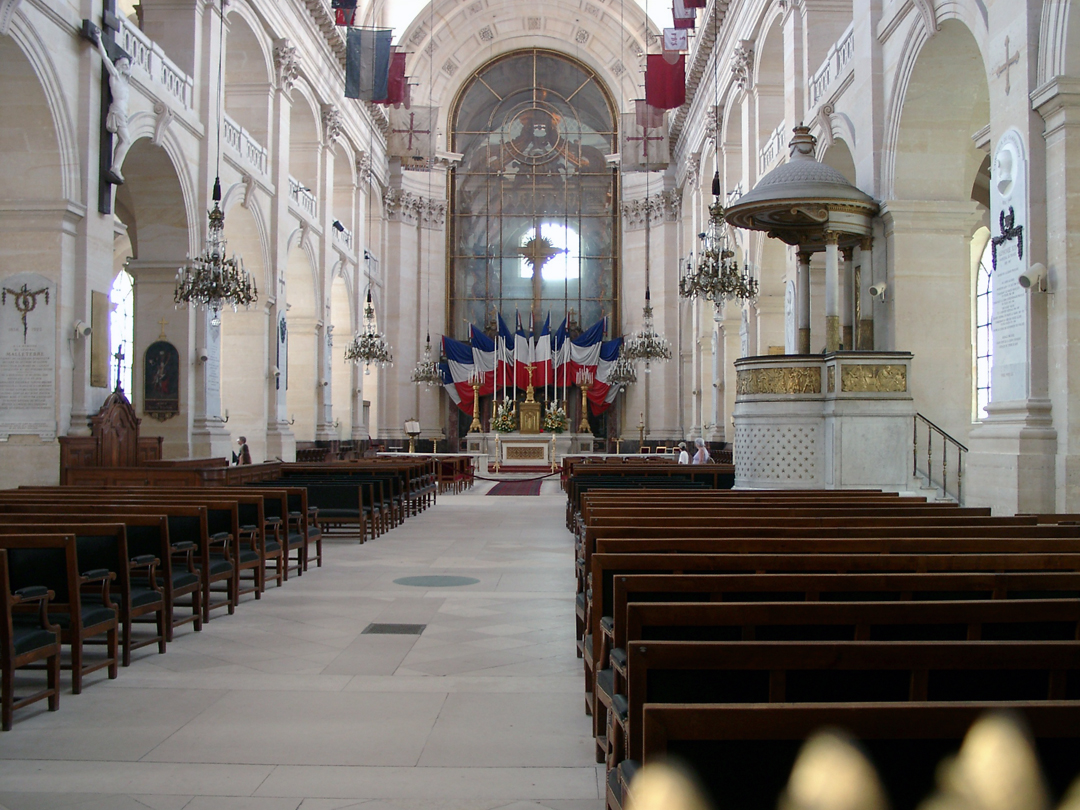
Saint-Louis des Invalides
Cathédrale Saint-Louis des Invalides
Hôtel des Invalides
Quartier des Invalides, 7th arrondissement
Paris, July 2002
“The Cathedral of Saint-Louis-des-Invalides is a Roman Catholic Cathedral in the 7th arrondissement of Paris that serves as the seat of the bishop to the members of the French armed forces. It is located within the park of Les Invalides, the home for French army veterans. It was commissioned by King Louis XIV and was built beginning in 1676 by architect Jules Hardouin-Mansart. It is located directly behind and adjoining the Dome Church of Les Invalides. The nave of the church displays flags captured by the French army in various wars and conflicts over its history.The church was built beginning in 1676 by Jules Hardouin-Mansart, following a concept of Liberal Bruant, the architect of the larger Invalides project. It was opened to soldiers beginning in 1679. The clock tower adjoining the church was intended to call the soldiers to their obligatory morning and evening prayer, and the obligatory attendance at mass and at vespers on Sunday and on important holidays.” (Cathedral of Saint-Louis-des-Invalides, Wikipedia)
Tuesday, July 29, 2003
Napoleon's tomb
Tombeau de Napoléon (Napoleon's tomb)
Hôtel des Invalides
Quartier des Invalides, 7th arrondissement
Paris, July 2002
“Napoleon's tomb (tombeau de Napoléon) is the monument erected at Les Invalides in Paris to keep the remains of Napoleon following their repatriation to France from Saint Helena in 1840, or retour des cendres, at the initiative of King Louis Philippe I and his minister Adolphe Thiers. While the tomb's planning started in 1840, it was only completed two decades later and inaugurated by Emperor Napoleon III on 2 April 1861, after its promoter Louis Philippe I, architect Louis Visconti, and main sculptors James Pradier and Pierre-Charles Simart had all died in the meantime.” (Napoleon's tomb, Wikipedia)
Monday, July 28, 2003
Joseph Bonaparte
Tomb of Joseph Bonaparte (1768–1844)
Monument by Alphonse-Nicolas Crépinet
Hôtel des Invalides
Quartier des Invalides, 7th arrondissement
Paris, July 2002
“The tombs of Napoleon's brothers were completed shortly afterwards, also in the Dome church, namely that of Jérôme Bonaparte in 1862 and that of Joseph Bonaparte in 1864.” (Napoleon's tomb, Wikipedia)
Sunday, July 27, 2003
Musée de l'Armée
Musée de l'Armée (The Army Museum)
Hôtel des Invalides
Quartier des Invalides, 7th arrondissement
Paris, July 2002
“The Musée de l'Armée (Army Museum) is a national military museum of France located at Les Invalides in the 7th arrondissement of Paris. It is served by Paris Métro stations Invalides, Varenne and La Tour-Maubourg. The Musée de l'Armée was created in 1905 with the merger of the Musée d'Artillerie and the Musée Historique de l'Armée. The museum's seven main spaces and departments contain collections that span the period from antiquity through the 20th century.” (Army Museum, Wikipedia)
Saturday, July 26, 2003
Friday, July 25, 2003
Les quatre saisons
“Les quatre saisons” fruit and vegetables
Rue Cler 34
Quartier du Gros-Caillou, 7th arrondissement
Paris, July 2002
Thursday, July 24, 2003
Wednesday, July 23, 2003
29 avenue Rapp
Building by Jules Lavirotte (architect) and Alexandre Bigot (ceramicist)
29 avenue Rapp
Quartier du Gros-Caillou, 7th arrondissement
Paris, July 2002
“The Lavirotte Building, an apartment building at 29 Avenue Rapp in the 7th arrondissement of Paris, France, was designed by the architect Jules Lavirotte and built between 1899 and 1901. The building is one of the best-known surviving examples of Art Nouveau architecture in Paris. The facade is lavishly decorated with sculpture and ceramic tiles made by the ceramics manufacturer Alexandre Bigot. Lavirotte was awarded the prize for the most original new facade in the 7th arrondissement in 1901.” (Lavirotte Building, Wikipedia)
Tuesday, July 22, 2003
Société théosophique
Immeuble de la Société théosophique by Louis Lefranc, 1915
Square Rapp
Quartier du Gros-Caillou, 7th arrondissement
Paris, July 2002
“This unusual building, constructed in 1912 by the architect Louis Lefranc, houses the Theosophical Society. Founded in New York in 1875 by Helena Blavatsky, this doctrine aims to spread Theosophy: this ancient philosophical system (dating back to antiquity) professes that humanity, in every religion, strives to approach the divine and understand the mysteries of truth. The society still exists in many countries and is based in the Adyar district of Madras, India. The building's mystical function is expressed in its façade. At its center, a large stone archway extends the full height of the building to the cornice: in its lower section, a vestibule connects to the 450-seat amphitheater. In its upper section, a glass roof illuminates the upper rooms dedicated to reading and meetings. While the building's base is made of stone, the upper section, constructed of brick, features a diamond-shaped pattern forming friezes of David's shields.” (La Société théosophique, Paris Promeneurs)
Monday, July 21, 2003
Droits de l'Homme
Monument des Droits de l'Homme (Human Rights monument) by Ivan Theimer
Champ de Mars
Avenue Charles Risler
Quartier du Gros-Caillou, 7th arrondissement
Paris, July 2002
“The Monument to the French Declaration of the Rights of Man and of the Citizen or Monument des Droits de l’Homme et du Citoyen in French, is located in Paris, in the Champs de Mars gardens on Avenue Charles-Risler. Commissioned by the City of Paris, it was erected in 1989 on the occasion of the bicentennial of the French Revolution. Inspired by Egyptian mastaba tombs, it includes many references to revolutionary imagery. It is the work of the Czech sculptor Ivan Theimer.” (Monument to the French Declaration of the Rights of Man and of the Citizen, Wikipedia)
Sunday, July 20, 2003
Palais de Chaillot
Palais de Chaillot and Jardins du Trocadéro
Tour Eiffel (Eiffel Tower)
Avenue Anatole France
Quartier du Gros-Caillou, 7th arrondissement
Paris, July 2002
“The Palais de Chaillot is a building atop the Chaillot hill in the Trocadéro area, in the 16th arrondissement of Paris, France. The building was designed in classicising "moderne" style by architects Louis-Hippolyte Boileau, Jacques Carlu and Léon Azéma. The Palais consists of two separate wings shaped to form a wide arc, which are those of the former Palais du Trocadéro with new taller portions built in front. The pair of larger central pavilions are also those of the former Palais du Trocadéro, encapsulated in new construction. The large central hall and towers of the old palais were demolished, leaving only the basement, with a wide esplanade created on top, establishing an open view from the Place du Trocadéro to the Eiffel Tower and beyond.” (Palais de Chaillot, Wikipedia)
Saturday, July 19, 2003
Front de Seine
Front de Seine seen from the Eiffel Tower
Quartier du Gros-Caillou, 7th arrondissement
Paris, July 2002
“Front de Seine is a development in the district of Beaugrenelle in Paris, France, located along the river Seine in the 15th arrondissement at the south of the Eiffel Tower. It is, with the 13th arrondissement, one of the few districts in the city of Paris containing highrise buildings, as most have been constructed outside the city (notably in La Défense). The Front de Seine district is the result of an urban planning project from the 1970s. It includes about 20 towers reaching nearly 100 m of height built all around an elevated esplanade. That esplanade is paved with frescos that can be seen only from the elevated floors of the towers. As opposed to Italie 13, the design of the towers is much more varied. The Hôtel Novotel Paris-Tour Eiffel (formerly known as Hôtel Nikkō), for instance, has red-encircled windows, while the Tour Totem consists of a stack of several glazed blocks. A newly redesigned shopping centre, the Centre commercial Beaugrenelle opened in 2013. Furthermore, while 13th arrondissement towers are predominantly residential and La Défense towers are predominantly commercial, the towers of the Front de Seine are of mixed commercial and residential use.” (Front de Seine, Wikipedia)
Friday, July 18, 2003
Île aux Cygnes
Front de Seine and Île aux Cygnes
Seen from the Eiffel Tower
Quartier du Gros-Caillou, 7th arrondissement
Paris, July 2002
“Île aux Cygnes (Isle of the Swans) is a small artificial island on the river Seine in Paris, France, in the 15th arrondissement. It was created in 1827 to protect the bridge named the Pont de Grenelle. It should not be confused with an earlier Île des Cygnes that was attached to the Champ de Mars in the late 18th century. The uninhabited island is 850 metres (2,789 ft) long and 11 metres (36 ft) at its widest point, making it the third-largest island in Paris. A tree-lined walkway, named L'Allée des Cygnes (Path of Swans), runs the length of the island. Since 2012, there has been a public workout space with bicycles and a climbing wall underneath the Pont de Grenelle, close to a Statue of Liberty replica. The island is crossed by three bridges: the Pont de Grenelle, the Pont Rouelle and the Pont de Bir-Hakeim. It is served by the Passy and Bir-Hakeim Métro stations.” (Île aux Cygnes, Wikipedia)
Thursday, July 17, 2003
Champ de Mars
Champ de Mars and École militaire
Tour Eiffel (Eiffel Tower)
Avenue Anatole France
Quartier du Gros-Caillou, 7th arrondissement
Paris, July 2002
“The Champ de Mars is a large public greenspace in Paris, France, located in the seventh arrondissement, between the Eiffel Tower to the northwest and the École Militaire to the southeast. The park is named after the Campus Martius (Mars Field) in Rome, which was dedicated to the god Mars. The name alludes to the fact that the lawns here were formerly used as drilling and marching grounds by the French military. The nearest Métro stations are La Motte-Picquet–Grenelle, École Militaire, and Champ de Mars-Tour Eiffel, an RER suburban-commuter-railway station. A disused station, Champ de Mars, is also nearby.” (Champ de Mars, Wikipedia)
Wednesday, July 16, 2003
Place de la Concorde
View of Place de la Concorde
Tour Eiffel (Eiffel Tower)
Avenue Anatole France
Quartier du Gros-Caillou, 7th arrondissement
Paris, July 2002
Tuesday, July 15, 2003
Passerelle Debilly
Passerelle Debilly (Debilly Footbridge)
Quai de New York - Quai Branly
Seen from the Eiffel Tower
Quartier du Gros-Caillou, 7th arrondissement
Paris, July 2002
“The Passerelle Debilly (Debilly Footbridge) is a through arch bridge in Paris spanning the Seine. It is a footbridge that connects the quai de New York to the quai Branly, close to the Eiffel Tower. In order to accommodate visitor traffic to the 1900 World's Fair across the Seine, the General Commissioner of the Exposition, Alfred Picard, approved the construction of a provisional footbridge opposite the Avenue Albert de Mun, to join the Army and Navy Halls to the exhibit recreating old Paris. Its architect, Jean Résal, also designed the Pont Alexandre III and the Viaduc d'Austerlitz. The Debilly footbridge had, as well, a succession of provisional names. It was initially called passerelle de l'Exposition Militaire or passerelle de Magdebourg, only later passerelle Debilly, after General Jean Louis Debilly of the French First Empire who was killed in the Battle of Jena in 1806. The bridge became a permanent fixture from its original provisional status under the management of the City of Paris in 1906 after it was relocated opposite to the rue de la Manutention. The footbridge is built on a metallic framework resting on two stone piers at the riverbanks, and decorated with dark green ceramic tiles arranged in a fashion that suggests the impression of waves. Along with the Eiffel Tower, this is the second metallic structure that stands as an attestation to the engineering achievements of its epoch. Nevertheless, in 1941, the Debilly footbridge was threatened with disappearance when the president of the architectural society characterized it as a forgotten accessory of a past event. As a contemporary of the Pont Alexandre III and the Austerlitz Viaduct, the Passerelle Debilly was eventually included in the supplementary registry of historical monuments in 1966. The bridge was repainted in 1991 and its cladding resurfaced with hard tropical wood in 1997.” (Passerelle Debilly, Wikipedia)
Monday, July 14, 2003
View of La Défense
View of La Défense
Tour Eiffel (Eiffel Tower)
Avenue Anatole France
Quartier du Gros-Caillou, 7th arrondissement
Paris, July 2002
“La Défense is a major business district in France's Paris metropolitan area, 3 kilometres (1.9 mi) west of the city limits. It is located in Île-de-France region's department of Hauts-de-Seine in the communes of Courbevoie, La Garenne-Colombes, Nanterre, and Puteaux. La Défense is Europe's largest purpose-built business district, covering 560 hectares (1,400 acres), for 180,000 daily workers,[1][2] with 72 glass and steel buildings (of which 20 are completed skyscrapers, out of 24 in the Paris region), and 3,500,000 square metres (38,000,000 sq ft) of office space. Around its Grande Arche and esplanade (le Parvis), La Défense contains many of the Paris urban area's tallest high-rises. Westfield Les Quatre Temps, a large shopping mall in La Défense, has 220 stores, 48 restaurants and a 24-screen movie theatre.” (La Défense, Wikipedia)
Sunday, July 13, 2003
Jardins du Trocadéro
Palais de Chaillot
Jardins du Trocadéro (Gardens of the Trocadero)
Seen from the Eiffel Tower
Quartier de Chaillot, 16th arrondissement
Paris, July 2002
“The Jardins du Trocadéro (Gardens of the Trocadéro) is a public space in the 16th arrondissement of Paris, France. It is bounded to the northwest by the wings of the Palais de Chaillot and to the southeast by the Seine and the Pont d'Iéna at the Place de Varsovie, with the Eiffel Tower on the opposite bank of the Seine. The entire site was formerly the garden of the original Trocadéro Palace, laid out by Adolphe Alphand for the 1878 Exposition Universelle. The present garden has an area of 93,930 m2, and was created for the Exposition Internationale des Arts et Techniques dans la Vie Moderne (1937). This was the design of Parisian architect Roger-Henri Expert. During the exposition in 1937, the pavilions of Nazi Germany and the Soviet Union were facing each other on opposite sides of the Jardins du Trocadéro. The grounds hosted the opening ceremony of the 2024 Summer Olympics.” (Jardins du Trocadéro, Wikipedia)
Saturday, July 12, 2003
Tour Eiffel
Tour Eiffel (Eiffel Tower)
Avenue Anatole France
Quartier du Gros-Caillou, 7th arrondissement
Paris, July 2002
“The Eiffel Tower (Tour Eiffel) is a wrought-iron lattice tower on the Champ de Mars in Paris, France. It is named after the engineer Gustave Eiffel, whose company designed and built the tower from 1887 to 1889. Locally nicknamed ‘La dame de fer’ (Iron Lady), it was constructed as the centrepiece of the 1889 World's Fair, and to crown the centennial anniversary of the French Revolution. Although initially criticised by some of France's leading artists and intellectuals for its design, it has since become a global cultural icon of France and one of the most recognisable structures in the world. The tower received 5,889,000 visitors in 2022. The Eiffel Tower is the most visited monument with an entrance fee in the world: 6.91 million people ascended it in 2015. It was designated a monument historique in 1964, and was named part of a UNESCO World Heritage Site (Paris, Banks of the Seine) in 1991.” (Eiffel Tower, Wikipedia)
Friday, July 11, 2003
Temple romantique
Temple romantique (Temple of love)
Île de Reuilly
Lac Daumesnil, Bois de Vincennes
Quartier du Bel-Air, 12th arrondissement
Paris, July 2002
“The island was created during the development of this part of the Bois de Vincennes and the construction of Lac Daumesnil. It is connected to the lake's southeast shore via the Promenade Maurice-Boitel by a small suspension bridge about twenty meters long. To the west, a second, similar bridge connects it to Île de Bercy . A footpath circles the island. Part of this path, known as the ‘Route des Îles’ (Island Road), is open to motor vehicles, providing access to the restaurant. At its eastern end, the island of Reuilly features an artificial grotto and waterfall created around 1860 by the architect Gabriel Davioud and overlooked by a romantic kiosk inspired — just like its almost identical replica known as the ‘Temple of the Sibyl’ on the island of Belvedere in the Buttes-Chaumont park built in 1866 — by the Temple of Vesta located in Tivoli near Rome in Italy.” (Île de Reuilly, Wikipedia)
Thursday, July 10, 2003
Rowing boats
Rowing boats
Lac Daumesnil, Bois de Vincennes
Quartier du Bel-Air, 12th arrondissement
Paris, July 2002
“Lake Daumesnil is an artificial lake located in the Bois de Vincennes in the 12th arrondissement in the east of Paris and administratively belongs to the quartier du Bel-Air. Lake Daumesnil is located in the southwest of the Bois de Vincennes. It has a water surface area of 12 hectares and contains two separate islands, Île de Reuilly and Île de Bercy, connected by bridges. Île de Reuilly features an artificial grotto and waterfall with a romantic rotunda designed by the architect Gabriel Davioud. All around the lake, a path bearing the name ‘Maurice-Boitel promenade’ since March 5, 2014 allows pedestrians to walk along the edges of the water. It is frequented by many joggers.” (Lac Daumesnil, Wikipedia)
Wednesday, July 9, 2003
Dépôt-vente
Dépôt-vente (Deposit sale)
Rue de Reuilly
Quartier des Quinze-Vingts, 12th arrondissement
Paris, July 2002
Tuesday, July 8, 2003
Gardeners at work
Gardeners at work
Jardin de Reuilly-Paul-Pernin
Quartier de Picpus, 12th arrondissement
Paris, July 2002
“The Reuilly garden, which became the Reuilly - Paul-Pernin garden, is a green space in the 12th arrondissement of Paris, France, designed by architect Pierre Colboc and landscape architects François-Xavier Mousquet, Philippe Thomas and Thierry Louf (Paysages agency). The garden is located at the intersection of Avenue Daumesnil and Rue de Charenton, directly opposite the town hall of the 12th arrondissement of Paris, at the end of Rue Montgallet. Avenue Daumesnil borders it to the south and Rue de Charenton to the southwest. To the west and north, the garden is bordered by Rue Jacques-Hillairet, and to the east by Rue Albinoni. The garden's official address is 15 Rue Albinoni.” (Jardin de Reuilly - Paul-Pernin, Wikipedia)
Monday, July 7, 2003
Jardin de Reuilly-Paul-Pernin
Passerelle BZ/12 (BZ/12 Footbridge), 1992
Jardin de Reuilly-Paul-Pernin
Quartier de Picpus, 12th arrondissement
Paris, July 2002
“At its west end near the Bastille, the parkway rises 10 metres (33 ft) above the surrounding area and forms the Viaduc des Arts, over a line of shops featuring the work of specialized craftsmen. The shops are located in the arches of the former elevated railway viaduct, with the parkway being supported atop the viaduct. This portion of the parkway runs parallel to the avenue Daumesnil. The parkway crosses the Jardin de Reuilly near the rue Montgallet and descends to street level. At that point, it becomes a grassy mall and then follows the old railway direction below street level towards the east, passing through several tunnels. As it reaches the rue du Sahel, it splits, with one portion continuing to the beltway, and the other terminating in the square Charles-Péguy along the former path of a branch line that once linked to the Petite Ceinture railway.” (Coulée verte René-Dumont, Wikipedia)
Sunday, July 6, 2003
BZ/12 Footbridge
Passerelle BZ/12 (BZ/12 Footbridge), 1992
Jardin de Reuilly-Paul-Pernin
Quartier de Picpus, 12th arrondissement
Paris, July 2002
“The footbridge's initial name comes from a systematic designation of Parisian thoroughfares for which no prior identification had been recorded. ‘BZ/12’ indicates that it is the 78th thoroughfare in the 12th arrondissement to have fallen into this category. The descriptive name ‘passerelle du parc de Reuilly’ (ou du jardin de Reuilly) is also encountered, even though it does not correspond to its designation in the official nomenclature of Parisian roads. The City of Paris also uses the term ‘passerelle Reuilly’ in its list of engineering structures. In May 2021, the footbridge was named André Léo footbridge in honor of Victoire Léodile Béra, known as André Léo, novelist, journalist and feminist activist, notably during the Paris Commune. The footbridge was created in 1992 as part of the development of the Reuilly urban development zone. It is a cable-stayed bridge, made of wood and metal, intended for pedestrians, approximately 80 m long. It connects Rue Jacques-Hillairet to the west with Allée Vivaldi to the east. An integral part of the coulée verte René-Dumont, it provides the transition between the section that comes from Bastille via the Viaduc des Arts , which is higher than the street, and the section that extends east of the Reuilly garden and is located below it.” (Passerelle André-Léo, Wikipedia)
Saturday, July 5, 2003
Coulée verte
Promenade plantée
Coulée verte René-Dumont
Quartier du Bel-Air, 12th arrondissement
Paris, July 2002
“The Coulée verte René-Dumont or Promenade plantée René-Dumont (Planted walkway [of] René Dumont) is a 4.7 km (2.9 mi) elevated linear park built on top of obsolete railway infrastructure in the 12th arrondissement of Paris, France. It was inaugurated in 1993. This Promenade plantée in Paris is an extensive green belt that follows the old Vincennes railway line. Beginning just east of the Opéra Bastille with the elevated Viaduc des Arts, it follows a 4.7-kilometre (2.9 mi) path eastward that ends at a spiral staircase leading to the boulevard Périphérique beltway.” (Coulée verte René-Dumont, Wikipedia)
Friday, July 4, 2003
Thursday, July 3, 2003
Windows and chimneys
Boulevard Diderot
Quartier des Quinze-Vingts, 12th arrondissement
Paris, July 2002
Wednesday, July 2, 2003
Tuesday, July 1, 2003
Saint-Louis-en-l'Île
Rue Saint-Louis-en-l'Île
Île Saint-Louis
Quartier Notre-Dame, 4th arrondissement
Paris, July 2002
“Saint-Louis en l'Île (Saint Louis on the Island) is a Roman Catholic parish church located at 19 Rue Saint-Louis en l'Île on Île Saint-Louis in the 4th arrondissement of Paris, France. Construction of the church began in 1664. It replaced an earlier church which was built in 1622, and the church was completed in 1675.” (Saint-Louis-en-l'Île, Wikipedia)
Subscribe to:
Comments (Atom)